Best water temperature for marlin fishing
Oh, the elusive marlin! There's nothing quite like the thrill of chasing these magnificent ocean gladiators, but let's be honest, it can also be incredibly frustrating when you're out on the vast Hawaiian waters and just can't seem to find them. Many anglers focus on lures, bait, or even moon phases, but often overlook one of the most critical factors influencing where these powerful fish will be: water temperature. This guide is all about unraveling the mystery of marlin and water temperature, giving you the real-world insights you need to understand their preferred habitats and increase your chances of a successful hook-up.
Understanding Marlin's Preferred Thermal Zones
When we talk about marlin, we're generally focusing on two main species in Hawaii: the majestic Blue Marlin and the often-sought-after Striped Marlin. Each of these incredible fish has a preferred comfort zone when it comes to water temperature, and understanding these ranges is like getting a secret map to their hideouts.
Blue Marlin Temperature Sweet Spot
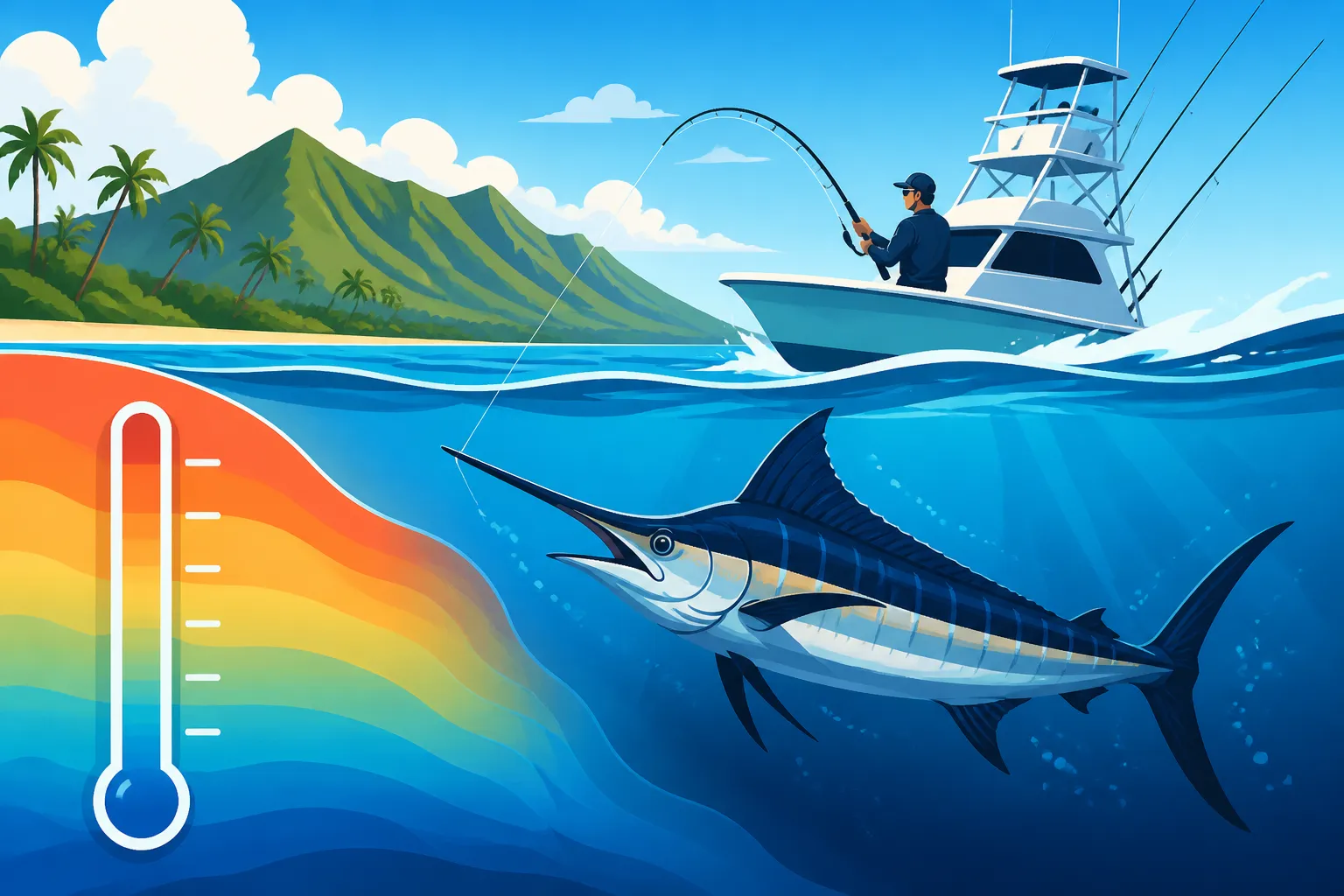
Blue Marlin, the true giants of the Hawaiian deep, are creatures of warm, tropical, and subtropical waters. They absolutely thrive in temperatures ranging from about 75°F to 84°F (24°C to 29°C). Think of it like this: if you're comfortable in a warm, sunny Hawaiian day, a Blue Marlin is probably feeling pretty good too. These fish are highly pelagic, meaning they spend most of their lives in the open ocean, often patrolling the surface layers or descending to moderate depths to hunt.
What's fascinating is that while they prefer this warm band, they're not just looking for uniform warmth. They're often drawn to areas where warm currents meet cooler water, creating what we call "temperature breaks" or "thermal edges." These aren't just arbitrary lines in the ocean; they're dynamic zones where different water masses converge, often pushing baitfish to the surface or concentrating them along these edges. For a Blue Marlin, this is like finding a buffet line! You'll often hear experienced captains talk about looking for these subtle temperature changes on their sonar or charting software, because that's where the action is likely to be.
Striped Marlin's Cooler Preferences
Now, Striped Marlin are a bit different. While still a warm-water species, they prefer slightly cooler temperatures than their blue brethren. Their ideal range typically falls between 65°F and 75°F (18°C to 24°C). This is why you'll often encounter Striped Marlin more frequently during Hawaii's cooler winter months, especially off the Kona Coast, when surface temperatures dip a bit.
They, too, are attracted to temperature breaks, but they'll often be found along the cooler side of a thermal edge where it meets warmer water. This difference in preference means that sometimes, on the same fishing trip, you might be targeting Blue Marlin in one area and then shift your focus to another zone just a few miles away where conditions are more favorable for Striped Marlin. Knowing the subtle nuances of these preferences can make all the difference, especially when you're trying to decide whether to run further offshore into warmer currents or stay closer to areas where upwellings might bring cooler, nutrient-rich water to the surface.
The Role of Thermoclines
Beyond surface temperatures, there's another crucial thermal factor at play: the thermocline. This is a distinct layer in the water column where the temperature changes more rapidly with depth than it does in the layers above or below. Think of it as an invisible underwater ceiling or floor that fish often orient themselves around. For marlin, the thermocline can be a crucial hunting ground.
Baitfish and other forage species often gather along the thermocline because it can concentrate nutrients or offer a layer of cooler, more oxygenated water. Marlin, being opportunistic predators, will patrol these thermoclines, using them as ambush points. If a thermocline is particularly shallow, say within 100 feet of the surface, it can make for incredibly exciting fishing as marlin push bait against this thermal barrier. Conversely, if the thermocline is very deep, marlin might be harder to find as they're spread out through a larger water column. Understanding how to interpret your fish finder to locate the thermocline is a skill that comes with time, but it's invaluable for serious marlin anglers.
Why Water Temperature is a Game-Changer for Marlin Fishing
You might be thinking, "It's just water, why does a few degrees matter so much?" But for pelagic fish like marlin, water temperature isn't just a preference; it's a fundamental driver of their biology, behavior, and ultimately, where you'll find them. It dictates everything from their metabolism to the distribution of their food source.
Metabolism and Activity Levels
Fish are cold-blooded creatures, which means their internal body temperature is largely regulated by the surrounding water temperature. This has a direct impact on their metabolism. In their ideal temperature range, marlin are energetic, active, and constantly on the hunt. Their digestion works efficiently, and they have the energy to chase down fast-moving prey.
However, if the water gets too cold or too hot, their metabolism slows down. They become sluggish, less inclined to feed, and will actively seek out more comfortable waters. Imagine trying to run a marathon in freezing cold water or stifling heat – it's just not going to happen efficiently. Marlin are no different. They're constantly on the move, migrating vast distances to stay within their preferred thermal window. This is why a sudden drop in water temperature in an area that was previously hot can cause marlin to seemingly vanish overnight. They simply moved on to find warmer, more productive feeding grounds.
Baitfish Concentration and Movement
Perhaps the biggest reason water temperature is such a critical factor is its direct influence on baitfish and other forage. Marlin don't just swim around randomly; they follow their food. Baitfish, like opelu, mackerel scad, or skipjack tuna (Aku), also have preferred temperature ranges. When these baitfish find optimal conditions, they school up in huge numbers.
Temperature breaks, current lines, and upwellings are all areas where different water masses converge, creating currents and eddies that concentrate plankton and smaller baitfish. Larger baitfish, in turn, are drawn to these concentrations, creating a food chain reaction that culminates in top predators like marlin. If you can locate these temperature-driven baitfish schools, you're halfway to finding marlin. Sometimes, it's not about finding the perfect marlin temperature, but finding the perfect baitfish temperature, knowing the marlin will be nearby. Many experienced anglers use highly sensitive marine thermometers, often integrated into their fish finders or available as standalone units on Amazon, to pinpoint these subtle temperature changes that indicate potential feeding zones.
Oxygen Levels and Water Clarity
Temperature also plays a role in less obvious, but still important, factors like oxygen levels and water clarity. Colder water generally holds more dissolved oxygen than warmer water. While marlin are adaptable, extremely warm, stagnant water can sometimes have lower oxygen levels, which can be less desirable for active predators.
Water clarity can also be influenced by temperature-driven currents. Converging currents can sometimes lead to murkier water as sediment and plankton are stirred up, while other currents might bring in crystal clear offshore water. While marlin are perfectly capable of hunting in various clarities, they are visual predators, and clearer water can sometimes make their hunting more efficient. These are secondary factors, but they contribute to the overall picture of why certain temperature zones become prime real estate for marlin.
Seasonal Water Temperature Trends in Hawaiian Waters
Hawaii's ocean temperatures, while generally warm year-round, do experience subtle but significant seasonal shifts that directly impact marlin fishing. Understanding these patterns is key to knowing when and where to focus your efforts.
Summer: Peak Blue Marlin Season
During Hawaii's summer months, roughly from May through September, the ocean waters warm up considerably, often hovering in the upper 70s to low 80s Fahrenheit. This is prime time for Blue Marlin Fishing off the Kona Coast. The warm, clear waters create an ideal environment for these powerful fish, and the baitfish populations tend to flourish. You'll find that the consistent warmth and favorable currents often push Blue Marlin closer to shore along the famous "Kona Coast Fishing Guide" region, making for some epic fishing. The peak of summer, particularly July and August, is when you hear stories of multiple grander sightings and consistent action for those targeting trophy Blue Marlin. It's also the best time to book a marlin charter if your main goal is to tangle with a blue.
Winter: Striped Marlin Dominance
As the islands transition into the cooler winter months, typically from October through April, the surface water temperatures will drop a few degrees, often settling into the low to mid-70s Fahrenheit. While Blue Marlin are still present, this shift often brings in a stronger presence of Striped Marlin. The cooler temperatures are more aligned with their preferred range, and they often become more active and accessible during this time.
Winter storms and larger swells can also influence temperature, creating more pronounced temperature breaks and current lines as different water masses mix. This is why many seasoned anglers consider winter the best time of year to fish in Hawaii for Striped Marlin, especially when targeting them from deeper offshore areas. These seasonal changes are why anglers closely follow Hawaii Fishing Seasons by Month to anticipate what species might be biting.
The Influence of El Niño and La Niña
Beyond the regular seasonal shifts, larger oceanic phenomena like El Niño and La Niña can have a profound impact on Hawaii's water temperatures and, consequently, marlin distribution for entire years.
- El Niño years typically bring warmer-than-average ocean temperatures to Hawaii. During these periods, the warm water "blob" can extend further north and east, potentially shifting marlin migration patterns. While it can mean even more consistent Blue Marlin action due to extended warm conditions, it can also push some cooler-water species further offshore or out of their usual ranges.
- La Niña years, on the other hand, often result in cooler-than-average water temperatures. This might mean an earlier onset of Striped Marlin season or a longer period of cooler conditions that favor them. It can also affect baitfish distribution, potentially altering where you find the feeding grounds.
These large-scale climate patterns are something experienced captains keep a close eye on, as they can predict broad trends in marlin fishing long before the season even begins. They understand that a slight change in the ocean's thermometer can have ripple effects throughout the entire marine ecosystem.
Practical Strategies for Tracking Water Temperature
So, you understand why water temperature matters, but how do you actually use this information to your advantage out on the water? Luckily, modern technology and good old-fashioned observation provide several excellent strategies.
Utilizing Sea Surface Temperature (SST) Charts
One of the most powerful tools available to serious marlin anglers today is Sea Surface Temperature (SST) charts. These satellite-derived maps show the temperature of the ocean's surface in incredible detail, often updated daily. Websites and marine forecasting services provide these charts, highlighting warm water eddies, cold water upwellings, and most importantly, sharp temperature breaks.
Before you even leave the dock, you can study these charts to identify potential areas where different temperature zones meet. Looking for those distinct color changes on the map? Those are your thermal edges, and they are prime areas to target. You can often see clear current lines forming around these breaks, which are essentially underwater highways that marlin and their prey use. Many professional charter captains swear by SST charts as their primary scouting tool, helping them decide which direction to head long before the sun rises. Several excellent subscription services offer high-resolution SST charts, some even available as apps on your phone or tablet for quick reference on Amazon.
On-Board Tools: Fish Finders and Marine Thermometers
Once you're out on the water, your boat's electronics become your best friends. Modern fish finders are incredibly sophisticated and often include a built-in water temperature sensor (or the ability to connect one). Pay close attention to the temperature reading on your display as you troll or move. Even a change of half a degree can signal that you're crossing into a new water mass that could be holding fish.
Beyond simply reading the surface temperature, some advanced fish finders can also show you the thermocline, as discussed earlier. This will appear as a distinct horizontal line or band on your sonar display, indicating where the temperature rapidly changes with depth. Knowing the depth of the thermocline can help you understand how deep marlin might be holding or where baitfish are concentrated. Carrying a reliable standalone marine thermometer on your boat can also be a great backup or verification tool, especially if your primary sensor seems off.
Reading Currents and Convergences
Water temperature and currents are inextricably linked. Temperature differences drive currents, and currents, in turn, create features that concentrate fish. Look for visual cues on the surface that indicate current lines or convergences:
- Debris lines: Long lines of floating sargassum, leaves, or other flotsam often form where two currents meet. These debris lines are magnets for baitfish, which seek shelter and food, and in turn, marlin will patrol these lines for an easy meal.
- Color changes: Sometimes, you'll see a distinct change in the color or clarity of the water, from a deep indigo blue to a slightly lighter blue or even a greener hue. This often indicates a transition between different water masses, which likely have different temperatures.
- Bird activity: Seabirds like terns, boobies, and frigates are excellent indicators of baitfish. If you see them actively diving or circling, especially over a current line or temperature break, there's a good chance baitfish are being pushed to the surface, and something bigger (like a marlin!) might be hunting below.
Combining all these observations, from satellite charts to on-board electronics and visual cues, gives you the most comprehensive picture of where marlin might be. It’s not just about finding the "best water temperature," but understanding how that temperature interacts with other oceanographic features to create a vibrant, fish-holding ecosystem. When you're trying to figure out how to catch marlin off the Kona Coast, or even what are the best lures for marlin trolling off Kona, thinking about water temperature should be at the top of your checklist.
By constantly monitoring and interpreting these temperature signals, you can fine-tune your approach, adjust your trolling patterns, and significantly improve your odds of having an unforgettable encounter with one of Hawaii's magnificent marlin.
| Marlin Species | Ideal Surface Water Temp (°F) | Key Behavioral Notes Related to Temp | Common Season in Hawaii |
|---|---|---|---|
| Blue Marlin | 75-84°F | Highly active, strong feeding drive | Summer (May-Sept) |
| Striped Marlin | 65-75°F | Follow cooler edges of warm currents | Winter (Oct-Apr) |
| Black Marlin | 78-85°F | Less common offshore, prefers coastal areas | Year-round, but rare |
Disclaimer
The information provided in this guide is for general informational purposes only. Fishing regulations and conditions in Hawaii can change frequently. Always consult the latest rules and advisories from the Hawaii Department of Land and Natural Resources (DLNR) Division of Aquatic Resources (DAR) before heading out. Be safe, respect the ocean, and practice sustainable fishing.