Hawaii Resident Ocean Fishing License Exemption
It can be incredibly confusing to figure out Hawaii's fishing license rules, especially when you've heard whispers that residents don't actually need one for ocean fishing. Many long-time residents and newcomers alike get tripped up by the nuances. This comprehensive guide will clear up that persistent question, explaining precisely when a resident needs a license and, more importantly, when they're happily exempt, along with other critical regulations to keep you fishing legally and responsibly.
Understanding Hawaii's Unique Approach to Ocean Fishing
Hawaii has always had a special relationship with its ocean, one that's deeply woven into the fabric of daily life for kama'aina, our local residents. This connection has historically shaped how fishing regulations, or the lack thereof, have been implemented, particularly concerning recreational ocean fishing for those who call these islands home.
The Historical Context of the Resident Exemption
Unlike nearly every other state in the U.S., Hawaii has traditionally granted its residents a unique privilege: exemption from needing a recreational ocean fishing license. This isn't just a random oversight; it's a policy deeply rooted in the state's cultural heritage and the long-standing traditional access rights that are fundamental to island living. For generations, fishing has been a critical component of subsistence and recreation here, an activity integral to putting food on the table and connecting with the 'āina (land and sea). To impose a fee on residents for this fundamental practice was, for a long time, considered contrary to the local way of life.
The ocean has historically been viewed as a communal resource, not something to be gated off by paid permits for residents. This long-standing policy has fostered a profound sense of shared responsibility and stewardship among residents for the marine environment. Rather than relying solely on a system funded by license fees, Hawaii has traditionally sought other avenues for conservation and management, emphasizing community involvement and traditional ecological knowledge. This approach stands in stark contrast to many mainland states where license revenue is the primary engine for fisheries conservation. If you're curious about the broader picture, our Hawaii Fishing License Guide for 2026 offers more historical context.
Federal Mandates and the New Landscape
However, the world of fisheries management doesn't operate in a vacuum, and federal mandates have increasingly influenced Hawaii's approach. The Magnuson-Stevens Fishery Conservation and Management Act, for instance, has been a significant driving force, pushing states to collect more robust data on recreational catches across the nation. This federal push created pressure for Hawaii to implement some form of licensing or registration system to ensure compliance with national data collection efforts.
Hawaii responded to these federal pressures in a thoughtful way, aiming to preserve the cherished resident exemption while still meeting its federal obligations. Instead of suddenly requiring all residents to purchase a license, the state opted for a system that primarily targets non-residents. This strategic decision allowed Hawaii to begin collecting the necessary data on marine recreational fishing effort without burdening its resident population with a new fee or permit requirement. It was a delicate balancing act, honoring tradition while adapting to modern conservation needs.
While residents still enjoy their exemption, the implementation of a new marine recreational fishing license for visitors has changed the overall landscape. This system helps the Division of Aquatic Resources (DAR) gather vital information on overall fishing pressure and the health of various fish stocks, which is absolutely crucial for sustainable management. So, even if you, as a resident, don't need a license, understanding these changes helps paint a complete picture of why the system is set up the way it is.
Who Qualifies as a Hawaii Resident for the Exemption
The concept of "residency" is often straightforward for everyday purposes, but when it comes to state-specific exemptions and privileges, it's essential to understand the exact definitions used by the governing agencies, in this case, the Hawaii Department of Land and Natural Resources (DLNR).
Defining "Resident" According to Hawaii DLNR
This is a really critical distinction, because simply existing in Hawaii for a few months isn't always enough to qualify you as a "resident" in the eyes of the DLNR for all fishing-related purposes. While you don't need to carry a physical ocean fishing license as a resident, if questions about your status were to arise in other contexts (like purchasing a freshwater license or if regulations were to shift in the future), you'd need to meet specific criteria. Generally, Hawaii's definition of a resident for these purposes involves having a physical domicile in the state for a continuous period, often cited as 6 months or more, with the clear intent to make Hawaii your permanent home.
The DLNR looks for tangible proof of this established residency. This usually means providing documentation that demonstrates your deep roots here. Think about things like a valid Hawaii driver's license or state ID card, current voter registration in Hawaii, evidence of filing Hawaii state income taxes, or a consistent history of utility bills in your name at a Hawaii address. These documents collectively paint a picture of genuine intent to reside permanently in the islands, moving beyond merely being a long-term visitor.
It's important to remember that the "resident" definition for fishing exemptions aligns with general state residency requirements for a multitude of other privileges and services. It's about more than just a temporary address; it's about establishing genuine, lasting ties to the community and the state. Understanding this distinction is vital for avoiding misunderstandings and ensuring you genuinely qualify for any resident-specific benefits, not just for fishing but across the board. If you ever have doubts, checking the official DLNR website is always the best bet.
Specific Exemptions and Age Requirements
One of the great things about the resident ocean fishing exemption is its broad applicability across age groups. For ocean recreational fishing, if you legitimately meet the DLNR's definition of a Hawaii resident, then all residents are exempt, regardless of their age. This means that from the youngest keiki (children) casting a line off a pier to our cherished kupuna (seniors) enjoying a quiet afternoon by the shore, everyone who is a bona fide resident can fish Hawaii's ocean waters without needing to apply for a license.
This blanket exemption for resident ocean fishing stands in stark contrast to many other states, and even to Hawaii's own freshwater fishing regulations. In most places, children might have specific age exemptions (e.g., under 16 don't need a license), or seniors might receive discounts or free licenses. Here, for ocean fishing, it's simpler: if you're a resident, you're exempt. However, don't confuse this with freshwater rules, which are different. For a deep dive into those, check out Hawaii Fishing License Age Requirements.
Imagine a family that has recently moved to the Big Island and established their residency. The kids, full of excitement, can immediately grab their fishing poles and head to a local beach or pier. There's no need for parents to worry about obtaining a special permit for them, unlike if they were merely visiting or planning a trip to a freshwater reservoir like Wahiawa. This seamless integration into the local fishing lifestyle really underscores the unique nature of Hawaii's resident ocean fishing exemption.
What the Resident Ocean Fishing Exemption Does Not Cover
While the resident ocean fishing exemption is a wonderful perk for those living in Hawaii, it's absolutely crucial to understand its limitations. Many anglers get into trouble not because they misunderstood the exemption itself, but because they assumed it applied universally.
Freshwater Fishing Requires a Separate License
This is perhaps the most common area of confusion for both new and long-time residents. While you might be able to cast a line into the vast Pacific Ocean without a license, if you plan to fish in Hawaii's streams, reservoirs, or other inland waters, you are absolutely required to purchase a separate freshwater fishing license. Places like Wahiawa Reservoir on Oahu, or the scenic streams of the Kokee Public Fishing Area on Kauai, fall under this distinct set of regulations.
The reason for this clear distinction is primarily resource management. Hawaii's freshwater resources are significantly more limited and often host introduced species like rainbow trout, largemouth bass, or peacock bass, which require intensive management, stocking programs, and habitat preservation efforts. The fees collected from freshwater licenses directly support these specific programs, ensuring the health and sustainability of these unique inland fisheries. It’s a dedicated funding stream for a dedicated resource, unlike the broader and more extensive ocean environment. For a full breakdown of these rules, make sure to read our guide on Hawaii Freshwater Fishing License and Rules.
To put it simply, you could be enjoying a beautiful afternoon fishing for papio off a rocky point on Maui, entirely within your resident exemption. The very next day, if you decide to try your luck with peacock bass at the Wahiawa Reservoir, you would need to have purchased a valid Hawaii freshwater fishing license beforehand. This dual system catches many people off guard, so always double-check your intended fishing spot. Even if you buy all your fantastic freshwater gear on Amazon, from specialized lures to a durable tackle box, it won't replace the need for that essential freshwater license!
Commercial Fishing and Other Specialized Activities
The resident exemption is explicitly for recreational fishing purposes only. The moment your intent shifts from personal enjoyment or subsistence to selling your catch, or if you're operating a business that takes others fishing (like a charter boat), you enter the realm of commercial fishing. This requires a completely different and far more stringent set of licenses, permits, and reporting requirements, which are managed separately to monitor commercial harvests and ensure market compliance.
Commercial fishing isn't just about direct sales at a market; it can also involve harvesting quantities or using specific types of gear that are typically associated with commercial operations, even if the fish aren't immediately sold. The line between recreational and commercial use can sometimes feel blurry, especially for those accustomed to subsistence fishing, so understanding the legal definitions is absolutely essential to stay compliant. Our article Hawaii Commercial vs Recreational Fishing License Rules goes into much greater detail on these distinctions.
Beyond commercial activities, there are other specialized recreational activities that, while not requiring a general marine fishing license for residents, have their own specific rules and regulations that must be followed. For example, spearfishing, a popular activity in Hawaii, has designated restricted areas and gear limitations. You can find comprehensive information on Hawaii Spearfishing Regulations and even the Hawaii SCUBA Spearfishing Ban to ensure you're compliant. The resident exemption is a convenience, not a free pass to disregard any and all specific rules governing fishing practices.
The New Marine Recreational Fishing License for Non-Residents
The conversation about Hawaii's resident ocean fishing exemption often leads to questions about visitors. While residents enjoy their unique privilege, the state has recently implemented a marine recreational fishing license specifically for non-residents. This change is significant and impacts how visitors can legally fish in Hawaii's bountiful ocean waters.
Why Non-Residents Now Need a License
The primary impetus behind the introduction of the Hawaii Marine Recreational Fishing License (HMFR) for non-residents stems directly from federal mandates. As previously mentioned, the federal government requires states to collect comprehensive data on marine recreational fishing effort and catch to feed into national fisheries management databases. This information is vital for assessing fish stock health and implementing effective conservation strategies across U.S. waters. By requiring non-residents to purchase a license, Hawaii ensures its compliance with these national data collection requirements.
From the state's perspective, this new license serves a dual purpose. Firstly, it allows the DLNR's Division of Aquatic Resources (DAR) to gather more accurate statistics specifically on the impact of visitor fishing on Hawaii's marine resources. With millions of tourists visiting annually, many of whom engage in fishing, understanding their collective footprint is crucial for balancing the interests of tourism with the imperative of conservation.
Secondly, the revenue generated from these non-resident licenses can be directed towards vital marine conservation and fisheries management programs within the state. These funds support scientific research, habitat restoration projects, enforcement efforts, and public education initiatives—all of which benefit Hawaii's precious ocean ecosystems, ultimately ensuring sustainable fishing opportunities for everyone, residents and visitors alike.
License Options and Costs for Visitors
To accommodate the diverse travel plans of visitors, Hawaii offers a range of non-resident marine fishing license options. For those on shorter vacations, there are convenient short-term licenses, typically available as a 1-day or 7-day option. These are perfect for visitors who might only plan a single fishing excursion or a short series of trips during their stay. For those who visit Hawaii frequently or plan an extended stay, an annual non-resident marine fishing license offers the best value and covers them for a full year.
The costs for these licenses are structured to reflect their duration. For instance, the Hawaii nonresident 1-day marine fishing license cost is generally the most economical for a single outing, while the Hawaii nonresident 7-day marine fishing license cost provides flexibility for a week-long fishing adventure. An annual license, while a higher upfront cost, proves most cost-effective for repeat visitors. These prices, while subject to change, are generally designed to be accessible while still contributing to conservation efforts.
Purchasing these licenses has been made relatively straightforward for visitors. They can typically be acquired online through the DLNR Division of Aquatic Resources (DAR) portal, offering a convenient way to get licensed before even arriving in Hawaii. Additionally, some authorized vendors across the islands may also sell these licenses, providing an in-person option for those who prefer it. This accessibility ensures that non-residents can easily comply with the new regulations and enjoy Hawaii's incredible fishing opportunities legally.
Staying Compliant and Protecting Hawaii's Fisheries
The resident ocean fishing license exemption is a privilege, not a free pass to disregard all other regulations. In fact, it places an even greater responsibility on resident anglers to be diligent, informed, and respectful stewards of Hawaii's precious marine resources. Staying compliant is about understanding the broader framework of rules designed to protect our fisheries.
Understanding Bag Limits, Size Restrictions, and Seasons
Even without needing a license, resident anglers have a massive and non-negotiable responsibility: to thoroughly know and scrupulously follow all other fishing regulations. This absolutely includes understanding the specific bag limits (how many fish of a certain species you can keep per day) and the minimum or maximum size restrictions for various fish. Catching more than your daily limit or keeping an undersized fish is illegal, regardless of your resident status, and can result in significant penalties.
Equally important is knowing and adhering to seasonal closures. Certain highly valued species, like moi (Pacific threadfin) or uhu (parrotfish), have specific closed seasons designed to protect them during critical spawning periods. Fishing for or possessing these species during their closed season, even if you are a resident, is a serious violation. It's not just about what you catch, but when you catch it. These regulations are vital for allowing fish populations to reproduce and recover. For comprehensive details, always consult resources like Hawaii Bag and Size Limits by Species and Hawaii Fishing Season Dates and Closures.
Consider this scenario: you're enjoying a beautiful day shoreline fishing off the coast of Oahu and you land a magnificent Moi. As a Hawaii resident, you're exempt from needing an ocean fishing license. However, your responsibility doesn't end there. You must know the current Hawaii Moi Closed Season, Explained dates and ensure your catch meets the Hawaii moi minimum size limit to legally keep it. Ignorance of these laws is never an acceptable excuse, and enforcement officers will hold you accountable.
Restricted Areas and Marine Life Conservation Districts
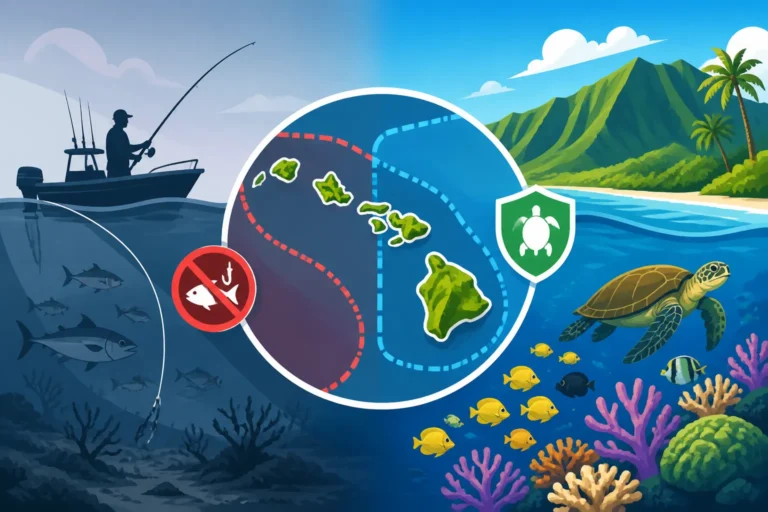
Hawaii has thoughtfully designated numerous areas as Marine Life Conservation Districts (MLCDs) or Fish Replenishment Areas (FRAs). These special zones are established with the critical purpose of protecting fragile marine ecosystems, allowing fish populations to recover, and preserving biodiversity. These areas typically have very strict rules, often prohibiting or severely limiting fishing, taking, or even disturbing marine life.
It cannot be stressed enough that the resident exemption for an ocean fishing license does not grant special privileges within these restricted zones. Anglers, whether they are residents or non-residents, are equally bound by the specific rules of each MLCD or FRA. Fishing in a no-take MLCD can lead to substantial fines, equipment confiscation, and other legal penalties. These districts are vital sanctuaries for marine life, and respecting their boundaries and rules is paramount for anyone fishing in Hawaii. To learn more about these crucial protected areas, refer to Hawaii Marine Life Conservation Districts, Explained.
A common real-world example is the iconic Hanauma Bay on Oahu, which is a prime MLCD where fishing is generally prohibited. Similarly, specific rules apply to other well-known areas, such as sections of Kealakekua Bay on the Big Island. Even for simple shoreline access, understanding where you can and cannot fish is vital. Just because you have public access to a coastline doesn't mean fishing is permitted there if it falls within a protected zone. Always be aware of your surroundings and any posted signs detailing specific local regulations.
Resources for Hawaii Anglers
Navigating fishing regulations, even with an exemption, requires diligence and access to reliable information. Thankfully, Hawaii provides excellent resources for both residents and visitors to stay informed and fish responsibly.
The DLNR Division of Aquatic Resources (DAR)
The authoritative source for all fishing regulations in Hawaii is the Department of Land and Natural Resources (DLNR), specifically its Division of Aquatic Resources (DAR). Their official website is an invaluable repository of information, serving as the single most important resource for every angler, resident or non-resident. It's here that you will find the most current and legally binding information on rules, updates, closures, and contact details for the department.
It's highly recommended that anglers make it a habit to regularly check the DAR website, especially before any fishing trip. Regulations in fisheries management are not static; they can and do change to adapt to new scientific findings, shifts in fish populations, environmental concerns, or evolving management needs. Relying on outdated information from social media or casual conversations can lead to inadvertent violations. The official Reading the Hawaii DLNR Fishing Regulations guide and PDF documents are often available for direct download, providing comprehensive details.
If you ever find yourself uncertain about a specific rule, a bag limit, or the boundaries of a restricted area, don't guess. The DLNR DAR staff are there to help clarify any confusion. It is always better to reach out and confirm the rules than to risk accidentally breaking them. Their goal, like ours, is to ensure sustainable and enjoyable fishing for everyone, for generations to come.
Staying Informed and Gear Considerations
Beyond the official government channels, tapping into the local fishing community can be incredibly beneficial for resident anglers. Local fishing clubs, online forums, and community groups are excellent places to share knowledge about current fishing conditions, effective techniques, and any recent regulatory changes. Being an active participant in the local fishing scene helps keep everyone informed and fosters a collective responsibility for our precious marine resources.
Even without a license, having the right gear is fundamental to a successful and enjoyable fishing experience. Whether you're targeting papio from the shore, jigging for bottomfish, or simply enjoying the serenity of a sunset cast, reliable equipment makes all the difference. This could range from a sturdy, corrosion-resistant fishing rod and reel setup designed for saltwater, to a well-organized tackle box filled with appropriate lures and terminal tackle, and, of course, essential sun protection like a good hat and UV-protective clothing. You can find a wide selection of quality fishing gear from reputable brands on online marketplaces like Amazon, including waterproof bags to keep your printed regulations safe and dry.
Ultimately, the resident ocean fishing license exemption in Hawaii is a significant privilege, but it carries with it an equally significant responsibility. It means that as a resident, you play a direct and crucial role in upholding responsible fishing practices and helping to preserve Hawaii's incredible marine bounty for future generations. So, go forth and enjoy the unparalleled fishing Hawaii offers, but always do it with respect, knowledge, and above all, pono (righteously).
Disclaimer
This information is for general guidance only and should not be considered legal advice. Fishing regulations in Hawaii can change, and it is the individual angler's responsibility to consult the most current rules and laws from the Hawaii Department of Land and Natural Resources (DLNR) Division of Aquatic Resources (DAR) before fishing.