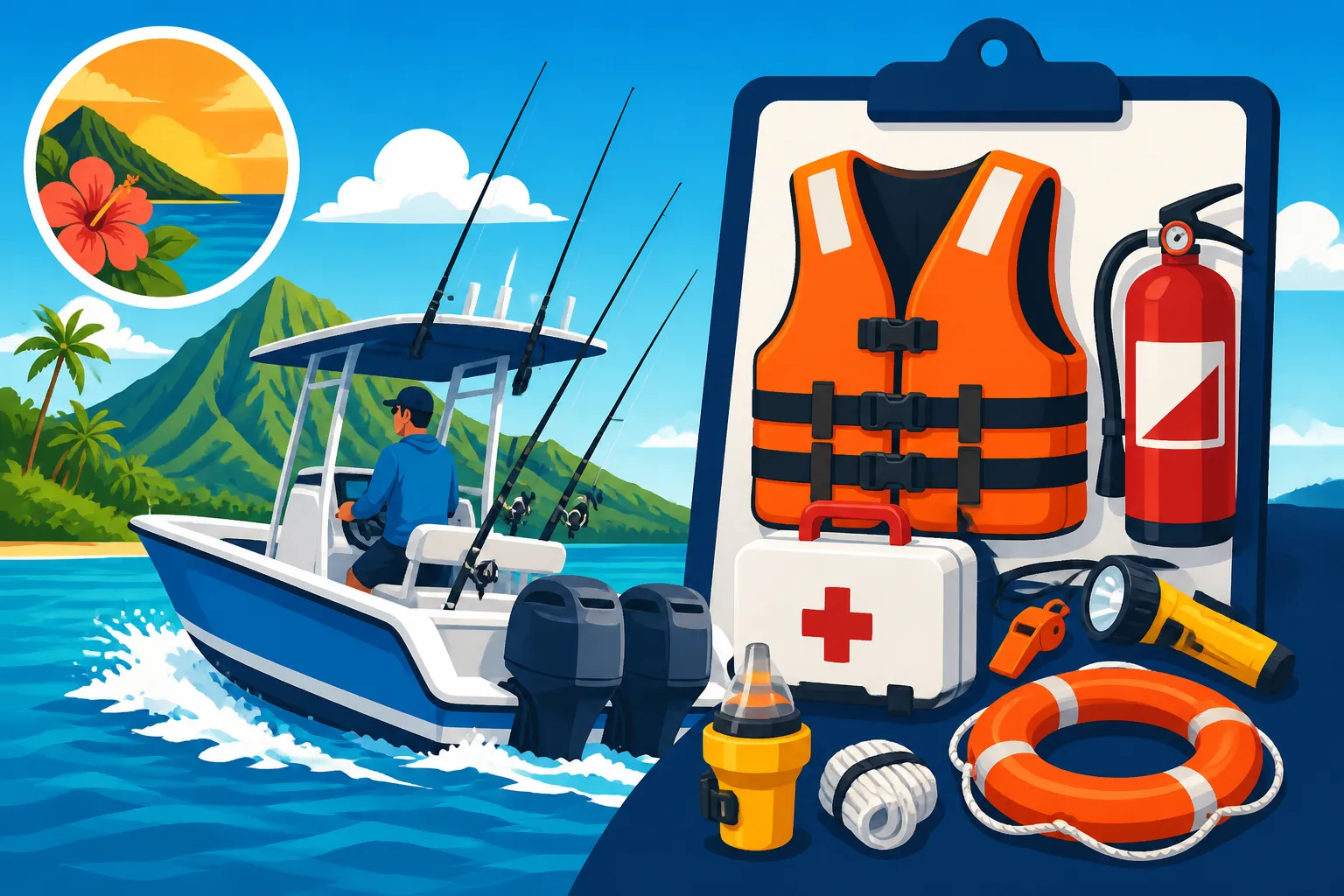
Hawaii required boat safety equipment checklist
Heading out on Hawaii's beautiful waters, whether for a quick fishing trip or a leisurely cruise, feels like pure freedom. But the thought of getting pulled over for a safety check and not having all the right gear can be a real buzzkill, not to mention a serious safety risk. It's easy to get confused by all the rules, but don't worry – this guide is here to break down exactly what boat safety equipment you need to stay safe and compliant in Hawaii, making sure your time on the water is nothing but aloha.
The Foundation of Safety: Why These Rules Aren't Just Bureaucracy
Before we dive into the nitty-gritty of what's required, let's take a moment to understand why these regulations exist. It’s not just about giving you a headache or letting the Coast Guard hand out fines. Every single item on this checklist is there to protect you, your passengers, and anyone else on the water. Hawaii's ocean environment, while stunning, can be unpredictable. Unexpected squalls, shifting currents, or even a simple mechanical issue can quickly turn a fun day into a dangerous situation. Having the right safety gear isn't just about following the law; it's about being prepared for the unexpected and ensuring everyone makes it home safely. Think of it as your insurance policy against Mother Nature's curveballs. Understanding these broader safety implications makes remembering and maintaining the gear a lot less of a chore.
Validating Common Frustrations with Boating Regulations
It's completely understandable to feel overwhelmed by the sheer volume of boating regulations. You just want to get out and enjoy the ocean, and it can feel like the rules are designed to make that harder, not easier. Many boaters, especially newcomers, struggle with knowing exactly what applies to their specific vessel, how old their flares can be, or even where to properly store a fire extinguisher. The laws can seem dense and sometimes contradictory, leading to genuine anxiety about accidentally breaking a rule. Plus, the consequences for non-compliance, from warnings to hefty fines and even court appearances, are enough to make anyone double-check their gear list multiple times. We've all been there, wondering if that old whistle still counts or if the life jacket tucked under a seat is truly "readily accessible." This guide aims to cut through that confusion and give you clear, actionable information.
Essential Safety Gear Required for All Vessels
No matter if you're piloting a small kayak or a larger powerboat, there are certain pieces of safety equipment that are non-negotiable under federal (U.S. Coast Guard) and Hawaii state law. These are the absolute basics, designed to cover fundamental safety needs on the water. Failing to have these items, or having them in poor condition, can result in citations and a spoiled day. It's critical to ensure all equipment is U.S. Coast Guard (USCG) approved, in serviceable condition, and easily accessible.
Personal Flotation Devices PFDs
This is probably the most crucial piece of safety equipment. Everyone on board, regardless of age, must have access to a USCG-approved PFD. For most recreational boats, this means having one wearable PFD for each person. If your vessel is 16 feet or longer, you also need one throwable PFD (Type IV).
- Wearable PFDs (Types I, II, III, V):
- Type I (Off-Shore Life Jacket): Designed for extended survival in rough, remote waters. They turn unconscious wearers face-up and offer the most buoyancy. You typically see these on commercial vessels or offshore charters.
- Type II (Near-Shore Vest): Good for calm, inland waters or where rescue is likely. They will turn some unconscious wearers face-up, but not always. These are very common and often less bulky than Type I.
- Type III (Flotation Aid): Designed for continuous wear, often used for watersports like kayaking or personal watercraft (PWC) riding. They are comfortable but will not turn an unconscious person face-up. This is where a lot of modern fishing vests and comfortable recreation vests fall.
- Type V (Special Use Device): These are PFDs designed for specific activities, like a kayaking vest with built-in hydration or a work vest. They must be used for their intended purpose to be counted as a legal PFD and typically offer similar buoyancy to a Type II or III. Some inflatable PFDs fall into this category and are popular for their minimal bulk, but they must be worn to be legal and require regular inspection and rearming.
- Throwable PFDs (Type IV): These are meant to be thrown to someone in the water. Think cushion-style PFDs or ring buoys. They are not designed to be worn but rather to provide temporary flotation until rescue. For vessels 16 feet and over, you need one of these. It must be immediately available for use, not stored away in a locker under a pile of gear.
It's important to remember that children under 13 years old must wear a USCG-approved PFD while on board any vessel that is underway, unless they are in an enclosed cabin. This is a common point of enforcement for the Department of Land and Natural Resources (DLNR) officers you might encounter while enjoying the state's beautiful waters. If you're planning a family trip, be sure to review Hawaii life jacket rules for children.
Sound Producing Devices
Every vessel needs some way to make an efficient sound signal. This is primarily for communicating with other vessels and for distress signals, especially in conditions of reduced visibility (like fog or heavy rain) or at night.
- For vessels under 40 feet: A whistle or air horn is generally sufficient. It needs to be capable of producing a four-second blast audible for at least half a mile. Many boaters keep a simple plastic whistle attached to their PFD or key chain, which is a smart move. You can easily find USCG-approved whistles and air horns on Amazon.
- For vessels 40 feet and over: You'll need a whistle or horn and a bell. The bell's mouth opening must be at least 7.9 inches (200mm) in diameter. For most recreational boaters, this won't be a concern, but it's good to know the distinction.
The key is that the device must be functional and readily accessible. Imagine trying to find a broken whistle in a crowded cooler when another boat is bearing down on you in the fog – not ideal.
Fire Extinguishers
Fires on board a boat, especially one made of fiberglass and fuel, can be catastrophic. Having a functioning fire extinguisher is a critical safety requirement.
- Vessels under 26 feet: If your boat has an inboard engine, closed compartments where fuel tanks may be stored, double bottoms not sealed to the hull, or enclosed living spaces, you'll need at least one B-I type USCG-approved fire extinguisher. Many smaller outboard-powered boats without these features are exempt, but it's always smart to carry one anyway.
- Vessels 26 feet to under 40 feet: You'll need two B-I type extinguishers, or one B-II type.
- Vessels 40 feet to under 65 feet: You'll need three B-I type extinguishers, or one B-I and one B-II type.
Key considerations:
- Accessibility: Fire extinguishers must be mounted in a readily accessible location, not buried under gear.
- Condition: Check the pressure gauge periodically to ensure it’s in the green zone. Ensure the tamper seal is intact and there are no signs of corrosion or damage.
- Type: The "B" in B-I or B-II refers to fires involving flammable liquids like fuel or oil, which are the most common types of fires on boats.
It's a good idea to know how to use your extinguisher before an emergency arises. A quick YouTube search for "how to use a fire extinguisher PASS method" can provide valuable instruction.
Visual Distress Signals (VDS)
When you're out on the vast Hawaiian ocean, signaling for help can be challenging. Visual distress signals are vital for letting other boats or search and rescue know you're in trouble.
- Required for all vessels operating in coastal waters, the Great Lakes, or open ocean waters, day or night. This means virtually all ocean-going recreational vessels in Hawaii.
- Accepted types of VDS:
- Pyrotechnic Devices: Flares (handheld, aerial, or parachute). These are very effective but have expiration dates, typically 42 months from the date of manufacture. Always check these dates!
- Red handheld flares: For night and day use, effective for attracting attention.
- Orange smoke signals (handheld or floating): For daytime use only, create a dense, visible plume of smoke.
- Red meteor or parachute flares: For night and day use, launch high into the air for maximum visibility.
- Non-Pyrotechnic Devices:
- Orange distress flag: For daytime use only, must be at least 3×3 feet with a black square and circle on an orange background.
- Electric distress light: For nighttime use only, flashes automatically and continuously, showing a light visible from all directions. The Orion Electronic SOS LED Flare is a popular USCG-approved alternative to traditional pyrotechnic flares, offering a longer lifespan and no expiration date, and can be found on Amazon.
- Pyrotechnic Devices: Flares (handheld, aerial, or parachute). These are very effective but have expiration dates, typically 42 months from the date of manufacture. Always check these dates!
You must carry appropriate VDS for both day and night use, unless your vessel is under 16 feet and only operates during daylight hours, or is a manually propelled vessel (like a kayak or canoe) operating in those same limited conditions. The most common combination for recreational boats is three handheld red flares and one orange smoke signal, or one electric distress light and one orange distress flag.
Additional Equipment Based on Vessel Type and Operating Conditions
While the basic gear covers most situations, certain types of vessels or specific operating conditions in Hawaii require additional safety equipment. These aren't universal, but they apply to many common boating scenarios.
Navigation Lights
If you plan to operate your vessel between sunset and sunrise, or during periods of restricted visibility (like fog or heavy rain), you must display proper navigation lights. These lights communicate your vessel's size, direction, and whether you are underway, anchored, or aground, preventing collisions.
- Powerboats: Typically require a masthead light, sidelights (red on port, green on starboard), and a sternlight. The exact configuration depends on the vessel's length.
- Sailboats: When under sail alone, they often only need sidelights and a sternlight. If using an engine, they must display the lights of a powerboat.
- Manually Propelled Vessels (kayaks, canoes, stand-up paddleboards): While not typically equipped with fixed navigation lights, if operating at night or in restricted visibility, you must have an all-around white light (like a headlamp or flashlight) ready to display in time to prevent a collision. It’s highly recommended to invest in a small, battery-operated LED navigation light that can be easily attached to your kayak or paddleboard. You can find many inexpensive, bright, and waterproof options from brands like Garmin or ACR Electronics for personal watercraft.
Remember, the goal of navigation lights is to be seen and understood by other boaters. Make sure your lights are bright, clean, and functioning before heading out in low light conditions.
Anchor, Rode, and Line
While not strictly mandated for all vessels in all situations, an anchor with sufficient rode (rope and/or chain) is a critical piece of safety equipment, especially in Hawaii's diverse coastal environments. Imagine an engine failure near a rocky shoreline or in a strong current – an anchor can be the difference between drifting to safety and a serious predicament.
- Anchor Type: The best anchor depends on the bottom type you'll encounter. In Hawaii, you'll often find coral, rock, or sand. A "reef anchor" or "grappling hook" is great for rocky bottoms, while a Danforth or scoop anchor is good for sand.
- Rode Length: A good rule of thumb is to have 7:1 scope, meaning seven feet of rode for every one foot of water depth. So, if you're anchoring in 20 feet of water, you'd want at least 140 feet of rode.
- Line: Beyond your anchor rode, having extra line on board is incredibly useful. It can be used for towing, tying up to a dock, or even as an emergency repair.
The DLNR often looks favorably upon vessels equipped with a proper anchoring system, seeing it as a sign of a responsible boater. If you're out deep-sea fishing off the Kona Coast or exploring reefs around Maui, an anchor is indispensable.
Dewatering Devices
Every boat should have a way to remove water from the hull. This can range from a simple bucket to a sophisticated bilge pump system.
- Manual Bailing Device: For smaller boats, kayaks, and canoes, a bucket, scoop, or hand bilge pump is sufficient. This must be readily available and in good working order.
- Bilge Pumps: Most larger powerboats are equipped with electric bilge pumps. It's crucial to regularly check that these pumps are functioning, the float switch is working, and the battery has enough charge to power them. Consider carrying a spare manual bilge pump even if you have an electric one, as electrical systems can fail.
Keeping your boat dry is not just about comfort; it's about stability and preventing swamping.
Other Important Considerations
Beyond the required items, several other pieces of equipment significantly enhance safety and compliance.
- Throwable Devices (for vessels 16 feet and over): As mentioned with PFDs, a Type IV throwable device is legally required for longer vessels. But even for smaller boats, having a buoyant cushion or ring buoy can be a lifesaver.
- First-Aid Kit: While not legally mandated by the Coast Guard for recreational vessels, carrying a well-stocked first-aid kit is pure common sense. From minor cuts to seasickness, a good kit can handle many on-water ailments. Make sure it's waterproof and easily accessible. You can pick up comprehensive, waterproof first-aid kits on Amazon.
- Engine Cut-Off Switch (ECOS): For most powerboats under 26 feet with an engine of 3 horsepower or more, federal law requires an ECOS link that attaches to the operator. This kills the engine if the operator is ejected from the helm, preventing a runaway boat. Many PWC operator minimum age regulations also emphasize the importance of using the ECOS.
- Navigation Equipment: A compass, charts (paper or electronic), and a GPS device are essential for safe navigation, especially if you venture beyond sight of land. While not always a "safety equipment" requirement, being able to know where you are and where you're going is fundamental to safety.
- Communication Device: A VHF radio is highly recommended for all vessels operating offshore. Cell phones are unreliable far from shore. A waterproof handheld VHF radio is an excellent investment. For offshore fishing, an EPIRB (Emergency Position Indicating Radio Beacon) or PLB (Personal Locator Beacon) is a wise choice, as it can alert rescue authorities with your exact location via satellite.
- Registration and Documentation: Always carry your vessel's registration or documentation papers onboard. For a detailed rundown on the requirements, check out our guide on Hawaii Boat Registration Requirements.
The table below provides a quick summary of minimum requirements based on vessel length, which is a common way the USCG categorizes rules.
| Equipment Type | Vessels Under 16 Feet (incl. kayaks, canoes) | Vessels 16 Feet to Under 26 Feet | Vessels 26 Feet to Under 40 Feet | Vessels 40 Feet to Under 65 Feet |
|---|---|---|---|---|
| Wearable PFDs | 1 per person | 1 per person | 1 per person | 1 per person |
| Throwable PFDs | Not required (recommended) | 1 (Type IV) | 1 (Type IV) | 1 (Type IV) |
| Sound-Producing Device | Whistle/horn | Whistle/horn | Whistle/horn | Whistle/horn + Bell |
| Fire Extinguisher (B-I type) | Usually not required (check exceptions) | 1 (if required) | 2 (or 1 B-II) | 3 (or 1 B-I & 1 B-II) |
| Visual Distress Signals (VDS) | Day/Night (if operating in coastal waters) | Day/Night | Day/Night | Day/Night |
| Navigation Lights | All-around white light (night/visibility) | Required for night/visibility | Required for night/visibility | Required for night/visibility |
| Engine Cut-Off Switch (ECOS) | Required for most powerboats | Required for most powerboats | Required for most powerboats | Required for most powerboats |
Note: This table summarizes federal USCG requirements. Always double-check with the Hawaii DLNR for any specific state-level additions or nuances, especially concerning Hawaii Boating Laws for Anglers.
Maintaining and Inspecting Your Safety Gear
It’s not enough to simply have the equipment; it must be in good working order. A yearly inspection of all your safety gear is a small investment of time that can pay huge dividends in an emergency.
Regular Inspections and Serviceability
Think of your annual boat safety check like getting your car serviced. You wouldn't skip an oil change, right?
- PFDs: Check for tears, mildew, broken buckles or straps, and proper fit. Make sure inflatables are armed and serviced according to manufacturer instructions. Sun exposure and prolonged storage in damp conditions can degrade materials over time.
- Flares: Verify expiration dates. Old flares are unreliable and won't count as valid VDS during an inspection. Dispose of expired flares properly (check with your local fire department or marine store for disposal options).
- Fire Extinguishers: Check pressure gauges, ensure they are fully charged, and inspect for any damage or corrosion. Shake them occasionally to prevent the powder from settling.
- Sound Devices: Test your whistle or horn. If it’s an air horn, ensure you have a full canister.
- Lights: Test all navigation lights before every night trip. Carry spare bulbs if applicable (though most modern lights are LED and more robust).
- Batteries: Replace batteries in flashlights, electric VDS, and communication devices regularly. Old batteries are useless in a crisis.
Making this a routine part of your boating season preparation ensures you're never caught off guard.
Common Mistakes to Avoid
Many boaters face citations not because they intentionally break the law, but due to oversight or misunderstanding.
- Expired Flares: This is one of the most common violations. Those flares tucked away for years? They're probably expired.
- Inaccessible Equipment: A fire extinguisher under a pile of fishing gear or a PFD zipped into a waterproof bag that takes minutes to open isn't "readily accessible."
- Ill-fitting PFDs: Especially for children. A PFD that's too big or too small won't do its job effectively. Ensure everyone has a PFD that fits properly.
- Damaged Gear: A PFD with a ripped strap, a rusty fire extinguisher, or a cracked whistle won't pass inspection and, more importantly, won't save a life.
- No VDS for Night Use: Many boaters have day signals but forget about night signals, or vice versa. Remember you need both if operating during dark hours.
By being mindful of these common pitfalls, you can easily avoid unnecessary trouble and ensure you’re genuinely prepared for any situation. Staying informed on topics like Fishing Without a Required License in Hawaii: Penalties or Hawaii Boating Laws for Anglers is also crucial for overall compliance.
Conclusion: Enjoying Hawaii's Waters Responsibly
Navigating the rules for boat safety equipment in Hawaii doesn't have to be a daunting task. By understanding the core requirements for PFDs, sound signals, fire extinguishers, and visual distress signals, and then considering the specific needs of your vessel and operating conditions, you can confidently prepare for your next adventure. These regulations aren't arbitrary; they are the bedrock of safe boating, designed to protect you and your loved ones while you enjoy the unparalleled beauty of Hawaii's ocean environment. A little preparation goes a long way in ensuring your time on the water is safe, memorable, and full of aloha. So, get your checklist in order, perform those routine inspections, and head out with peace of mind.
Disclaimer
This guide is intended for informational purposes only and should not be considered legal advice. Boating regulations, both federal and state, can change. Always consult the most current U.S. Coast Guard (USCG) regulations and the Hawaii Department of Land and Natural Resources (DLNR), Division of Boating and Ocean Recreation (DOBOR) guidelines for the most accurate and up-to-date information on required safety equipment before operating any vessel in Hawaiian waters. Your ultimate responsibility is to ensure your vessel is equipped and operated in full compliance with all applicable laws and regulations.