Best fishing spots for akule schools on Oahu
Finding those elusive akule (bigeye scad) schools on Oahu can feel like chasing a ghost sometimes, can't it? One day they're busting on the surface, the next they've vanished without a trace, leaving you wondering if you're even looking in the right place. This guide is here to cut through that frustration, offering you detailed insights into where and how to reliably locate and catch akule schools around Oahu, ensuring your next fishing trip isn't a wild goose chase.
Understanding Akule Behavior and Seasonality on Oahu
Before we dive into specific locations, it's really helpful to understand the creatures we're after. Akule, or bigeye scad, aren't just random fish; they have distinct patterns and preferences that, once understood, can dramatically increase your chances of finding them. They are a schooling species, meaning they move and feed in large groups, and catching one often means catching many.
Akule's Preferred Habitats and Schooling Patterns
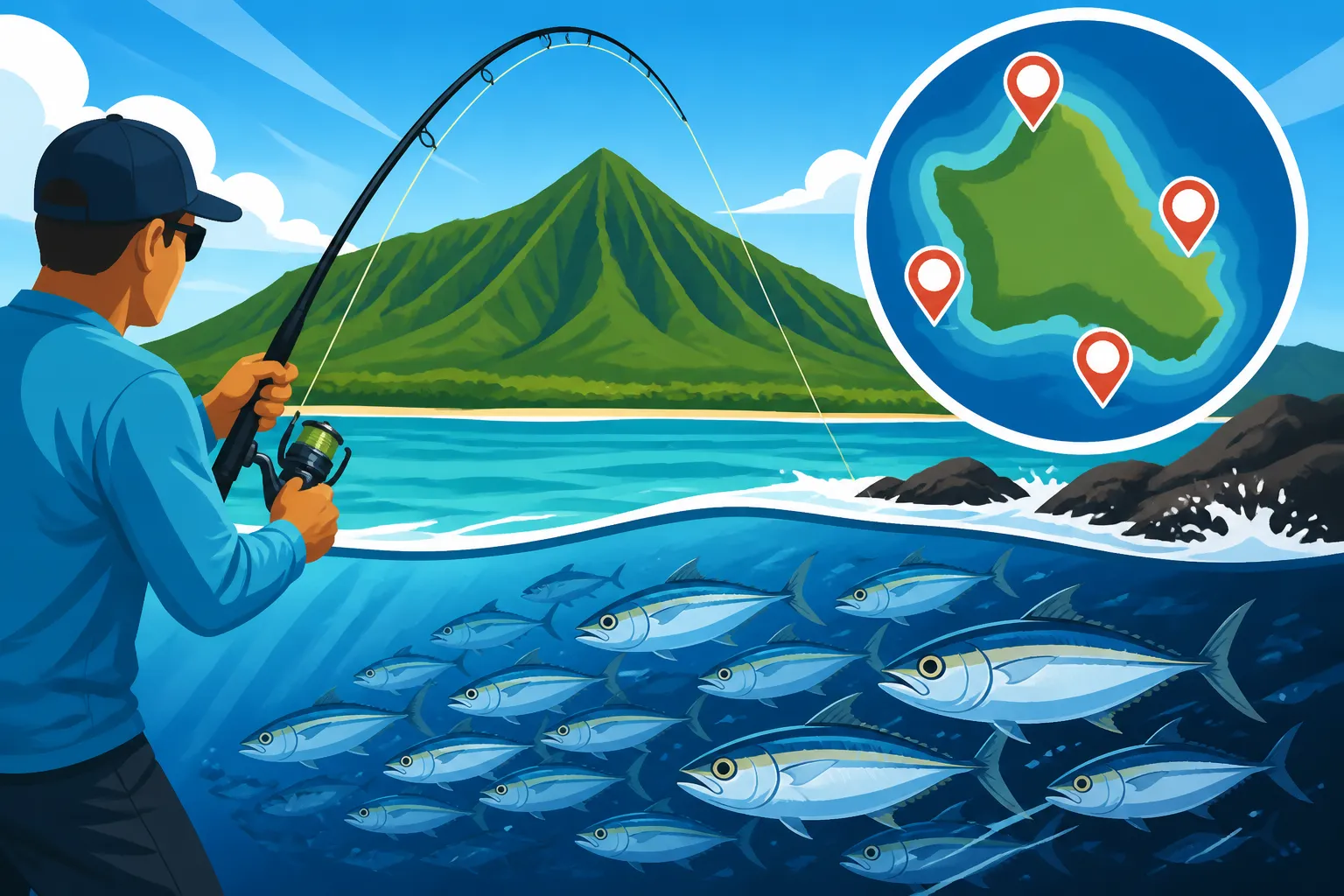
Akule are pelagic fish, but unlike some of the deeper-water pelagics, they tend to hang closer to shore, often in depths ranging from 20 to 100 feet, though they can be found shallower or deeper depending on the conditions and available food. What they absolutely love are areas with a good amount of structure and baitfish. This can mean sandy flats adjacent to reefs, harbors, protected bays, or even around FADs (Fish Aggregating Devices) a little further offshore. They're opportunistic feeders, primarily preying on smaller baitfish like juvenile opelu, sardines, or anchovies, as well as crustaceans and squid.
Their schooling patterns are fascinating. Sometimes you'll see massive, dark "clouds" of akule moving slowly under the surface, almost like a shadow on the water. Other times, they'll be breaking water, creating a commotion as they chase bait, often attracting larger predators like ulua or even small tunas. These schools are typically most active during dawn and dusk, but they can be found throughout the day, especially if there's a good current or active bait around. Pay close attention to seabirds like terns diving, as this is often a dead giveaway that baitfish, and thus akule, are present beneath them. It's truly a sight to behold when an akule school is in a feeding frenzy! To learn more about their movements, check out our detailed article on Akule (Bigeye Scad) Schooling Behavior.
Seasonal Peaks and Environmental Factors
While akule can be found year-round in Hawaiian waters, there are definitely peak seasons when they are more prevalent and easier to find around Oahu. Generally, the warmer months, roughly from late spring through fall (May to November), see the most consistent and largest schools. This aligns with warmer ocean temperatures and the abundance of baitfish that also thrive during these times. However, don't rule out the cooler months; smaller, more dispersed schools can still be found.
Environmental factors play a huge role. Water clarity is one – akule often prefer slightly murkier water, especially if they are feeding, as it gives them a bit of cover. Strong currents, particularly around points and channels, can concentrate baitfish, making these areas prime akule hunting grounds. Tidal changes, especially incoming or outgoing tides, can also trigger feeding activity. Kona winds (southwesterly) can sometimes push bait closer to shore on the windward side, while trade winds (northeasterly) might concentrate them on the leeward. Keep an eye on the moon phase too; some local anglers swear by certain moon phases for increased akule activity, though this can be quite anecdotal. For a broader understanding of when these fish are most active, our guide on When akule schools show up on Oahu offers even more insights.
Prime Akule Fishing Locations on Oahu's Windward Side
Oahu's Windward Coast, stretching from Makapu'u Point up to Kahuku, is renowned for its lush landscapes and, crucially for us, its productive fishing grounds. The protection offered by the Koolau Mountains means calmer, clearer waters in many areas, creating ideal conditions for akule schools.
Kaneohe Bay's Abundant Waters
Kaneohe Bay is, without a doubt, one of Oahu's premier akule hotspots. This massive bay, protected by a barrier reef, offers a diverse range of habitats that akule adore. You'll find them schooling over sandy patches, near the edges of the coral reefs, and especially around the many channels and deep holes within the bay. Areas around Coconut Island (Moku o Lo'e) are particularly famous, as the deeper water and nearby research facility structures seem to attract and hold large schools.
Accessing Kaneohe Bay is relatively easy. There are several public boat launches, like the Heeia-Kea Small Boat Harbor, where you can launch a boat or a kayak. Kayak fishing for akule in the bay is incredibly popular and effective, allowing you to stealthily approach schools without spooking them. Shoreline access is also available in various spots, though finding deep enough water close to shore that holds akule can be more challenging. Look for areas where the reef drops off sharply or near channel entrances. Local knowledge is key here, and sometimes just observing where other boats or net throwers are congregating will give you the best clue. Our guide to Kaneohe Bay Fishing Spots has even more specific details on where to drop a line.
You might find akule schools here practically year-round, but late spring through early fall sees the biggest concentrations. Early morning and late afternoon are prime times. On a calm day, you might even spot their tell-tale dark shadows moving just beneath the surface. Using a fish finder on a boat or kayak can dramatically improve your success here, as you can cruise around until you mark a school.
Waimanalo and Makapu'u's Coastal Stretches
Moving south from Kaneohe Bay, the coastal areas of Waimanalo and Makapu'u offer different, but equally productive, opportunities for akule. These open coastlines are more exposed to the trade winds, but they also have deeper drop-offs closer to shore and vibrant reef systems that attract plentiful baitfish.
At Waimanalo Beach Park, for instance, the long sandy stretch often hides channels and reef formations further out. Here, akule schools can often be found just beyond the surf line, particularly during calm conditions or when there's an active current pushing bait along the coast. Anglers here often use throw nets from shore or cast sabiki rigs with heavy weights to reach deeper schools. The key is finding those subtle depressions or reef edges where akule might congregate.
Further south, near Makapu'u Point, the water gets significantly deeper closer to shore. The strong currents and exposed nature of this area mean you'll need to be mindful of conditions, but it's precisely these conditions that can concentrate large schools of akule. Anglers often fish from the rocky ledges or use small boats to access the deeper waters just beyond the point. The presence of larger pelagic fish, like mahimahi or ono, which often feed on akule, is a good indicator that schools might be nearby. Keep an eye out for diving seabirds, a universal sign that baitfish are being harassed. This area can be fantastic for bait-gathering purposes if you're targeting bigger fish later on.
Top Akule Haunts on Oahu's Leeward and South Shores
While the Windward side gets a lot of love, Oahu's Leeward and South Shores, including Honolulu, also boast excellent akule fishing opportunities, often with the added benefit of more sheltered waters during strong trade winds.
Ke'ehi Lagoon and Honolulu Harbor's Sheltered Spots
Ke'ehi Lagoon, just west of Honolulu, is another fantastic, often overlooked, spot for akule. This large, relatively shallow lagoon is dotted with deeper channels and is protected from the open ocean by Sand Island. The mix of sandy bottom, scattered coral heads, and the constant influx of nutrients from surrounding areas creates a rich environment for baitfish, which in turn attracts akule.
Within Ke'ehi Lagoon, focus your efforts around the deeper channels that snake through the area, as well as near the entrance to Honolulu Harbor. These are natural funnels for baitfish and offer good current. Small boats and kayaks are ideal for navigating the lagoon and reaching the more productive areas. You'll often find akule schools hanging in these channels, especially during tide changes when bait is being flushed in or out. The boat traffic here means the fish are accustomed to some noise, so a stealthy approach isn't as critical as it might be in other, more pristine areas.
Honolulu Harbor itself, while bustling with commercial activity, also holds surprising numbers of akule. The deep water near the piers, especially around Kewalo Basin, can be prime real estate. The constant presence of boats and docks provides structure and shelter, and leftover bait or chum from other fishing activities can keep schools hanging around. Pier fishing with sabiki rigs is a common and effective method here. Just be sure to be aware of all local regulations and respect commercial operations. These are truly some of the Best Harbor Fishing Spots on Oahu for a variety of species, including akule.
Deeper Water FADs and Buoys Offshore
For those with access to a boat and looking to venture a bit further, the Fish Aggregating Devices (FADs) and various buoys strategically placed offshore of Oahu are absolute magnets for akule, along with a host of other pelagic species. These FADs act like artificial reefs in the open ocean, providing structure in an otherwise featureless environment, attracting plankton, small baitfish, and then larger predators.
Akule schools will often congregate around these FADs, sometimes in truly massive numbers, using the structure for orientation and protection. They form a crucial link in the food chain out here, serving as forage for everything from mahimahi and ono to various tuna species and even marlin. You can often find state-maintained FADs marked on navigation charts or by checking the Hawaii Division of Aquatic Resources (DAR) website for their locations.
When fishing FADs for akule, you'll typically be using sabiki rigs or small jigs. Drifting past the FAD, or anchoring up-current and letting your lines drift down to it, are common tactics. Pay attention to your fish finder as you approach and circle the FAD; you'll often see distinct schools marking up, sometimes in huge columns extending down hundreds of feet. The challenge here is not just finding the FADs, but also dealing with potentially larger, more aggressive fish that are also drawn to the akule schools. Sometimes, you'll hook a mahimahi or skipjack tuna while trying to catch akule bait!
Essential Techniques and Gear for Targeting Akule
Now that we know where to look, let's talk about how to catch them. Akule are not particularly picky eaters, but using the right techniques and gear will significantly boost your success rate.
Netting and Sabiki Rigs for Live Bait
One of the most traditional and effective methods for catching akule, especially when they are schooling close to shore or in harbors, is with a casting net (also known as a throw net). This takes practice to master, but a well-thrown net can engulf an entire school in one go. You'll need to locate the school first, either by sight (looking for dark shadows or surface activity) or by using a fish finder. The key is to approach stealthily and cast your net directly over the densest part of the school. Remember to check local regulations on net sizes and areas where netting is permitted. Our guide on Casting Nets for Bait Fish in Hawaii has more detailed instructions.
For those without a throw net, or when akule are in deeper water, a sabiki rig is your best friend. A sabiki rig is a multi-hooked lure designed to imitate small baitfish, often with flashy materials or tiny feathers. You can buy these at any local tackle shop.
Here's how to use one effectively:
- Rod and Reel: A light spinning rod (6-8 feet) with a sensitive tip and a small to medium spinning reel (2500-4000 size) spooled with 10-20 lb monofilament or braided line is perfect.
- Weight: Attach a 1-3 ounce lead weight to the bottom of the sabiki rig, depending on current and depth. You want it to sink quickly.
- Technique: Drop the rig to the depth where you're marking fish on your fish finder, or let it sink to the bottom if fishing blind. Then, gently jig it up and down with short, sharp lifts and pauses. The idea is to make the sabiki rig "swim" like a small school of baitfish. When you feel a bite, don't immediately reel up; often, multiple akule will strike the different hooks on the rig, leading to a "full house" of fish!
- Bait: While sabiki rigs are designed to be fished unbaited, sometimes tipping the tiny hooks with a small piece of squid, shrimp, or even fish belly can make them even more irresistible, especially if the fish are finicky.
Akule caught on sabiki rigs are excellent table fare, but they are also fantastic live bait for larger game fish like ulua, mahimahi, or marlin. Keeping a livewell full of akule can turn an ordinary day into an epic one if a predator comes calling.
Night Fishing with Lights for Akule
Night fishing for akule is a time-honored tradition in Hawaii, and it's incredibly effective, especially from a boat or pier. The principle is simple: use lights to attract plankton, which then attracts small baitfish, and then the akule come in to feed on the bait.
- Light Source: You'll need a powerful light source. Submersible green or white LED fishing lights are popular, as are strong above-water lights that can penetrate the surface. Many local anglers use generators to power multiple bright lights.
- Location: This technique works best in relatively calm, somewhat protected waters, like bays (Kaneohe Bay is a prime example), harbors, or near lighted piers.
- Technique: Anchor your boat, deploy your lights, and then wait. It might take 30 minutes to an hour for the plankton to start accumulating, followed by the small baitfish. Once the bait schools are thick around your lights, the akule won't be far behind. Sometimes they appear as flashes in the beam, other times as dense, swirling masses.
- Fishing Method: Once the akule are congregated, you can catch them using sabiki rigs, small jigs, or even light tackle with tiny flies or grubs. The action can be fast and furious!
Night fishing for akule can be a magical experience, watching the underwater world come alive with the glow of your lights. It's a fantastic way to fill a cooler for dinner or stock up on live bait for a morning offshore trip. For more specific advice on this technique, take a look at our article on How to catch akule at night with lights.
Maximizing Your Akule Catch and Enjoyment
Catching akule isn't just about finding the schools; it's also about respecting the resource and making the most of your time on the water.
Responsible Angling and Preservation
Hawaii's fisheries are precious, and responsible angling practices are crucial for ensuring that future generations can enjoy the thrill of catching akule.
- Know the Regulations: Always be aware of current Hawaii fishing regulations. While akule generally have no size or bag limits for recreational fishing, rules can change, and you might encounter other regulated species while targeting them. Checking the Hawaii Division of Aquatic Resources (DAR) website is always a good idea.
- Take Only What You Need: Akule are schooling fish, and it's easy to get carried away and catch far more than you can use. Practice restraint, especially when they are biting furiously. Share your catch with friends and family, but avoid waste.
- Handle Fish with Care: If you're using akule as live bait, handle them gently to ensure they stay lively. If you're releasing any, do so quickly and carefully.
- Leave No Trace: Pack out everything you pack in. Dispose of all trash, including discarded fishing line and broken sabiki rigs, properly. Our reefs and beaches deserve our respect.
Preparing Your Akule for the Table
Akule are a highly prized food fish in Hawaii, known for their delicate, flaky white meat and mild flavor. They are incredibly versatile in the kitchen.
- Cleaning: Akule are fairly easy to clean. Scale them (a fish scaler or the back of a knife works well), then gut them. You can leave the head on for certain preparations or remove it.
- Storage: On the boat, immediately place your catch on ice to preserve freshness. Once home, clean them promptly. They are best eaten fresh, but can be frozen for later use. For freezing, consider vacuum-sealing or wrapping them tightly in plastic wrap and then foil to prevent freezer burn.
- Cooking Methods:
- Fried Akule: A classic preparation. Lightly flour or cornstarch them, then fry until golden brown and crispy.
- Grilled or Broiled: Marinate whole akule (with heads on) in shoyu (soy sauce), ginger, garlic, and a touch of sugar, then grill or broil until cooked through. The skin gets wonderfully crispy.
- Steamed: For a lighter option, steam whole akule with ginger, green onions, and a splash of shoyu and sesame oil.
- Poke: Fresh, raw akule can be cut into cubes and mixed into a delicious poke with soy sauce, sesame oil, limu (seaweed), and chili flakes. This is a local favorite!
No matter how you prepare them, fresh akule are a true taste of Hawaii.
| Location Type | Prime Oahu Spots | Best Time of Day | Primary Method | Notes |
|---|---|---|---|---|
| Protected Bay/Lagoon | Kaneohe Bay, Ke'ehi Lagoon | Dawn, Dusk, Night | Sabiki, Throw Net | Look for channels, reef edges, light attraction |
| Open Coastline/Beach | Waimanalo Beach, Makapu'u | Dawn, Dusk, Day | Sabiki, Throw Net | Deeper water beyond surf, active currents |
| Harbor/Pier | Honolulu Harbor, Kewalo Basin Piers | Day, Night | Sabiki | Structure, lights, easy access |
| Offshore FADs/Buoys | Various DAR FADs offshore | Day | Sabiki, Small Jigs | Boat access required, deep water, can attract large predators |
Planning Your Akule Adventure
Ready to chase those shimmering schools? Planning is key, and resources like FishingBooker can be incredibly helpful. Even if you're not booking a charter, browsing their listings for Oahu can give you an idea of where professional guides are taking their clients to find akule, which in turn points to active areas. You can see which harbors are most popular for baitfishing, and even get a sense of typical seasonal success rates for certain areas.
If you're a beginner, or just want to maximize your chances, consider joining a local fishing forum or Facebook group for Oahu anglers. The local community is often willing to share general information and tips, and you can learn a lot from experienced hands. Sometimes, hearing about an active school in a specific area is the best "insider" tip you can get. Just remember to always be respectful and contribute back when you can!
Whether you're casting from shore, paddling a kayak, or venturing offshore in a boat, the pursuit of akule on Oahu offers a rewarding and delicious experience. With a bit of knowledge, the right gear, and a keen eye for those tell-tale signs, you'll be bringing home a cooler full of these Hawaiian treasures in no time.
Disclaimer
The information provided in this guide is for general informational purposes only and is not intended as legal, financial, or professional advice. Fishing regulations and conditions in Hawaii can change frequently. Always consult the latest rules and advisories from the Hawaii Department of Land and Natural Resources (DLNR) Division of Aquatic Resources (DAR) before engaging in any fishing activities. Adherence to all local, state, and federal laws is the responsibility of the individual angler.