Hawaii turtle and monk seal proximity rules for anglers
It can be incredibly disheartening to be out enjoying a peaceful day of fishing in Hawaii, only to suddenly realize you're a little too close to a precious green sea turtle or, even more critically, a rare Hawaiian monk seal. Many anglers grapple with the fear of accidentally disturbing these protected creatures or, worse, running afoul of the strict regulations designed to keep them safe. This comprehensive guide will walk you through the essential proximity rules, what your responsibilities are as an angler, and how to ensure your fishing adventures are both enjoyable and respectful of Hawaii's unique marine treasures.
Understanding Hawaii's Protected Marine Life
Before we dive into the specific rules, it’s vital to understand why these regulations are in place. Hawaii is home to several incredible marine species, many of which are protected by both federal and state laws due to their endangered or threatened status. As anglers, we share the ocean with these animals, and our actions directly impact their survival.
The Basics of Honu (Green Sea Turtles)
The Hawaiian green sea turtle, locally known as honu, is perhaps one of the most beloved and iconic creatures you'll encounter in Hawaii's waters. These gentle giants are listed as a threatened species under the U.S. Endangered Species Act. While their populations have shown signs of recovery thanks to conservation efforts, they still face numerous threats, including habitat loss, boat strikes, disease, and entanglement in fishing gear.
Honu are often seen basking on sandy beaches, resting in shallow reef areas, or swimming gracefully through the water columns near shore. Their diet primarily consists of limu (seaweed) and seagrass, making them frequent visitors to rocky shores and calm bays where these food sources thrive. As an angler, you'll likely spot them in areas where you might be casting for papio or whipping for other reef fish. Their natural curiosity can sometimes lead them close to boats or even shorelines where people are fishing, which is why understanding the rules is so important.
The Unique Hawaiian Monk Seal ('Ilio-holo-i-ka-uaua)
The Hawaiian monk seal, or 'ilio-holo-i-ka-uaua (which beautifully translates to "dog that runs in rough water"), is one of the most critically endangered marine mammals in the world. Endemic to Hawaii, meaning they are found nowhere else on Earth, their population numbers are tragically low and declining. These seals are federally protected under both the Endangered Species Act and the Marine Mammal Protection Act.
Monk seals spend a significant amount of time foraging in deeper waters, but they frequently haul out onto beaches, reefs, and even rocky ledges to rest, digest food, or give birth. It's not uncommon to see a monk seal sleeping soundly on a busy beach, seemingly unbothered by human activity. However, appearances can be deceiving. They are highly sensitive to human disturbance, which can lead to stress, abandonment of pups, and even aggression if they feel threatened. Anglers might encounter them unexpectedly while fishing from shore or while boating in nearshore waters. Their vulnerability makes strict adherence to proximity rules absolutely non-negotiable.
Federal and State Protections
Both federal and state laws converge to protect marine mammals and sea turtles in Hawaii. Federally, the Endangered Species Act (ESA) and the Marine Mammal Protection Act (MMPA) are the primary legal frameworks. The ESA makes it illegal to "take" (which includes harass, harm, pursue, hunt, shoot, wound, kill, trap, capture, or collect, or attempt to engage in any such conduct) any endangered or threatened species. The MMPA prohibits the "take" of any marine mammal.
Here in Hawaii, the Department of Land and Natural Resources (DLNR) Division of Aquatic Resources (DAR) implements state-level protections, often mirroring or even exceeding federal guidelines. The purpose of these laws is not to impede your fishing experience but to ensure the long-term survival of these irreplaceable species. Familiarizing yourself with the general Hawaii Fishing Regulations Explained and even specific documents like the Hawaii DLNR fishing regulations PDF can help ensure you're always fishing responsibly.
Specific Proximity Rules and Angler Responsibilities
Now, let’s get down to the nitty-gritty: the actual distances you need to maintain and your direct responsibilities as someone enjoying Hawaii’s waters. These rules are designed for the safety of both the animals and the public.
The 10-Foot Rule (and Beyond) for Monk Seals
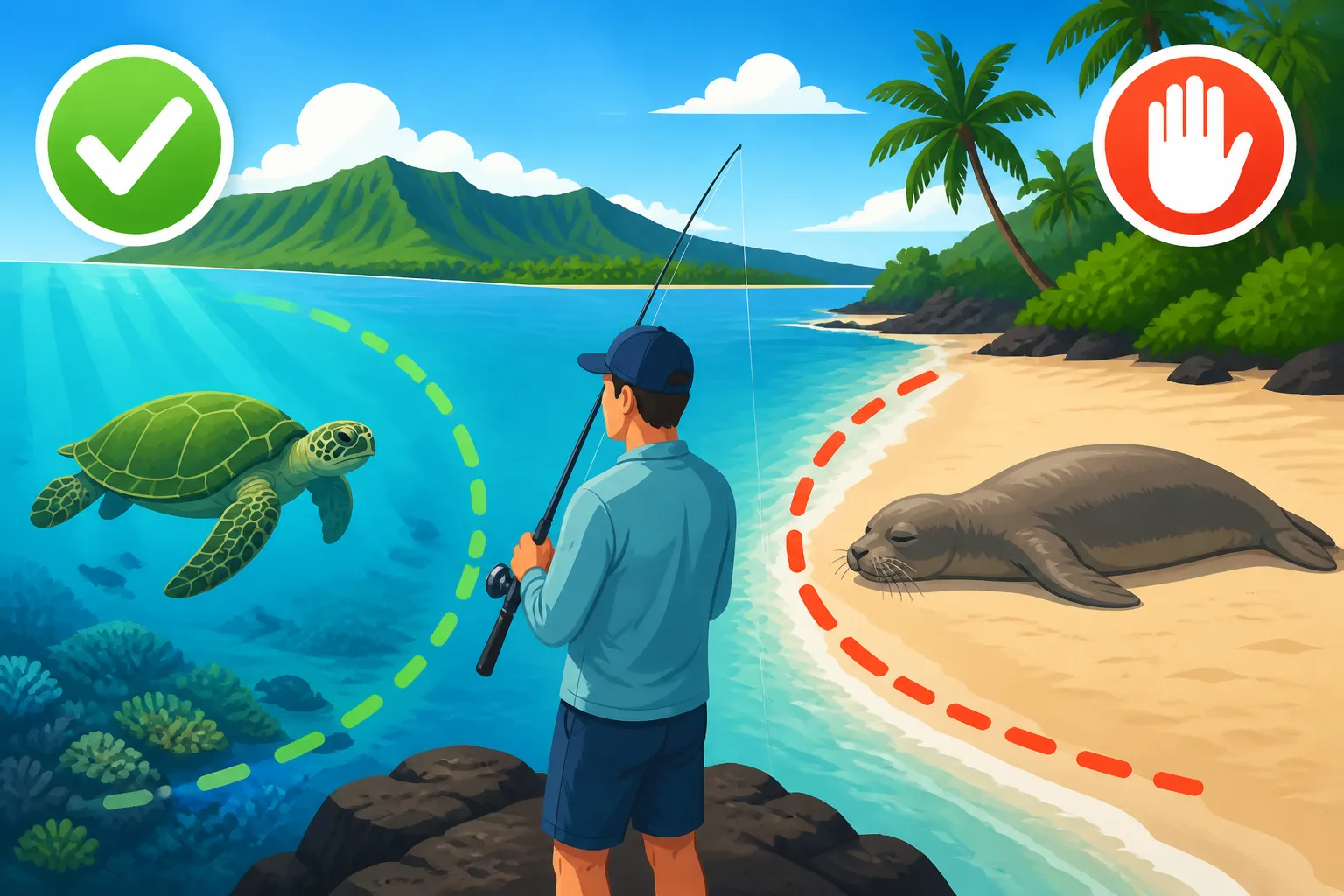
For Hawaiian monk seals, the general rule of thumb enforced by NOAA (National Oceanic and Atmospheric Administration) Fisheries is to maintain a minimum distance of 50 feet (15 meters) from them. This applies whether they are in the water or hauled out on a beach. However, when you're specifically interacting with a monk seal or if a seal approaches you, it's critical to give them even more space if possible.
There's also an unofficial "10-foot rule" often cited for many marine animals, but for monk seals, 50 feet is the standard. If a monk seal approaches your boat, kayak, or even your shoreline fishing spot closer than 50 feet, it's your responsibility to back away or remove yourself from the situation. Never approach them, try to feed them, or attempt to swim with them. This is especially true if you are fishing off a popular beach like Lanikai or Waikiki, where monk seals occasionally rest. If you're using a drone for scenic shots of your fishing location, remember that flying drones too close can also be considered harassment.
When fishing from shore, if a monk seal hauls out near your casting area, you must cease fishing in that immediate vicinity and relocate to a spot where you can maintain the 50-foot distance. This might mean packing up and moving further down the beach or to an entirely different spot. It’s inconvenient, yes, but it’s a small price to pay for the survival of a critically endangered species.
Respecting Sea Turtle Space While Fishing
For green sea turtles (honu), the general guideline is to keep a minimum distance of 10 feet (3 meters). This applies whether they are in the water, basking on rocks, or resting on the sand. While they are more common and less critically endangered than monk seals, they are still a federally protected species.
As an angler, this means:
- No Approaching: Never actively swim towards, chase, or try to touch a sea turtle. Even if it seems friendly, human interaction can alter their natural behavior and cause stress.
- Maintaining Distance from Shore: If you're casting from a rocky point or sandy beach and a honu swims within 10 feet of your line, try to reel in carefully to avoid entanglement. If one surfaces nearby while you're jigging or bottomfishing, simply observe from a respectful distance.
- Boat Proximity: If you're fishing from a boat or kayak, maintain the 10-foot distance. If a turtle surfaces near your vessel, slow down and give it space. Remember your Hawaii Boating Laws for Anglers, which also emphasize safe operation around marine life.
- Incidental Catches: This is perhaps the most critical scenario for anglers. If you accidentally hook a sea turtle, do not cut the line immediately unless it's absolutely impossible to reel it in. Instead, carefully reel the turtle to the boat or shore. Once you have it, call the NOAA Fisheries Marine Wildlife Hotline immediately (details below). They will provide specific instructions. They may advise you to attempt to dehook the turtle if it's a simple mouth hook and you have the right tools (like a long-nosed dehooker, which you can find on Amazon). If the hook is deep or the turtle is entangled, wait for responders. Cutting the line often leaves hooks and monofilament in the turtle, leading to injury or death.
Avoiding Disturbance and Harassment
The term "harassment" under federal law is broad and can encompass any act that has the potential to injure a marine mammal or turtle in the wild, or to disturb it by causing a disruption of behavioral patterns. For anglers, this means:
- No Feeding: Never feed turtles or seals. Not only is it illegal, but it habituates them to humans, which can be dangerous for both the animals and people. It also disrupts their natural foraging behaviors.
- Minimizing Noise: While fishing, try to keep excessive noise to a minimum, especially around known resting or foraging areas. Loud shouts, blaring music, or sudden engine revs can startle animals.
- Avoiding Sudden Movements: If you spot a protected animal nearby, avoid sudden, jerky movements that might be perceived as a threat. Move slowly and deliberately.
- Respecting Resting Spots: If a monk seal or turtle is hauled out on a beach or rock, consider that their resting spot. Setting up your fishing gear directly next to them, even if outside the 10-foot (or 50-foot) buffer, can still cause them stress by disrupting their peace.
- Litter Prevention: Always pack out what you pack in. Discarded fishing line, hooks, and plastic trash are major entanglement and ingestion hazards for marine life. Take extra care to ensure no gear is left behind.
Understanding these nuances is key to responsible angling. It's not just about avoiding a ticket; it's about being a good steward of Hawaii's natural environment.
What to Do If You Encounter a Protected Animal While Fishing
Despite your best intentions, encounters can happen, especially when you're focused on reeling in a big one. Knowing exactly what steps to take can make all the difference for the animal's well-being and your peace of mind.
Accidental Hooking or Entanglement
This is arguably the most stressful scenario for an angler. If you accidentally hook a Hawaiian green sea turtle or, in very rare cases, a Hawaiian monk seal, remember these crucial steps:
- Stay Calm and Call for Help: Immediately call the NOAA Fisheries Marine Wildlife Hotline at (888) 256-9840. This hotline operates 24/7. Provide them with your exact location, the type of animal, the nature of the entanglement or hooking, and any other relevant details.
- Keep the Animal Alongside: If safe to do so, carefully reel in the animal to your boat or to shore. Do not try to bring a large turtle or monk seal completely out of the water unless instructed by NOAA.
- Do NOT Cut the Line Immediately: Resist the urge to cut the line. As mentioned earlier, leaving hooks and line in the water can lead to further injury or death for the animal. Only cut the line if you are in immediate danger or if the NOAA responder explicitly tells you to.
- Wait for Instructions: Follow the instructions provided by the NOAA responder. They may ask you to stand by until a trained response team can arrive, or they might guide you through specific dehooking or disentanglement procedures if it's safe and simple enough for you to perform. Having a pair of needle-nose pliers or a specialized dehooker (many anglers keep a sturdy one in their tackle box, often purchased from stores or online retailers like Amazon) can be incredibly useful for superficial hookings, but always get clearance from NOAA first.
- Document the Incident: Take photos or videos from a safe distance if possible. This can help responders assess the situation before they arrive. Note the time, location, and conditions.
Remember, reporting an accidental hooking or entanglement is not an admission of guilt if you followed all regulations. It's a responsible action that helps conservation efforts. Penalties are typically reserved for intentional harassment or negligence, not genuine accidents where you sought to help.
Reporting Sightings or Concerns
Beyond hooking incidents, there are other times you might need to report an encounter:
- Injured, Stranded, or Entangled Animals: If you see a monk seal or sea turtle that appears sick, injured, stranded on a beach, or entangled in marine debris, call the NOAA Fisheries Marine Wildlife Hotline immediately at (888) 256-9840. Do not attempt to intervene yourself, as these animals can be dangerous when distressed, and specialized training is required.
- Harassment or Violation: If you witness someone harassing a monk seal or sea turtle, intentionally violating the proximity rules, or engaging in illegal activities involving these animals, report it. You can call the NOAA Fisheries Enforcement Hotline at (800) 853-1964 or the DLNR Division of Conservation and Resources Enforcement (DOCARE) hotline at 643-DLNR (643-3567). Try to get details like location, time, a description of the people involved, and if possible, a license plate or boat registration number.
Your prompt reporting can be crucial for an animal's rescue or for enforcing necessary protections. It plays a significant role in supporting efforts like those discussed in Hawaii monk seal protected status near fishing grounds.
Educating Yourself and Others
Being informed is your best defense against accidental violations and your greatest asset in protecting Hawaii's marine life.
- Stay Updated: Regulations can change. Periodically review official sources like the NOAA Fisheries Pacific Islands Region website and the Hawaii DLNR Division of Aquatic Resources.
- Spread Awareness: Gently educate fellow anglers or beachgoers you encounter who might be unaware of the rules. A friendly "Hey, did you know that monk seals need at least 50 feet of space?" can go a long way. Share resources like Reading the Hawaii DLNR Fishing Regulations.
- Observe Respectfully: Invest in a good pair of binoculars (which you can easily find on Amazon) to observe marine wildlife from a safe and legal distance. Enjoy the beauty of these creatures without interfering with their natural behaviors.
Penalties for Violating Proximity Rules
It’s easy to think of these rules as mere suggestions, but the reality is that violating proximity rules for protected marine life carries significant legal consequences. Both federal and state governments take the protection of these species very seriously.
Federal and State Consequences
The penalties for violating the Endangered Species Act or the Marine Mammal Protection Act can be severe:
- Fines: Civil penalties can range from tens of thousands of dollars per violation. For instance, violations of the Marine Mammal Protection Act can carry civil penalties of up to $28,526 per violation, while ESA violations can reach $50,000.
- Imprisonment: In cases of egregious or intentional harassment or harm, criminal penalties can include substantial fines and even imprisonment for up to one year.
- Forfeiture: Boats, fishing gear, and other equipment used in the commission of a violation may be subject to forfeiture.
On the state level, Hawaii Revised Statutes also carry penalties for harassing protected marine species. These often involve significant administrative fines and may include community service related to marine conservation. You can learn more about general consequences by reading Hawaii fishing without a license penalty, which provides a broader context for violations.
It’s important to understand that these penalties aren’t just for direct, malicious harm. Even actions interpreted as unintentional harassment due to negligence (e.g., repeatedly disturbing a resting seal because you didn't move your fishing spot) can lead to citations and fines. The legal framework is designed to err on the side of caution for the animals.
The Broader Impact of Non-Compliance
Beyond the legal and financial repercussions, there's a significant ethical and ecological cost to violating proximity rules:
- Increased Stress on Animals: Frequent human disturbance, even if seemingly minor, can lead to chronic stress for protected species. This stress can impact their foraging efficiency, reproductive success, and overall health.
- Disrupted Behavior: Animals that become habituated to human presence may alter their natural behaviors, sometimes leading them into dangerous situations, such as increased risk of boat strikes or interaction with harmful objects.
- Conservation Setbacks: Every incident, especially those resulting in injury or death, represents a setback for the recovery of these vulnerable populations. For species like the Hawaiian monk seal, where every individual counts, a single incident can have a disproportionate impact.
- Negative Public Perception: Violations by anglers can unfortunately cast a shadow over the entire fishing community, leading to calls for stricter fishing regulations or even closures in certain areas. Responsible angling, on the other hand, strengthens the community's reputation as stewards of the ocean.
Ultimately, adherence to these rules is about respecting the unique wildlife that makes Hawaii so special. By understanding and following these guidelines, you're not just avoiding legal trouble; you're actively contributing to the health and future of Hawaii's precious marine ecosystems. Your fishing experience in Hawaii should be one of joy and respect for its incredible natural environment.
| Protected Marine Animal | Minimum Proximity Rule (Federal/State) | What Anglers Should Do | Emergency Hotline |
|---|---|---|---|
| Hawaiian Monk Seal | 50 feet (15 meters) | Move away immediately if seal approaches; cease fishing in immediate area. | NOAA Marine Wildlife Hotline: (888) 256-9840 |
| Green Sea Turtle | 10 feet (3 meters) | Maintain distance; reel in line carefully if turtle approaches. | NOAA Marine Wildlife Hotline: (888) 256-9840 |
| Accidental Hooking/Entanglement (All Protected Species) | N/A (Rules for incident handling) | Do NOT cut line; reel animal to boat/shore if safe; call hotline immediately. | NOAA Marine Wildlife Hotline: (888) 256-9840 |
| Witnessed Harassment/Violation | N/A (Reporting violation) | Report to authorities with details (location, time, description). | NOAA Enforcement Hotline: (800) 853-1964; DLNR DOCARE: 643-DLNR (643-3567) |
Disclaimer
The information provided in this guide is for general informational purposes only and does not constitute legal advice. While we strive to keep the information up-to-date and correct, regulations are subject to change. Always consult the official websites of NOAA Fisheries and the Hawaii Department of Land and Natural Resources (DLNR) for the most current and authoritative regulations and guidelines before engaging in any fishing activities.