Hawaii sea cucumber harvest regulations
It's incredibly frustrating when you're trying to do the right thing, to understand the rules for harvesting something from the ocean, only to find that the regulations seem to be a tangled mess or, worse yet, conspicuously absent for the specific species you're interested in. Sea cucumbers in Hawaii are a prime example. You want to enjoy the bounty of our waters responsibly, but knowing exactly where you stand with harvesting these unique creatures can feel like navigating a maze. This guide aims to clear up that confusion, diving deep into what you need to know about Hawaii's sea cucumber harvest regulations, and how to enjoy our marine environment ethically and legally.
Understanding Sea Cucumbers in Hawaiian Waters
Before we even get into the nitty-gritty of regulations, it's really important to appreciate what sea cucumbers are and why they play such a critical role in our delicate ocean ecosystems. They might not be as glamorous as a marlin or as sought-after as an ahi (Yellowfin Tuna) Fishing in Hawaii, but their contribution is immense.
The Vital Role of Sea Cucumbers in Reef Ecosystems
Think of sea cucumbers as the unsung heroes of the reef, the ocean's diligent janitors. These fascinating echinoderms, related to starfish and sea urchins, are primarily detritivores, meaning they feed on detritus – the decaying organic matter found on the seabed. As they move across the ocean floor, they ingest sand and sediment, process the organic material, and then excrete cleaner sand. This constant sifting and cleaning action is absolutely crucial for maintaining healthy reef environments.
Without them, our reefs would be smothered in organic waste and algae, which can choke out corals and other essential reef inhabitants. They also help cycle nutrients, making them available for other organisms. Their role in bioturbation (the mixing of sediments) also helps oxygenate the seabed, which is vital for many benthic organisms. So, when we talk about harvesting them, it's not just about what you can take; it's about preserving this essential ecological service. Any disruption to their populations can have cascading negative effects on the entire reef community, something we definitely want to avoid here in Hawaii.
Common Sea Cucumber Species You Might Encounter
Hawaii is home to a diverse array of sea cucumber species, ranging in size, color, and habitat. While many look like simple "cukes" or "loli" as they are sometimes called locally, some are quite striking. You might encounter the sturdy, dark-bodied 'Ula'ula (Stichopus horrens), often found in shallow reef areas, or the sometimes vibrantly colored Holothuria atra (black sea cucumber), common in sandy lagoons.
There are also species like the leopard sea cucumber (Bohadschia argus) with its distinct spotted pattern, or the worm-like Synapta maculata, which can stretch several feet long and is often mistaken for a snake. Each species has its own ecological niche, contributing in its unique way to the health of the marine environment. While many are common, it's always wise to remember that some species might be rarer or have localized populations that are more vulnerable to over-harvesting. A good marine identification guide, perhaps one you can find on Amazon, is an invaluable tool for any responsible angler or gatherer. Knowing what you're looking at is the first step in responsible interaction.
Navigating Hawaii's General Aquatic Resource Regulations
Here’s where it gets a little tricky and often causes the most confusion for people. Unlike many popular fish species that have very clear Hawaii Bag and Size Limits by Species for recreational take, specific, detailed harvest regulations for most sea cucumber species for recreational purposes are largely absent from Hawaii's fishing laws. This doesn't mean it's a free-for-all, though! It simply means you need to understand the broader framework of aquatic resource management and the distinction between recreational and commercial activities.
The Absence of Specific Recreational Bag and Size Limits for Most Species
For the casual beachcomber or diver who might stumble upon a sea cucumber and wonder if they can take it home, there often isn't a readily available regulation stating, "You can take X number of Holothuria atra of Y size." This silence in the regulations can be misleading. It's not a green light to take as many as you want. Instead, it pushes the activity into a gray area where general conservation principles and commercial regulations often dictate the rules.
In many cases, the state's focus for recreational harvest is on species traditionally targeted for food and sport. Sea cucumbers, while considered a delicacy in some cultures and an ingredient in others, aren't typically high on the recreational fishing list for the vast majority of Hawaii's residents or visitors. Therefore, the Department of Land and Natural Resources (DLNR) hasn't felt the need to establish specific recreational limits for every single sea cucumber species. However, this absence puts the onus on you to be extra cautious and adhere to general principles of sustainability and to be aware of the distinction if your activity crosses into commercial territory.
When a Commercial Marine License Becomes Necessary
This is a critical distinction, and it's where many people can inadvertently run afoul of the law. If your intent is anything beyond purely personal, subsistence use – meaning you plan to sell them, barter them, or take them in quantities that suggest commercial intent – then you absolutely need a Hawaii Commercial vs Recreational Fishing License Rules.
The threshold for what constitutes "commercial intent" isn't always a hard line, but it generally refers to taking aquatic resources for profit or financial gain. Even if you're just giving them away to friends frequently, or taking larger quantities than what one family might reasonably consume, you could be seen as engaging in commercial activity. A commercial marine license (CML) involves specific reporting requirements, fees, and often different regulations than recreational take. For example, some species might be entirely off-limits for commercial harvest, or only permitted during certain seasons or in specific quantities. If you're ever in doubt about whether your activities require a CML, it's always best to err on the side of caution and consult directly with the Hawaii Division of Aquatic Resources customer service phone number. It's better to ask than to face the penalties later.
General Prohibitions on Injuring or Taking Aquatic Life
Beyond specific species regulations, Hawaii has overarching laws designed to protect its precious aquatic resources. It is generally prohibited to injure, damage, or take any aquatic life by unlawful means. This means that even if there isn't a specific regulation for a particular sea cucumber, using destructive methods, or causing undue harm to the environment during collection, is absolutely illegal and frowned upon.
For example, using certain types of gear like poisons, explosives, or other harmful methods to collect anything from the ocean is strictly prohibited. You should always aim for minimal impact. When collecting, ensure you're not disturbing the surrounding environment, damaging coral, or dislodging other organisms unnecessarily. The spirit of the law is to protect the entire ecosystem, not just individual species, so your actions must always align with that principle.
Crucial Restricted Areas for Sea Cucumber Harvesting
While specific sea cucumber regulations might be sparse, the geographical restrictions are very clear and extremely important to understand. Many of Hawaii's most pristine and ecologically vital areas are designated as protected zones where no taking of marine life, including sea cucumbers, is allowed. Ignoring these boundaries can lead to significant penalties, both legal and ecological.
Marine Life Conservation Districts (MLCDs)
Marine Life Conservation Districts (MLCDs) are the strictest form of marine protected areas in Hawaii. These are specific ocean zones established to conserve and replenish marine resources, often in areas with high biodiversity or significant cultural value. In an MLCD, all forms of fishing and marine life take are generally prohibited, with very few exceptions. This absolutely includes sea cucumbers.
Examples of MLCDs include popular spots like Hanauma Bay on Oahu, Molokini Shoal off Maui, and Kealakekua Bay on the Big Island. Fishing is not allowed at Hanauma Bay, and if you're ever visiting these breathtaking locations, remember that it's a visual experience only – no touching, no taking, just observation. Even picking up a dead shell might be against the rules. These areas are vital nurseries and sanctuaries for marine life, allowing populations to thrive and spill over into adjacent, less protected areas. Violating MLCD rules is taken very seriously by enforcement officers and carries substantial fines.
Fish Replenishment Areas (FRAs) and Other Protected Zones
Beyond MLCDs, there are other types of protected areas where marine resource harvest is restricted or prohibited. Fish Replenishment Areas (FRAs), for instance, are designed to protect certain species during critical life stages or to allow fish populations to recover. While FRAs might have different rules than MLCDs (some may allow certain types of fishing, for example), it is imperative to check the specific regulations for each FRA you encounter. The Hawaii Fish Replenishment Areas in West Hawaii are a good example where specific rules are in place to help certain fish populations recover.
Other protected zones can include designated refuges, estuarine areas, or even specific stretches of coastline protected by local ordinances. Before attempting to harvest anything, especially in an unfamiliar area, always take the time to research the specific regulations for that location. The DLNR website is your best friend here, or consider carrying a printed copy of the Reading the Hawaii DLNR Fishing Regulations PDF from their site, perhaps stored in a waterproof case you might find on Amazon, just in case you're out of cell service range.
Private Property and Traditional Access Rights
While most of Hawaii's shoreline is publicly accessible, there are instances where marine resources may be on or near private property. Always respect private property boundaries and ensure you have permission before accessing land or waters that are not clearly public. The issue of Hawaii shoreline fishing rights and public access rules is complex, but the general principle is that public access to the shoreline below the high-water mark is generally protected. However, how you reach that shoreline and whether you can harvest from specific adjacent areas might vary.
Additionally, it's worth noting the concept of Hawaii traditional and customary fishing rights explained. While these rights primarily pertain to Native Hawaiian practices, they underscore the importance of respecting historical uses and traditional knowledge of resource management. For recreational gatherers, the takeaway is to always be mindful and respectful of the local community and their relationship with the ocean.
Responsible Harvesting Practices and Ethical Considerations
Given the general lack of explicit recreational regulations for many sea cucumber species, it becomes even more critical for you, the individual, to embrace responsible harvesting practices. It's not just about what's legal; it's about what's ethical and sustainable for the long-term health of our oceans.
Minimizing Impact and Sustaining Populations
When harvesting sea cucumbers (or any marine life for which specific rules are unclear), always operate under the principle of "take only what you need, leave the rest." Avoid taking large quantities that could deplete local populations. Sea cucumbers are slow-moving and often aggregated, making them vulnerable to over-harvesting if too many are removed from a small area. Think about how many you truly need for your intended use, and stick to that.
Furthermore, practice selective harvesting. Don't just grab the first ones you see. Leave smaller individuals to grow and mature, ensuring they have a chance to reproduce. Consider leaving larger, older individuals as well, as they are often significant contributors to the gene pool. A good practice is to distribute your take over a wider area rather than stripping one small patch. This minimizes the localized impact and allows populations to recover more easily.
Identifying and Avoiding Endangered or Protected Species
Even if a general permit allows collection, you must be absolutely certain that the species you are targeting is not listed as endangered or protected. While no sea cucumber species in Hawaii are currently listed under federal endangered species acts, conservation statuses can change, and localized populations can be vulnerable. Always be aware of any Endangered and Protected Fish Species in Hawaii and other marine life.
The responsibility falls on the harvester to correctly identify species. If you are unsure, the safest bet is to leave it alone. Carry a waterproof field guide or have access to reliable identification resources on your phone. If a sea cucumber looks unusual or unfamiliar, admire it, photograph it, but don't harvest it. It’s always better to be safe than sorry, both for the environment and for avoiding potential legal trouble.
Tools and Techniques for Sea Cucumber Harvesting
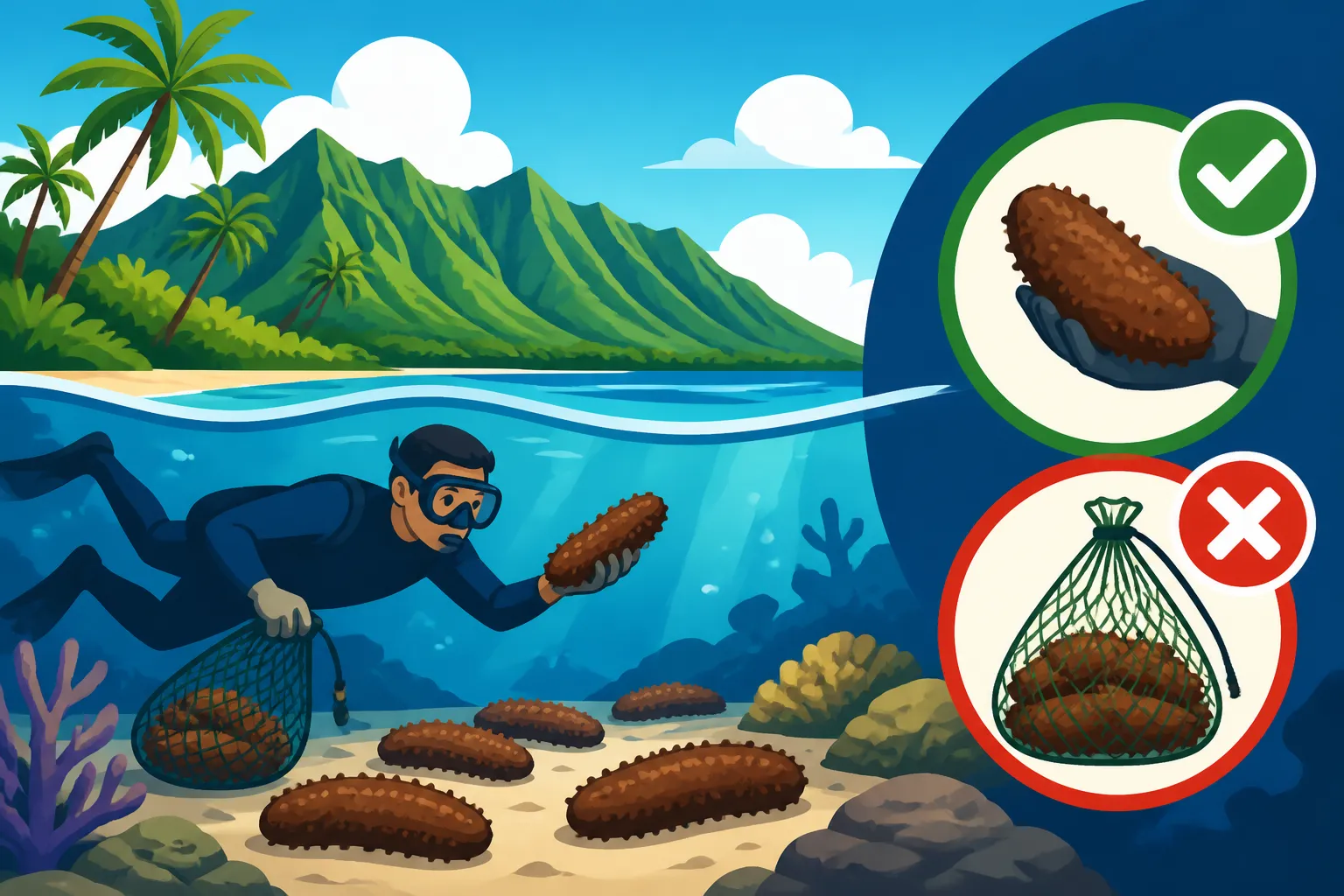
When it comes to tools for harvesting sea cucumbers, simplicity and minimal impact are key. Hand-picking is often the most appropriate method. If the sea cucumber is in an accessible shallow area, you can gently detach it by hand. Avoid using tools that could damage the animal or the surrounding substrate, such as sharp knives or crowbars that might inadvertently harm corals or other marine life.
A small net or a bucket (perhaps a sturdy collapsible one from Amazon for easy transport) can be useful for holding your collection. Always ensure any containers used for transport are clean and don't introduce foreign substances into the marine environment. If you're wading or snorkeling, move slowly and deliberately to avoid stirring up excessive sediment or damaging fragile reef structures. The goal is to collect your target with the least possible disturbance to its habitat and the creatures around it.
Consequences of Non-Compliance: Don't Risk It
It might seem like a small thing, taking a few sea cucumbers, especially if there aren't explicit regulations for them. But don't be fooled by the lack of specific rules for every species. Hawaii's aquatic resource laws are comprehensive, and violating general prohibitions or protected area rules can lead to serious repercussions. The state is very serious about protecting its unique and fragile marine ecosystems.
Penalties for Violating Aquatic Resource Laws
The consequences for violating Hawaii's aquatic resource laws can be substantial. Hawaii fishing without a license penalty or harvesting in a prohibited area, for instance, can lead to significant fines. These fines can range from hundreds to thousands of dollars, depending on the severity of the offense, the type of violation, and whether it's a first-time offense or a repeat infraction.
Beyond monetary fines, violators can also face the confiscation of their gear, vessels, and even their catch. In some cases, particularly for egregious or repeated violations, criminal charges could be brought, potentially leading to jail time. The DLNR has a strong enforcement arm, and they patrol our waters and shorelines regularly. They are trained to identify illegal activities, and they don't hesitate to enforce the law to protect our precious marine environment. It's simply not worth the risk.
The DLNR's Role in Enforcement
The Department of Land and Natural Resources (DLNR), specifically the Division of Aquatic Resources (DAR) and the Division of Conservation and Resources Enforcement (DOCARE), are the primary agencies responsible for upholding Hawaii's aquatic resource laws. DOCARE officers are uniformed and armed law enforcement personnel with the authority to issue citations, make arrests, and investigate violations across the state.
They monitor fishing activities, patrol MLCDs and other protected areas, and respond to reports from concerned citizens. They understand the nuances of local ecosystems and the impact of improper harvesting. Their goal is not just to punish, but to deter destructive practices and ensure the long-term health of Hawaii's marine resources for everyone to enjoy. If you see something that looks suspicious or like a clear violation, don't hesitate to report it to the DLNR; it helps them protect what we all cherish.
Ultimately, harvesting sea cucumbers in Hawaii requires a blend of common sense, ecological awareness, and adherence to general marine resource laws, even if specific species-level regulations are not always explicitly stated. When in doubt, always err on the side of caution, prioritize conservation, and consult official sources.
| Aspect of Harvest | Key Consideration | Best Practice |
|---|---|---|
| Specific Regulations | Often absent for recreational sea cucumber take. | Assume general marine resource laws apply. |
| Commercial Intent | Any taking for profit/barter. | Requires a Commercial Marine License (CML). |
| Protected Areas | Marine Life Conservation Districts (MLCDs), Fish Replenishment Areas (FRAs), etc. | NO TAKE allowed in MLCDs; check specific rules for FRAs. |
| Species Identification | Many species exist; some may be vulnerable. | Identify accurately; when in doubt, leave it alone. |
| Harvesting Tools/Method | Avoid destructive practices. | Hand-picking, minimal impact, clean containers. |
| Quantity | No specific bag limits for most. | Take only what you need; practice selective harvest. |
| Environmental Impact | Minimize disturbance to habitat and other marine life. | Move carefully, avoid damaging coral or stirring excessive sediment. |
| Penalties | Fines, confiscation, potential criminal charges. | Always comply with general laws; research before you harvest. |
Disclaimer
Please be aware that fishing and aquatic resource regulations in Hawaii are subject to change. While this guide provides comprehensive information based on current knowledge, it is your responsibility to verify all regulations with the official Hawaii Department of Land and Natural Resources (DLNR) or Division of Aquatic Resources (DAR) before engaging in any harvesting activities. This article is for informational purposes only and does not constitute legal advice.