What water temperature bottomfish prefer
It can be incredibly frustrating to head out on the beautiful Hawaiian waters, convinced you're in a prime bottomfishing spot, only to come up empty-handed. Many anglers focus on bait, lure color, or even the moon phase, completely overlooking one of the most critical factors influencing where bottomfish decide to hang out: water temperature. This guide will dive deep into understanding the thermal preferences of Hawaii's prized deepwater species, helping you unlock more consistent success on your next trip.
The Critical Role of Water Temperature in Hawaii Bottomfishing
When you're out on the vast expanse of the Pacific, the ocean might seem like one big, uniform body of water. But beneath the surface, especially in the deep waters where Hawaii's bottomfish thrive, it's a dynamic environment with distinct layers and often subtle, yet powerful, temperature shifts. Ignoring these thermal nuances is like trying to find a specific house in a dark city without turning on any lights. Bottomfish aren't just swimming around randomly; they're constantly seeking their comfort zone, and that comfort zone is largely defined by temperature.
Why Temperature Dictates Bottomfish Behavior
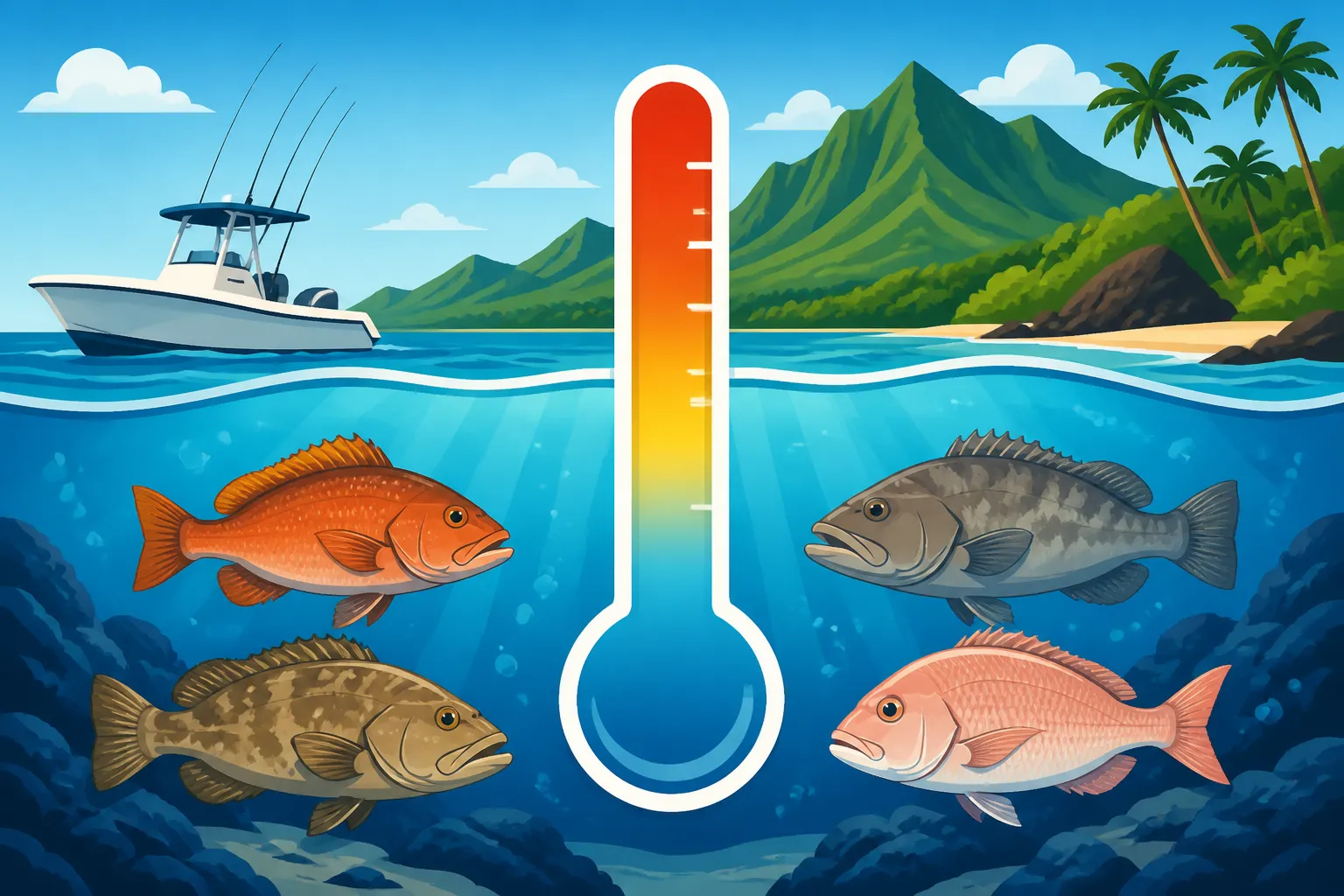
Think of fish like people. We have a temperature range where we feel most comfortable, where our bodies function optimally. For deepwater bottomfish, their metabolic rates, feeding habits, and even their ability to process oxygen are all closely tied to the water temperature around them. If the water is too cold, they might become sluggish, reducing their activity and appetite. If it's too warm, they might seek deeper, cooler waters, or become stressed, which also impacts their willingness to bite. It's a delicate balance, and even a few degrees can make a world of difference.
For instance, many of our prized deepwater species, like opakapaka and onaga, are cold-blooded creatures. This means their body temperature matches their environment. If the surrounding water warms up beyond their preferred range, they have to expend more energy to maintain their bodily functions, or they simply become uncomfortable. This often leads them to retreat to deeper, more stable thermal layers. Conversely, a perfect temperature band can create a feeding frenzy, as their metabolism kicks into high gear, and they become more active predators. Understanding these basic biological drivers is the first step to truly successful Bottomfishing in Hawaii.
Thermal Stratification and Its Impact on Deep Water
Hawaii's deep ocean waters are not uniformly mixed. Instead, they often form distinct layers, a phenomenon known as thermal stratification. The sun warms the surface, creating a warmer, less dense layer of water. Beneath this, you'll find cooler, denser water. The boundary between these two layers, where the temperature drops significantly over a short depth, is called the thermocline. For bottomfish, this thermocline is a critical feature.
This isn't just about temperature; it's also about oxygen and food. Warmer surface waters tend to be more oxygen-rich due to interaction with the atmosphere, but deep below the thermocline, oxygen levels can drop. However, the thermocline itself often acts as a nutrient trap and a congregation point for baitfish and plankton, which thrive on these nutrient-rich boundaries. This means that while bottomfish generally prefer cooler waters, they'll often be found just above or within the thermocline, taking advantage of the abundant food sources while remaining in their preferred temperature envelope. Knowing how to identify these layers using your electronics, as discussed in Best sonar settings for finding structure off Kona, can be a game-changer for locating concentrations of fish.
Ideal Temperature Ranges for Hawaii's Prized Bottomfish Species
Pinpointing an exact "perfect" temperature for all bottomfish in Hawaii is a bit like trying to find a single perfect wave for every surfer – it doesn't quite work that way. Different species have different preferences, and even within a species, their tolerance might shift based on factors like spawning cycles or the availability of food. However, we can certainly identify general ranges that increase your chances significantly.
Opakapaka and Onaga: The Deepwater Dwellers
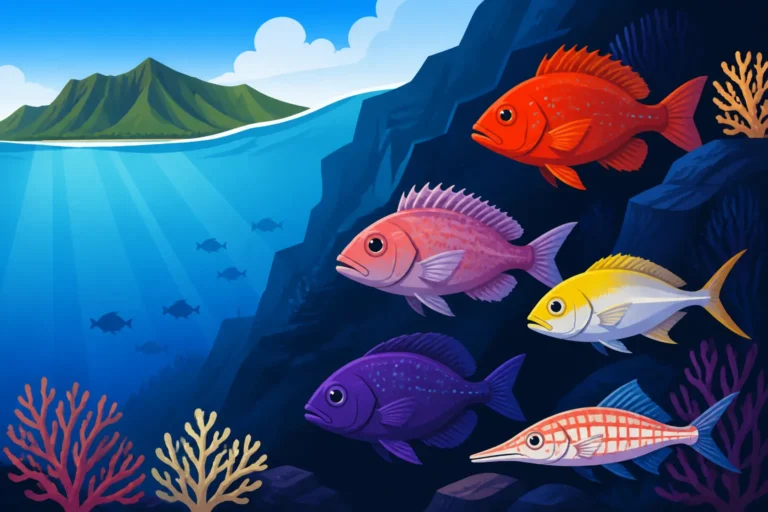
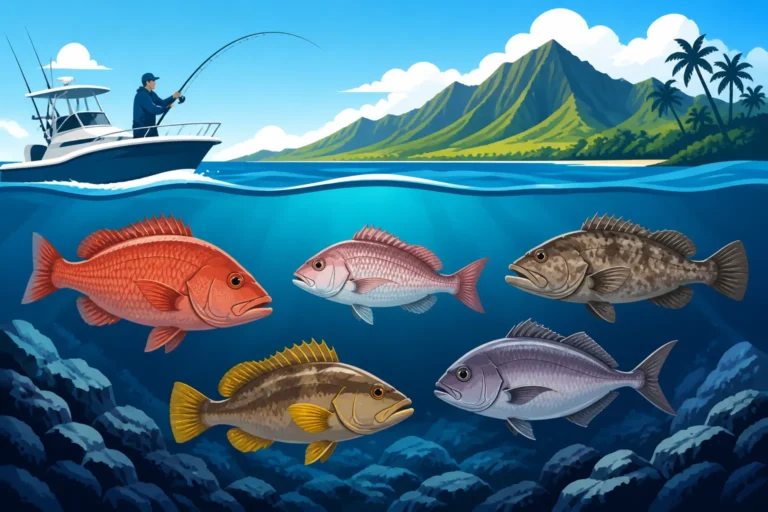
Two of the most sought-after bottomfish in Hawaii are the opakapaka (pink snapper) and the onaga (ruby snapper). These gorgeous, delicious fish are true deepwater specialists, and they have particular thermal needs. Generally, you'll find them in waters ranging from about 45°F to 55°F (7°C to 13°C).
The opakapaka, known for its vibrant pink hue, tends to prefer the slightly warmer end of this deepwater spectrum, often found in waters around 48-55°F. They are often associated with rocky ledges, deep reefs, and underwater pinnacles, where these specific temperatures prevail. If the surface waters warm considerably, opakapaka will retreat to deeper contours where the water remains consistently cool. You can learn more about their specific habitat and feeding patterns in Opakapaka (Pink Snapper) Habits.
The onaga, with its striking ruby red color, is often found even deeper and can tolerate, and even prefer, slightly colder temperatures, typically in the 45-52°F range. These fish are exquisitely sensitive to temperature shifts. A sudden change in deepwater currents bringing warmer water can cause them to shut down their bite or move off completely. Finding that sweet spot where the water is consistently cool and stable is key to a successful onaga trip. Understanding their nuances is crucial for success, and Onaga (Ruby Snapper) Habits offers further insight.
Other Key Bottomfish: Hapu'upu'u, Ehu, and Kalekale
While opakapaka and onaga might be the crown jewels, Hawaii's deep-water bounty includes other fantastic bottomfish species, each with its own thermal leanings.
- Hapu'upu'u (Hawaiian Grouper): These powerful fighters are often found in a slightly broader temperature range, perhaps 50-65°F (10-18°C). They are less particular about the extreme cold than onaga and can be found in a variety of depths, from shallower ledges to very deep drop-offs, making them a common target when exploring new Bottomfishing in Hawaii grounds. Their robust nature allows them to tolerate a wider thermal envelope.
- Ehu (Red Snapper): These beautiful red fish are often found alongside opakapaka but can sometimes tolerate slightly warmer temperatures, typically in the 50-60°F (10-16°C) range. They're usually found a bit shallower than onaga but still in respectable deepwater territory.
- Kalekale (Silverjaw Snapper): Similar to opakapaka, kalekale prefer cooler deep waters, often in the 50-58°F (10-14°C) range. They're known for their delicious white flesh and are a welcome addition to any bottomfish haul.
The takeaway here is that while there's overlap, subtle differences exist. A diverse spread of baits and rigs targeting various depths within a productive temperature zone can increase your chances of catching a mixed bag of these incredible Bottomfish Species of Hawaii.
The Impact of Depth on Perceived Temperature
It’s easy to look at a surface temperature reading of 78°F and think the ocean is too warm for deep-sea bottomfishing. However, temperature drops rapidly with depth, especially in tropical waters like Hawaii's. The crucial factor isn't the surface temperature, but the temperature at the depth you're fishing. This is why understanding How deep bottomfish species live is so intrinsically linked to their temperature preferences.
For example, while the surface might be bathwater warm, you might find that by 300-400 feet (50-66 fathoms), the temperature has dropped into the 60s°F, and by 600-900 feet (100-150 fathoms), it's well into the 40s and low 50s°F. Modern fish finders and sonars can give you real-time temperature readings at various depths, which is invaluable. Don't be fooled by warm surface waters; the deep is a different world. It's this deep, consistent coolness that draws and holds bottomfish, even when the sun is blazing overhead.
Here's a quick reference for common Hawaii bottomfish and their approximate preferred temperature and depth ranges:
| Bottomfish Species | Preferred Temperature Range (Approx.) | Typical Depth Range (Fathoms) | Key Habits Related to Temp |
|---|---|---|---|
| Opakapaka (Pink Snapper) | 48-55°F (9-13°C) | 60-120 | Moves deeper with warm surface water, congregates near structure. |
| Onaga (Ruby Snapper) | 45-52°F (7-11°C) | 80-150+ | Highly sensitive to temperature changes, prefers cooler, stable water. |
| Ehu (Red Snapper) | 50-60°F (10-16°C) | 30-100 | More tolerant of slightly warmer water than deeper snappers, but still prefers cool. |
| Hapu'upu'u (Hawaiian Grouper) | 50-65°F (10-18°C) | 20-150+ | Wider range, often found near ledges and deep drop-offs. |
| Kalekale (Silverjaw Snapper) | 50-58°F (10-14°C) | 50-100 | Similar to opakapaka but can be found slightly shallower. |
Practical Strategies for Measuring and Utilizing Water Temperature
Knowing that temperature matters is one thing, but actually using that knowledge to improve your fishing is another. This isn't just theory; it's practical application that can turn a slow day into a banner day. Incorporating temperature monitoring into your routine will make you a much more effective bottom fisherman.
Essential Gear for Temperature Monitoring
You can't guess water temperature; you need to measure it accurately. The good news is that modern fishing electronics have made this easier than ever.
- Fish Finders with Temperature Sensors: Most quality fish finders today come equipped with transducers that provide real-time surface temperature readings. More advanced units, especially those designed for deepwater fishing, can often display temperature at various depths, allowing you to see thermoclines and temperature breaks. This is an indispensable tool for deep-dropping. If you're looking to upgrade, check out the selection of marine electronics on Amazon for models that offer comprehensive temperature data.
- Specialized Deepwater Thermometers: For those who prefer a more direct reading or as a backup, there are specialized deepwater thermometers that can be deployed on a line. These typically log the temperature at specific depths as they descend. While a bit more manual, they offer precise readings that can be invaluable for confirming what your electronics are telling you. Searching for "deep water fishing thermometer" on Amazon will show you a range of options suitable for Hawaii's conditions.
- Satellite Temperature Charts: Before you even leave the dock, satellite-derived sea surface temperature (SST) charts can give you a broad overview of warmer and cooler water masses. While these only show surface temps, they can indicate larger thermal currents or eddies that might influence deeper waters. These are especially useful for planning your general area before launching.
Having the right tools is the first step. Don't underestimate the power of a good fish finder to tell you not just where the fish might be, but what the conditions are like where they live.
Interpreting Sonar and Temperature Readings
Once you have the gear, learning to read and interpret the data is crucial. Your fish finder isn't just for seeing fish; it's for seeing the ocean's structure, including thermal layers.
- Look for Thermoclines: On your sonar display, a distinct thermocline will often appear as a hard, solid line or a hazy band where the water density changes. Below this line, temperatures will be significantly cooler. Many bottomfish will hold just above, directly on, or just below this layer, taking advantage of bait concentrated there or finding their ideal comfort zone.
- Identify Temperature Breaks: Sometimes, instead of a distinct thermocline, you'll encounter subtle temperature breaks – areas where the water temperature gradually changes over a longer vertical distance, or horizontally as you move the boat. These can also be productive zones. Paying attention to even half-degree changes can lead you to the fish.
- Correlate with Structure: Always combine temperature data with structural elements. Bottomfish love ledges, humps, pinnacles, and deep canyons. When you find these features within a preferred temperature range, you've hit the jackpot. It's about finding the intersection of ideal temperature and ideal habitat. For a more detailed look at what your sonar can reveal, check out Best sonar settings for finding structure off Kona.
Adjusting Your Strategy to Temperature Shifts
The ocean is constantly in motion. Currents, upwellings, and even large weather systems can cause temperature shifts. The successful bottom fisherman is the one who adapts.
- Change Depths: If you're not getting bites at a certain depth, and your temperature readings show conditions are outside the preferred range, don't be afraid to adjust your fishing depth. Move shallower or deeper until you find that thermal sweet spot. This is especially true when using techniques like Jigging for Bottomfish in Hawaii, where precise depth control is paramount.
- Target Different Species: If the deep, cold waters aren't producing opakapaka or onaga, but you're finding good temperatures for hapu'upu'u a bit shallower, shift your focus! Adjust your tackle and bait to target what's biting.
- Consider Bait Presentation: Fish in marginally cooler waters might be more lethargic, requiring a slower, more enticing bait presentation. In warmer, more active zones, a faster retrieve or more aggressive jigging might be effective. For those engaging in Best Techniques for Deep Drop Bottomfishing, the speed of your retrieve and the action of your bait can be highly dependent on the observed water temperature at fishing depth.
Always be flexible. The fish will tell you what they prefer, but temperature data helps you understand why they're telling you that.
Seasonal Temperature Fluctuations and Their Bottomfish Implications
Hawaii's waters might seem perpetually warm, but even here, we experience seasonal variations that directly impact where and how you'll find bottomfish. These shifts are subtle compared to temperate zones, but they are significant enough to warrant attention.
Winter's Cooler Waters and Productive Deep Drops
During Hawaii's "winter" months (roughly November through March), the ocean surface temperatures are at their coolest. While still warm by mainland standards, this slight cooling can have a profound effect on the deeper layers. The thermocline might deepen, or some of the deeper, cooler water might upwell, bringing nutrient-rich, cooler water closer to areas you typically wouldn't associate with prime bottomfishing.
This often means that winter can be an exceptionally productive time for deep dropping. Species like opakapaka and onaga might be more widespread and actively feeding. Many experienced captains will tell you that some of their biggest deepwater catches come during these cooler months. It's a fantastic time to practice Best Techniques for Winter Bottomfishing and really dial in your deep-drop game. Furthermore, understanding Cold Front Fishing Tactics for Hawaii Bottomfish can be beneficial, as post-front conditions often settle the water, making it clearer and potentially more conducive to finding the fish in their preferred thermal zones.
Summer's Warmer Layers and Deeper Retreats
As Hawaii transitions into its summer months (roughly May through September), surface waters warm up significantly. This can create a stronger, shallower thermocline, pushing the cooler, oxygen-rich water deeper. Consequently, bottomfish species that prefer cooler temperatures, like onaga and opakapaka, will generally retreat to even deeper waters to find their thermal comfort zones.
This doesn't mean bottomfishing shuts down in summer, but it does mean you might have to fish deeper than usual to find consistent bites. Or, you might target species like hapu'upu'u that are more tolerant of slightly warmer deepwater conditions. The key is to check your temperature gauges and adjust your strategy accordingly. Don't be surprised if your usual "honey hole" at 80 fathoms is now unproductive, and you have to search closer to 120-150 fathoms.
Planning Your Bottomfishing Trips Around Temperature Trends
Ultimately, the goal is to use this knowledge to plan more effective fishing trips. It’s not about finding the perfect temperature on one given day, but understanding the broader trends and how they impact fish behavior.
- Consult Local Knowledge: Chat with local bait and tackle shop owners or experienced charter captains. They often have an intuitive understanding of how recent temperature shifts have affected the bite. Many of the Best Bottomfishing Charters in Hawaii owe their success to their intimate knowledge of these local, micro-seasonal shifts.
- Observe Patterns: Keep a log of your trips. Note the date, location, depth, species caught, and most importantly, the water temperature at those productive depths. Over time, you'll start to see patterns emerge that are specific to your favorite spots and target species.
- Be Flexible with Locations: If your usual spot isn't producing, and the temperature readings are off, be prepared to move. Sometimes, a short run to a different part of the coast or a different depth contour can put you right back in the fish. This adaptability is part of what makes Bottomfishing in Hawaii such a rewarding challenge. Consider investing in a good GPS and charting system available on Amazon to mark these productive temperature-dependent spots and return to them when conditions are right.
By combining an understanding of species preferences, the use of modern electronics, and awareness of seasonal changes, you'll dramatically increase your chances of a successful bottomfishing adventure in Hawaii. The more you pay attention to this crucial element, the more the ocean will reveal its secrets to you.
Disclaimer
This article is for general informational purposes only and does not constitute professional advice. Laws, prices and regulations vary by location and change over time. Consult a qualified professional for guidance on your specific situation.