How to Catch Marlin off the Kona Coast
The dream of hooking into a powerful marlin off the fabled Kona Coast is one that fuels countless fishing trips, yet for many, it feels like an elusive quest. The vastness of the Pacific, the mystery of pelagic movements, and the sheer power of these magnificent fish can make the endeavor feel incredibly daunting. You might find yourself wondering if you're using the right lures, trolling at the correct speed, or even looking in the right spots. This comprehensive guide is here to demystify the art and science of catching marlin in Hawaii's most legendary big-game fishing grounds, giving you the insights to turn those dreams into unforgettable battles.
Understanding Kona's Unique Marlin Fishery
There's a reason why Kona, on the Big Island of Hawaii, holds legendary status in the world of big-game fishing. It's not just a beautiful place; it's an oceanic anomaly that consistently produces some of the biggest and most aggressive marlin on the planet. Understanding what makes this fishery so special is the first step toward connecting with one of these giants.
Why Kona is the Marlin Capital
The secret to Kona's unparalleled marlin fishery lies in its unique underwater topography and geographical location. Unlike many other major big-game destinations, Kona boasts an incredibly steep drop-off just a few miles offshore. The ocean floor plunges rapidly from shallow reefs to depths of thousands of feet, creating a natural highway for pelagic fish. This means you don't have to run dozens of miles offshore to reach prime marlin territory; often, it's just a short boat ride from Honokohau Harbor. This proximity to deep water, combined with nutrient-rich upwellings and a consistent supply of baitfish, creates a perfect feeding ground for marlin. The calm, leeward waters of the Kona coast, sheltered by Mauna Loa and Hualalai, also contribute to ideal fishing conditions for most of the year, minimizing rough seas that can make offshore fishing challenging elsewhere.
Moreover, the deep-sea fishing tradition here is deeply ingrained, with generations of captains and crews honing their skills and passing down invaluable knowledge. This local expertise is a huge asset, and many anglers, both novice and experienced, choose to embark on trips with one of the many renowned Kona sportfishing charters. These seasoned professionals know the local currents, bait movements, and marlin habits like the back of their hand, significantly increasing your chances of success.
Species of Marlin in Hawaiian Waters
While the blue marlin (Makaira nigricans) is undoubtedly the king of Kona and the primary target for most anglers, Hawaiian waters are home to several other incredible billfish species. The Pacific blue marlin here is known for its immense size and incredible fighting spirit, often reaching "grander" status – over 1,000 pounds. These are truly magnificent creatures that test an angler's skill, strength, and endurance to their absolute limits.
Beyond the blues, you'll also encounter striped marlin (Kajikia audax), which are generally smaller but incredibly acrobatic fighters, often leaping clear of the water during a fight. They are a common catch, particularly during certain seasons, and provide fantastic light-tackle action. Spearfish (Tetrapturus angustirostris) are another exciting, albeit less common, billfish found here. These smaller, sleek billfish are known for their lightning-fast runs and provide excellent sport. Less frequently, but still present, are black marlin (Istiompax indica) and even sailfish (Istiophorus platypterus), although these are much rarer catches in Kona compared to blue and striped marlin. For more details on these pelagic beauties, check out our guide on Pelagic Species Identification Guide for Hawaii. Each species presents its own unique challenge and thrill, contributing to the diverse and exciting fishery off the Kona Coast.
Marlin Behavior and Habitat Preferences
Understanding marlin behavior is crucial for effective fishing. Blue marlin are apex predators, constantly on the hunt for food. They prefer warm, open ocean waters, typically found along current lines, temperature breaks, and around offshore submerged structures or FADs (Fish Aggregating Devices). These areas concentrate baitfish, making them prime hunting grounds. Marlin are highly migratory, following bait schools and favorable water conditions across vast stretches of the Pacific. Their diet primarily consists of tuna, mahi-mahi, ono (wahoo), and various squid and mackerel species. They are visual hunters, often slashing through bait schools with their bills before circling back to consume stunned prey.
Striped marlin tend to prefer slightly cooler waters than blues and are often found further offshore or in deeper thermocline layers. They are known to congregate in areas with strong current upwellings that push bait to the surface. Spearfish are typically found in deeper offshore waters, often solitary hunters. All marlin species are characterized by their incredible speed and power, making every hookup an adrenaline-pumping experience. Their preference for specific depths and water temperatures can vary, so paying attention to water conditions and local knowledge is paramount for success.
Prime Seasons and Conditions for Marlin
Knowing when and where to fish for marlin off Kona is half the battle. While marlin can be caught year-round, certain seasons and ocean conditions significantly increase your chances of a successful trip. The Big Island's unique climate often provides calm conditions, but understanding the subtle shifts in the ocean can be the difference between a slow day and a hot bite.
Peak Seasons for Blue Marlin
Kona's blue marlin season is often considered to be at its peak during the warmer months, roughly from May through September. This period sees a higher concentration of larger blue marlin migrating through the area, drawn by the abundance of baitfish like skipjack tuna (aku) and yellowfin tuna (ahi) that are also prevalent during these months. Many of the grander marlin recorded off Kona have been caught during this summer peak. However, it's important to note that blue marlin are present year-round, and trophy fish can be caught in any month. Some of the most memorable catches occur outside the "peak" season, when fewer boats are on the water.
Striped marlin tend to be more abundant in the cooler, winter months, from roughly November through April. During this time, the water temperatures might drop slightly, making it more favorable for these acrobatic fighters. While the focus might shift from giant blues, the striped marlin offer fantastic action and are a highly sought-after game fish in their own right. For a more detailed look at the seasonal shifts, you might find our guide on Hawaii Fishing Season Dates and Closures helpful for planning your trip.
Optimal Water Temperature and Clarity
Marlin are highly sensitive to water temperature. Blue marlin generally prefer warmer water, typically between 78-84°F (25.5-29°C). Finding these temperature breaks or convergences where warmer and cooler waters meet is often key to locating feeding marlin. These breaks create invisible walls that concentrate baitfish, and consequently, the predators that feed on them. Your boat's electronics, especially a good sea surface temperature (SST) gauge, are invaluable tools for identifying these productive zones.
Water clarity is another significant factor. Marlin are visual hunters, so clear, blue water is generally preferred. Murky or turbid water, often resulting from heavy rainfall runoff, can disperse bait and make it harder for marlin to locate lures or bait. While marlin can be found in a range of conditions, consistently clear, blue water with good visibility offers the best chance for an encounter. Many experienced captains will head further offshore or to different areas if inshore waters become less clear. Understanding What water temperature marlin prefer is essential for a productive day on the water.
Weather and Ocean Conditions
The Kona coast is famous for its relatively calm waters, thanks to the shielding effect of the large volcanoes. However, understanding local weather patterns and ocean conditions is still critical. While strong winds are less common directly offshore, swells can travel across the Pacific, making for a bumpier ride. Typically, a calm to moderate sea state (1-3 foot swells) is ideal for trolling, allowing lures to run true and present naturally. High winds can create whitecaps and make it difficult for marlin to see lures, and for anglers to spot fish or bait on the surface.
Currents play a vital role in concentrating bait and creating feeding lanes for marlin. The main current off Kona generally flows from north to south, but eddies, rips, and counter-currents are common and can create highly productive areas. Observing bird activity is also a huge indicator; diving birds often signal baitfish being pushed to the surface, a sure sign that predators, including marlin, might be nearby. Overcast conditions can sometimes be beneficial as they reduce glare on the water, making it easier for marlin to ambush prey and for anglers to spot surface activity.
Essential Gear and Tackle for Kona Marlin
Successfully battling a blue marlin requires more than just luck; it demands specialized, heavy-duty gear designed to withstand the immense power of these fish. Investing in quality tackle or choosing a charter that provides it is non-negotiable. It's easy to get overwhelmed by the sheer amount of gear available, but focusing on the essentials will set you up for success.
Rods and Reels for Big Game
For blue marlin, you'll typically be using heavy conventional tackle. Rods are usually 80-pound or 130-pound class, stout and powerful, designed to absorb the incredible shock and pull of a grander. They'll feature roller guides to minimize line friction during blistering runs. The length often ranges from 6 to 7.5 feet, providing leverage without being unwieldy in the fighting chair or when stand-up fighting. Many charters will have custom-built rods tailored to their specific fishing styles and local conditions.
Reels are where the true horsepower lies. These are massive, lever-drag conventional reels capable of holding hundreds of yards of heavy monofilament or braided line. Popular choices for Kona marlin fishing often include models from brands like Penn International, Shimano Tiagra, or Daiwa Saltiga. For instance, a Shimano Tiagra 80W or a Penn International 70VSW would be common sights on a serious marlin boat. These reels are engineered for incredible drag pressure and line capacity, crucial for long, sustained fights. You can often find a wide selection of these high-performance reels and accessories on platforms like Amazon if you're looking to purchase your own gear, though most charters will provide top-of-the-line equipment.
Lines, Leaders, and Terminal Tackle
Line choice is critical. For 80-pound class tackle, you'll typically have 80-pound test monofilament line, usually a high-visibility color, spooled over a braid backing for extra capacity. For 130-pound class, you'll use 130-pound test mono. Monofilament offers stretch, which acts as a shock absorber during violent headshakes and surges.
The leader system is equally important. Blue marlin have incredibly abrasive bills and powerful jaws, so a heavy monofilament or fluorocarbon leader is essential. Leaders for Kona marlin are typically 300 to 600 pounds test, anywhere from 15 to 30 feet in length, sometimes even longer, connected to the main line via a strong wind-on leader or a chafe guard and loop-to-loop connection. The sheer strength of this leader is paramount to withstand the abuse during a fight.
Terminal tackle includes heavy-duty swivels, snaps, and hooks. Hooks are large, single J-hooks or circle hooks, varying in size from 10/0 to 14/0, depending on the lure or bait used. Circle hooks are increasingly popular for catch-and-release, as they tend to hook fish in the corner of the mouth, minimizing deep hooking and improving post-release survival. All connections must be impeccably tied and crimped to withstand immense pressure.
Lures and Baits of Choice
Kona marlin fishing is famous for its vibrant, skirted trolling lures. These aren't just pretty; they're designed to mimic various baitfish and create a disturbance in the water that attracts marlin. Common lure head shapes include plungers, chuggers, and jet heads, often rigged with bright, contrasting skirts in colors like purple, black, green, pink, or blue. Captains will often have their "secret weapon" lures that have proven effective in Kona's waters. For specific recommendations, check out our article on Best Lures for Marlin Trolling off Kona.
While lures are a staple, live bait fishing can be incredibly effective, especially for picky fish or when a boat has already raised a marlin on lures that didn't commit. Common live baits include skipjack tuna (aku), small yellowfin tuna (ahi), or large mackerel scad (opelu). These are often trolled slowly or drifted with live baits rigged to swim naturally. Dead bait, like large squid or bonito, can also be effective when rigged properly to swim like live bait. The choice between lures and bait often depends on the captain's preference, sea conditions, and the current feeding patterns of the marlin.
Trolling Techniques for Kona Marlin
Trolling is the cornerstone of marlin fishing off the Kona Coast. It's a highly dynamic and visually exciting method that involves covering vast expanses of ocean, presenting a spread of lures or baits to patrolling marlin. Mastering the art of the troll is crucial for consistent success.
The Kona Lure Spread
A typical Kona lure spread is a carefully orchestrated arrangement designed to cover multiple zones in the water column and imitate a school of baitfish or a single, injured prey item. Most boats will run between 4 to 6 lines, sometimes more. The general idea is to have lures running at different distances behind the boat and often at slightly different depths, creating a staggered "V" shape.
A common spread might include:
- Short Corner: Closest to the boat, often a plunger or chugger lure that creates a big splash, positioned just outside the prop wash.
- Long Corner: A bit further back, often a similar style of lure, designed to appear as a straggler from the short corner's commotion.
- Short Rigger: Run from an outrigger, often a smaller, fast-swimming lure, placed further out to the side.
- Long Rigger: The furthest lure out to the side, also from an outrigger, designed to be seen from a distance.
- Shotgun (or Stinger): The longest line, run from the center rigger or directly from the transom, often a subtle lure, mimicking a fish lagging behind the school.
Each lure's position is critical for preventing tangles and ensuring it runs properly. Captains often have specific lures that perform best in certain positions within their spread. The goal is to create a dynamic presentation that triggers a marlin's predatory instincts.
Trolling Speeds and Patterns
Trolling speed is highly variable and depends on sea conditions, lure type, and the target species. For most blue marlin lure trolling, speeds typically range from 7 to 10 knots. Faster speeds can be used to cover more ground or to make lures "smoke" and "pop" more aggressively, which can be irresistible to marlin. Slower speeds might be employed when fishing with natural baits or when trying to entice a finicky fish.
Patterns are also crucial. Instead of just running in a straight line, experienced captains will often troll in S-curves, figure-eights, or along specific depth contours. Turning the boat causes the lures on the inside of the turn to slow down and sink, while those on the outside speed up and rise. This erratic movement often mimics a struggling baitfish, which can trigger a strike. Trolling along current lines, temperature breaks, or around submerged seamounts also increases your chances of encountering fish. Paying close attention to the sounder for baitfish schools or signs of structure is paramount while maintaining these patterns.
Lure Selection and Presentation
The choice of lure size, shape, and color is an art form influenced by many factors. Generally, larger lures are used for blue marlin, especially when targeting trophy fish, while smaller lures might be effective for striped marlin or when the bait profile is smaller. As mentioned, plunger, chugger, and jet head lures are popular, each creating a different action and wake signature. Some lures are designed to dive, others to stay on the surface, while some create a lot of splash.
Color can be key. While marlin don't see color exactly as humans do, certain combinations are consistently productive. "Evil" (black and red/orange), "Zuker's Halloween" (black and orange), "Purple Magic" (purple and black), and various shades of blue, green, and pink are perennial favorites. The goal is to match the hatch if a specific baitfish is abundant, or to present something unique and highly visible. Ensuring lures are running cleanly, without spinning or blowing out of the water, is vital for a natural and enticing presentation. Regular inspection of the lure skirts and leaders for wear and tear is also a must, as a compromised lure can be easily lost or ignored.
Live Baiting Strategies for Marlin
While trolling lures is a classic Kona technique, live baiting offers a compelling alternative, particularly when marlin are finicky or when targeting specific fish seen on the surface. There's something incredibly exciting about presenting a live, struggling baitfish and watching a marlin absolutely obliterate it.
Sourcing and Keeping Live Bait
The first step in any successful live bait operation is acquiring the bait itself. Off Kona, the primary live baits for marlin are small skipjack tuna (aku) and yellowfin tuna (ahi), often referred to as "shibi" when small. These are typically caught by trolling small lures or feathers, or by jigging, often around the FADs (Fish Aggregating Devices) or around schools of mackerel scad (opelu) that are chummed to the surface. Mackerel scad are also excellent live baits. The goal is to catch healthy, energetic baits.
Once caught, these baits need to be carefully transferred to a large, well-aerated livewell. A good livewell system is crucial for keeping bait alive and frisky for hours. It should be round or oval to prevent baits from bumping into corners and injuring themselves, and it needs a constant supply of fresh, circulating seawater. Temperature control can also be important, especially for tuna baits which can stress easily. Keeping bait lively is paramount, as a weak or dying bait will be far less appealing to a discerning marlin.
Rigging Live Bait for Trolling and Drifting
Rigging live bait properly is an art form. The goal is to allow the bait to swim naturally while ensuring the hook is well-positioned for a solid hookup. For trolling live bait, a common method is to bridle the bait, typically through the nose or eye sockets, with a heavy circle hook or J-hook free-swinging below. Bridling prevents the hook from being swallowed too deeply and allows the bait to swim unimpeded. The leader for live baiting is often heavy fluorocarbon, which is less visible in the water, or wire leader if targeting toothy fish like wahoo that might also be in the area.
When drifting, baits can be rigged similarly but might be allowed to swim deeper using a small lead weight or by using a kite to present them on the surface. The captain will position the boat to drift over productive areas, such as seamounts or ledges, allowing the live baits to explore the water column naturally. This technique can be deadly for large, wary marlin that might ignore trolled lures. The key is to be patient and let the bait do the work.
Targeting Specific Depths with Live Bait
Live baiting isn't just a surface game. Marlin, especially large blue marlin, will often feed at various depths, particularly when baitfish are holding deeper. While trolling live baits often keeps them relatively near the surface, there are techniques to present them deeper. Downriggers can be used to present live baits at a precise depth, although this can be challenging with powerful, active baits like tuna. Another method involves using a lead weight attached to a rubber band or break-away clip, which is then released when a fish strikes, allowing a direct fight on the main line.
For even deeper presentations, especially when targeting fish marked on the sonar or known to be holding near specific structures, specialized deep-dropping techniques can be employed. This often involves very heavy tackle and electric reels to deploy large live baits to significant depths. While not as common for typical recreational marlin fishing, it's a tactic used by some to target monster fish. Whether near the surface or deep in the water column, the natural movement and scent of live bait can be an irresistible offering to a hungry marlin.
Reading the Ocean and Finding Marlin
Catching marlin isn't just about putting lines in the water; it's about understanding the complex ecosystem of the open ocean. Experienced Kona captains possess an almost sixth sense for reading the subtle clues the ocean provides, greatly increasing their chances of finding these elusive predators.
Identifying Baitfish Schools and Birds
Marlin follow their food, so finding baitfish schools is paramount. Keep a keen eye out for surface activity: schools of skipjack tuna or yellowfin tuna crashing bait, often marked by diving birds. Terns, boobies, and shearwaters are excellent indicators. If you see a flock of birds actively diving and feeding, it's a strong signal that there's a bait ball below, and where there's bait, there are often marlin. Pay attention to the type of bird activity – sporadic dives might indicate scattered bait, while a concentrated "boil" of birds suggests a large, active bait school.
Another common sign of baitfish is "porpoising" tuna or mahi-mahi on the surface. These smaller pelagics are often feeding on even smaller bait, and marlin, in turn, prey on them. Observing the color and texture of the water can also hint at bait presence; slicks on the surface can indicate oil from baitfish being devoured. This kind of visual reconnaissance is a critical skill that comes with experience, but even a novice angler can learn to spot these obvious signs of life.
Understanding Current Lines and Temperature Breaks
The open ocean is rarely a uniform environment. Currents and temperature breaks act like invisible fences, concentrating nutrients, plankton, and ultimately, baitfish. A current line is a visible demarcation where two currents meet or where a current brushes against an underwater feature, often characterized by a line of debris, sargassum weed, or a change in water color. These lines are prime ambush points for marlin.
Temperature breaks, as mentioned earlier, are areas where warmer and cooler water masses converge. These can be identified with a boat's sea surface temperature gauge or by observing subtle changes in water appearance. Even a one or two-degree difference can be enough to concentrate bait. Kona's unique deep-water topography often creates upwellings and eddies that pull nutrient-rich water from the depths, contributing to these vital feeding zones. Trolling along these current lines and temperature breaks is a highly effective strategy, as it puts your lures in the high-probability areas where marlin are actively hunting.
Using Electronics for Marlin Detection
Modern marine electronics are invaluable tools for locating marlin and bait. A high-quality sonar or fish finder is essential for identifying bait balls, schools of larger game fish, and underwater structure like seamounts, ledges, or pinnacles where fish might congregate. Learning to interpret the sonar readings for baitfish schools or even the distinct arches of large predators can guide your trolling efforts.
GPS and chart plotters are used to mark productive spots, track trolling patterns, and navigate to FADs or known fishing grounds. Satellite imagery, particularly for sea surface temperature and chlorophyll charts, can provide a broader view of productive areas before you even leave the dock. Radar can also be useful for tracking distant bird activity or identifying rain squalls. While traditional observation skills are paramount, combining them with cutting-edge electronics gives anglers a significant advantage in the vast expanse of the Pacific. Understanding How to locate bottomfish structure with sonar can provide insights into reading similar signs for pelagic species.
Fighting and Landing a Hawaiian Marlin
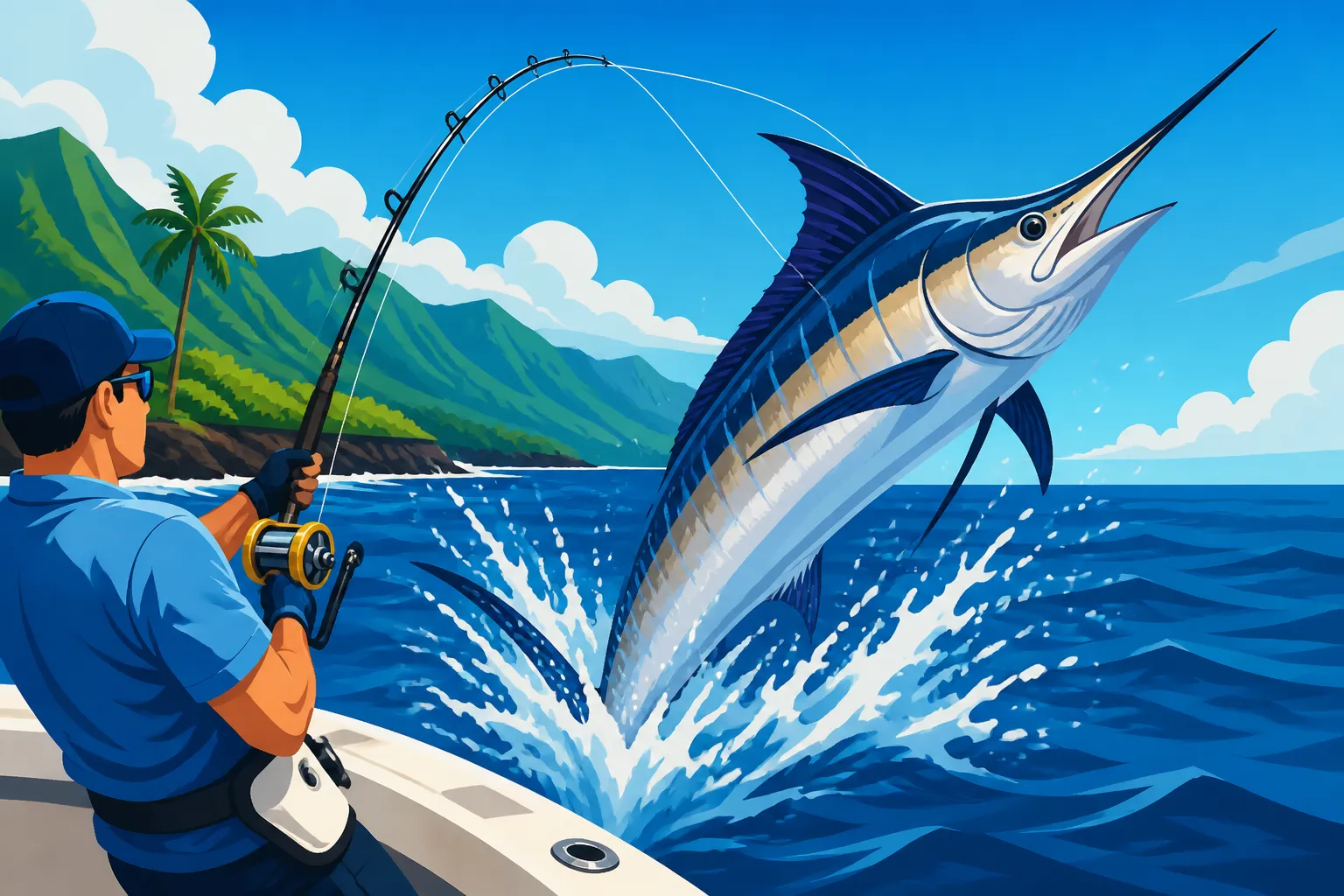
The moment a marlin strikes is electrifying. The line screams off the reel, the rod bends double, and adrenaline surges. But the real work begins now. Fighting and landing a powerful Hawaiian marlin is a test of strength, skill, and teamwork.
Initial Hookup and Stand-Up Fighting
When a marlin strikes, the first thing you'll hear is the furious whine of the reel as line peels off at an incredible speed. The initial run is often blistering, with the fish trying to escape. Your immediate action, if stand-up fighting, is to get the rod into your harness and brace yourself. The captain will typically speed up the boat briefly to ensure a solid hook set, then back down or turn to keep the fish off the stern and give the angler the best fighting angle.
During the initial run, it's crucial to maintain pressure without trying to stop the fish cold. Let the drag do its job. When the fish slows or jumps, crank down quickly to recover line. Marlin are notorious for their spectacular jumps and tail-walking displays, which are both incredible to witness and dangerous for the line. The crew will be watching closely for any slack line, which can lead to pulled hooks or tangles. The angler's job is to keep constant pressure, using the boat's momentum and the rod's leverage to wear the fish down.
Chair Fighting and Boat Maneuvers
For larger marlin, especially those targeted on 130-pound tackle, a fighting chair is often used. This allows the angler to leverage the power of their legs and core against the fish, reducing fatigue in the arms and back. The angler sits in the chair, rod butt in the gimbal, and uses the chair's pivot to follow the fish. It's a highly efficient way to fight big fish for extended periods.
The boat's captain plays an equally critical role. During a fight, the captain's primary goal is to maneuver the boat to keep the fish off the stern, prevent it from wrapping the line around the propellers, and maintain an advantageous angle for the angler. This often involves backing down on the fish, circling, or running parallel to it. The captain and angler must work in perfect sync, communicating constantly. If the fish sounds (dives deep), the captain will try to keep the boat directly over it, allowing the angler to slowly pump it up from the depths. A coordinated team effort is the hallmark of successfully landing a big marlin.
Safety Protocols During the Fight
Safety is paramount during a marlin fight. These are powerful, unpredictable animals, and the boat is a dynamic environment. Always wear your safety harness and ensure it's properly fitted. Keep clear of the fighting chair and lines, as a spooling line can cause severe injury. The deck can get wet and slippery, so good deck shoes are a must.
When the fish is close to the boat, especially if it's a large blue marlin, the bill can be a serious weapon. The wireman or gaff man, who handles the leader, is at the most critical and dangerous position. They wear gloves and often a safety belt, understanding the immense power of a fish at boatside. Follow all crew instructions precisely and stay clear of the transom area when the fish is being brought alongside. Accidents can happen quickly, so vigilance and adherence to safety protocols are non-negotiable.
Post-Catch Care and Release Practices
Marlin are magnificent creatures, and responsible angling practices ensure their conservation for future generations. Whether you plan to release your catch or harvest a trophy, handling the fish with care is essential. Hawaii has specific regulations regarding certain pelagic species, so understanding them is important. For instance, knowing the Hawaii Pelagic Species Bag Limits is crucial.
Responsible Catch and Release for Marlin
The majority of marlin caught off Kona, particularly blue marlin, are released. Catch and release is a crucial conservation practice that helps maintain healthy fish populations. To maximize a marlin's survival chances post-release, minimize the fight time as much as possible, as extended fights can exhaust the fish beyond recovery. Use appropriate heavy tackle to shorten the battle.
When the fish is boatside, avoid bringing it completely out of the water if you intend to release it. Keep it in the water alongside the boat, holding it gently by the bill if necessary, while the hook is removed or the leader is cut as close to the hook as possible. If using circle hooks, they often hook in the jaw, making removal easier. Avoid handling the fish by its gills or eyes, and avoid dragging it over the gunwale. Get photos quickly and release the fish gently, pointing its head towards the open ocean and sometimes even reviving it by gently moving it forward until it swims off strongly.
Photo Tips and Quick Measurements
Everyone wants a photo with their impressive catch, but remember to prioritize the fish's health during this process. For released fish, try to get photos with the fish still in the water, or if absolutely necessary, lift it for a quick shot, ensuring it's supported horizontally and returned to the water within seconds. This minimizes stress and injury.
If you plan to harvest a fish, or if it's a potential record, quick and accurate measurements are necessary before it's brought fully onboard. Measure length from the tip of the lower jaw to the fork of the tail. For a trophy fish that might be mounted, ensure you get good photos from various angles and precise measurements. Many anglers opt for a replica mount made from photos and measurements, which is far more conservation-friendly than taking the actual fish. You might find our discussion on Marlin Growth Rate to Grander Size interesting in the context of trophy fish.
Handling Trophy Fish for Mounts or Harvest
While most marlin are released, harvesting a grander or a fish for food is certainly an option, especially if it's an important catch for the angler or if the fish is not expected to survive. If you decide to harvest, ensure you are aware of all current Hawaii Bag and Size Limits by Species.
For fish destined for the dinner table, the crew will typically bleed the fish immediately to ensure the best meat quality. It will then be stored in an ice-filled fish box. Marlin meat, especially from smaller blue marlin, is excellent, often resembling swordfish. For a trophy mount, if you're taking the actual fish, the crew will carefully bring it aboard, being mindful not to damage the bill or fins. They will then protect it until it can be transported to a taxidermist. However, with the advancements in replica mounts, many anglers choose this option, allowing them to commemorate their catch without taking the life of a magnificent creature.
Conclusion
The pursuit of marlin off the Kona Coast is an extraordinary adventure, a blend of skill, patience, and the raw power of nature. From understanding the unique dynamics of Kona's deep-water fishery to mastering the art of trolling and live baiting, and finally, to the adrenaline-fueled battle and responsible release, every aspect contributes to an unforgettable experience. While the ocean can be unpredictable, arming yourself with knowledge, choosing experienced captains, and respecting these magnificent creatures will undoubtedly increase your chances of connecting with the fish of a lifetime. So, gear up, keep your eyes on the horizon, and prepare to write your own chapter in the legendary waters of Kona.
Disclaimer
The information provided in this guide is for general informational purposes only and does not constitute professional advice. Fishing regulations, seasons, and conditions in Hawaii can change frequently. Always consult the latest rules and guidelines from the Hawaii Department of Land and Natural Resources (DLNR) Division of Aquatic Resources before engaging in any fishing activities. Adherence to all local, state, and federal laws is the responsibility of the angler. Fishing carries inherent risks, and safety precautions should always be taken.