Best charters near Kewalo Basin
You land in Honolulu, search for a fishing trip, and suddenly every listing claims to be the best boat at Kewalo Basin. The photos all show the same grinning angler holding the same mahimahi, and you have one morning to get it right. This guide shows you how the Kewalo Basin charter scene actually works, which trip types fit which anglers, and how to pick a boat with confidence.
Why Kewalo Basin Is Honolulu’s Charter Hub
If you have spent any time around Ala Moana Boulevard, you have probably driven right past Kewalo Basin without realizing it. It is a compact harbor tucked between Ala Moana Beach Park and Honolulu Harbor, sitting on the edge of the Kakaako neighborhood and a short ride from Waikiki. For decades it has been home to a working fleet of sportfishing boats, along with snorkel boats, dinner cruises and the occasional research vessel. When people talk about fishing charters “out of Honolulu,” a large share of them mean this basin.
What makes Kewalo special is not glamour. The docks are functional, the parking is tight on busy mornings, and you will see crews hosing down decks and hauling ice long before most visitors are awake. What makes it special is location. The south shore of Oahu drops into deep blue water remarkably fast, which means a boat leaving Kewalo can be trolling in water deep enough to hold pelagic fish within a short run of the harbor mouth. That matters enormously when you are paying by the hour and when you or someone in your group is not sure how their stomach will handle the open ocean.
The Short Run to Deep Water
On many mainland coastlines, you burn the first part of a half-day trip just getting to productive water. Off Honolulu, the shelf is narrow and the bottom falls away quickly. Captains leaving Kewalo commonly set lines soon after clearing the channel and start working ledges, current lines and bird piles along the south shore, toward Diamond Head on one side and toward the Barbers Point side on the other.
For a first timer, this is a genuine advantage. Instead of spending an hour bouncing in a cabin, you spend most of the trip watching the spread, listening for a reel to scream, and learning what the crew is looking for on the surface. For families with kids, the short run means less time for boredom or nausea to set in before the action starts.
What Swims Off the South Shore
The fish you can realistically target from Kewalo are the same open ocean species that make Hawaii famous. Here is the general picture, keeping in mind that ocean conditions shift from year to year and no captain can promise a specific catch.
| Species | Local name | Typical method from Kewalo | When it tends to show up |
|---|---|---|---|
| Blue marlin | Kajiki | Trolling lures or rigged bait | Present year round, with stronger summer activity |
| Yellowfin tuna | Ahi | Trolling, sometimes chunking or drifting near buoys | Larger fish more common in summer; smaller fish at other times |
| Skipjack tuna | Aku | Trolling small lures | Often strongest in warmer months |
| Mahimahi | Mahimahi | Trolling, casting around floating debris | Spring and fall runs are popular, but they can appear any time |
| Wahoo | Ono | Trolling, often at higher speeds | Frequently mentioned as a late summer and fall target |
| Deep water snappers | Opakapaka, onaga, ehu and others | Bottomfishing with heavy weights and electric reels | Subject to federal and state rules, check before booking |
If you want a wider picture before choosing a trip, Oahu Fishing Guide covers how the south shore grounds fit into the island as a whole.
How Kewalo Compares With Other Oahu Departure Points
Kewalo is not the only place to catch a charter on Oahu. Some boats run from other harbors on the south and west sides, and a few operators pick up near Waikiki itself. Each option trades convenience, travel time and fishing grounds a little differently.
| Departure area | Main advantage | Main trade off | Best fit |
|---|---|---|---|
| Kewalo Basin | Largest concentration of sportfishing boats close to Waikiki and Ala Moana | Busy mornings and limited parking | Visitors staying in town who want choice and a short run to deep water |
| Waikiki pickups | Walking distance for many hotel guests | Fewer dedicated fishing boats, often smaller vessels | Casual anglers who value convenience over options |
| Leeward and west side harbors | Calmer water on many trade wind days and access to different grounds | Long drive from Waikiki in traffic | Anglers with a car and an early start who prioritize comfort |
| North Shore | Different scenery and seasonal fishing | Winter surf can limit trips; far from town | Anglers already staying on that side of the island |
If you are staying in Waikiki and do not want to rent a car, see Best charters departing from Waikiki for how those trips differ. For a broader look at every Honolulu option in one place, read Best Charters Out of Honolulu.
Types of Charters You Will Find at Kewalo Basin
When people search for the best charter near Kewalo Basin, they usually picture one perfect boat. In reality, “best” depends far more on matching the trip type to your group than on any single operator. A crew that is perfect for a solo angler chasing a big blue marlin can be a frustrating choice for a family of five with a seven year old. Let’s break down the main formats.
Shared Sportfishing Trips
A shared trip, sometimes called a split charter or open boat, means you buy individual seats and fish alongside strangers. The boat runs whether your group is two people or one, as long as the operator fills enough seats to make the trip worthwhile. Rods are usually rotated so each person gets a turn when a fish strikes, and the crew explains the rotation at the dock.
Shared trips appeal to solo travelers, couples and anyone who wants to experience offshore fishing without paying for an entire boat. The trade off is control. You will not choose how long to stay on a spot, whether to chase a bird pile, or when to head in. If a big fish hits during someone else’s turn, you watch. Some anglers love the social energy of a shared deck, and others feel like passengers on someone else’s trip.
Picture a couple on their honeymoon who mostly want a fun morning on the water and a photo with a fish. A shared half-day trip from Kewalo is often a sensible fit for them. Now picture a retired angler who has dreamed of a blue marlin for twenty years. For him, a shared seat may feel like rationing a once in a lifetime chance. For more on how these trips are structured, see Best Shared Fishing Charters in Hawaii.
Private and Exclusive Charters
A private charter means your group books the entire boat. You decide whether to target marlin all day, switch to tuna, or spend the last hour trying to put fish in the cooler for dinner. Most private charters on uninspected vessels are limited to six paying passengers, which is the familiar “six pack” limit tied to the captain’s Coast Guard license. Larger inspected vessels can take more people, but they are less common in the sportfishing fleet.
The biggest benefit of a private trip is flexibility. If someone gets queasy, you can ask the captain to slow down or head toward calmer water. If the kids lose interest, you can turn the trip into a cruise along Diamond Head for a while. You also control the rod rotation, so a determined angler can take every strike if the group agrees.
The cost structure is different too. You pay a flat rate for the boat and split it however you like. For four to six people, the per person cost of a private trip can get surprisingly close to individual shared seats, which is why groups often find private charters better value than they expected. When you compare private listings on a platform like FishingBooker, check that the passenger limit, trip length and catch policy are spelled out, since those details shape the real value far more than the headline price.
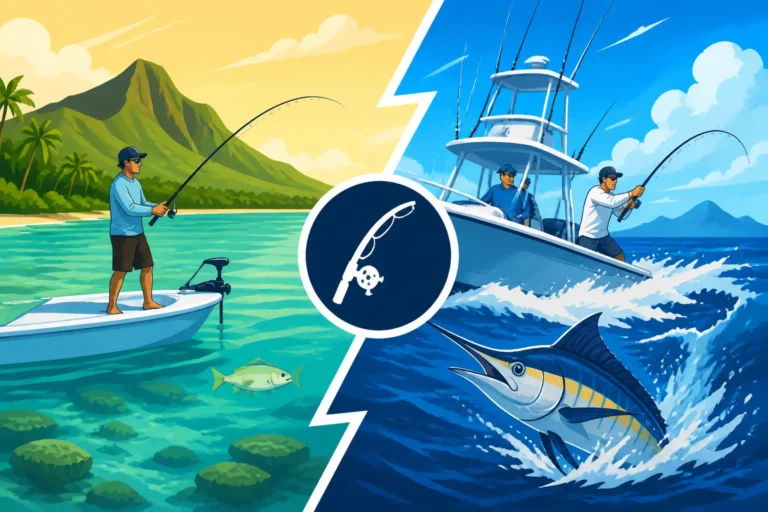
Bottomfishing and Light Tackle Trips
Not every Kewalo trip is about trolling for pelagics. Some operators offer bottomfishing, where you drop heavy weighted rigs into deep water to target snappers and other reef and ledge species. Bottomfishing for the prized deep water snappers locally called the Deep 7 is regulated, and the rules can include seasonal closures and catch limits that change, so a reputable crew will tell you exactly what is open on your trip date.
Light tackle trips are another niche. Instead of heavy trolling gear, you use spinning or casting rods for smaller tuna, mahimahi, papio or reef fish. They tend to be more hands on, which suits anglers who want to cast, feel every fish and learn technique rather than wait in a chair. If bottomfishing is your main interest, ask each operator which species are open, what gear they use and whether guests keep any of the catch.
Comparing Trip Formats at a Glance
| Trip format | Who it suits | Typical length | Control over the day | Notes |
|---|---|---|---|---|
| Shared half-day | Solo travelers, couples, first timers | Around four hours | Low | Rod rotation with strangers; good introduction |
| Shared full-day | Committed solo anglers | Around eight hours | Low | More water covered, but long day with strangers |
| Private half-day | Families and small groups | Around four hours | High | Popular with kids and nervous stomachs |
| Private three-quarter or full-day | Serious anglers and marlin hunters | Six to eight hours or more | High | Best chance at big pelagics; plan for a long day |
| Bottomfishing | Anglers who want to keep fish to eat | Varies by operator | Medium to high | Check current Deep 7 rules before booking |
| Light tackle | Hands on anglers who want to cast and fight fish | Varies | High | Fewer giant fish, more action and technique |
How to Choose the Right Kewalo Basin Charter
This is where most visitors get stuck. Booking platforms, hotel concierges and dock walkers all promote different boats, and every listing uses the same words: experienced captain, well maintained vessel, great reviews. Here is a practical process to cut through it. For an island wide version of this checklist, How to Choose a Hawaii Fishing Charter goes into even more detail.
A Step by Step Vetting Process
- Decide your goal before you browse. Write down whether you want a shot at a marlin, a relaxed family outing, fish for dinner, or simply a few hours on the ocean. This single decision rules out half the listings.
- Pick the format. Use the table above to choose between shared and private, and between half-day and longer trips. Be honest about how long your group can comfortably stay on a rocking boat.
- Build a short list of three to five boats. Booking platforms such as FishingBooker are useful here because they let you filter by departure point, trip length and group size, and they show reviews from past guests side by side.
- Read reviews for patterns, not stars. Look for repeated comments about the crew’s patience, safety briefings, cleanliness and how they handled slow days. One angry review is noise; five reviews mentioning a rude deckhand is a signal.
- Ask direct questions before paying. Who is the captain on your date, what is the passenger limit, what is included, who keeps the catch, and what happens if weather cancels the trip.
- Verify licensing. Ask for the captain’s Coast Guard credential and confirm the operation holds the state commercial marine license that Hawaii requires of charter operators. How to verify a Hawaii charter captain’s license walks through how to check.
- Confirm logistics in writing. Get the slip number or meeting point, check-in time, parking guidance and the cancellation policy in an email or booking confirmation.
- Prepare your group. Share what to bring, discuss seasickness prevention and set expectations about the possibility of a slow day.
Questions to Ask Every Operator
A good crew will answer these quickly and without irritation. Hesitation or vague replies are worth noting.
| Question | Why it matters | What a solid answer sounds like |
|---|---|---|
| Who keeps the fish? | In Hawaii, it is common for the boat to keep some or all of the catch | A clear policy, such as how much the guests take home and what happens to large fish |
| Is the trip shared or private? | Some listings are vague about whether you will be with strangers | A direct yes or no, plus the maximum number of guests |
| What is the weather cancellation policy? | Trade winds and south swells can cancel trips | A specific explanation of refunds, reschedules and who makes the call |
| Is there a restroom on board? | Matters a lot for kids and longer trips | A simple yes or no, with honest details about the head |
| Is tackle, bait and ice included? | Prevents surprise charges | A list of what is included and what costs extra |
| Can we bring food and drinks? | Policies vary widely | Clear guidance on coolers, alcohol and glass |
| Is the captain on the listing the one running our trip? | Larger operations rotate crews | Honest answer and the name of the actual captain |
The catch policy question surprises many visitors. On the mainland, people often assume every fish goes home with the paying customer. In Hawaii, crews commonly keep at least part of the catch, especially big tuna and marlin, because selling fish helps cover fuel and wages. Neither approach is wrong, but you deserve to know which one applies before you leave the dock. Asking politely is completely normal.
Using Booking Platforms Wisely
Booking platforms make comparison easier, especially when you are planning from home. FishingBooker, for example, shows departure locations, trip lengths, what is included and reviews in a standard layout, which makes it simpler to compare a Kewalo boat with one leaving from elsewhere on the island. The prices you see there change with season and demand, so treat listed figures as a starting point and confirm the total on the provider’s own page or booking confirmation.
A few habits help you get the most from any platform:
- Read the full listing text, not just the headline. Important details such as “shared trip” or “catch belongs to the boat” are often in the description.
- Check the date on reviews. A boat that was excellent several seasons ago may have changed captains.
- Message the operator through the platform before booking. Response speed and tone tell you a lot about how the day will go.
- Compare the same trip length and format. A four hour private trip and a six hour shared trip are not comparable, even if the price looks similar.
If you prefer booking directly, many operators at Kewalo also take reservations by phone or through their own sites. Direct booking can give you more room to ask questions, while platforms can make comparison and reviews easier. Either route can work well when you do your homework. Pricing generally moves with trip length, shared versus private format, season and how far the boat runs, so compare like with like.
Red Flags Worth Walking Away From
Most Kewalo crews are hardworking professionals, but it pays to know the warning signs. Walk away, or at least slow down, if you notice any of these:
- The operator cannot or will not tell you the captain’s name or show proof of licensing.
- The listing promises guaranteed fish or guaranteed marlin.
- There is no clear written cancellation policy.
- The boat looks poorly maintained in recent photos or reviews mention breakdowns.
- You are pressured to pay in full immediately in cash with no receipt.
- Reviews repeatedly mention unsafe behavior, such as no safety briefing or a crew that ignored weather.
The full list lives in Red flags to watch for when booking a Hawaii charter, which is worth a quick read before you hand over a deposit.
Planning Your Day on the Water From Kewalo
Once you have booked, a little preparation turns a decent morning into a great one. Kewalo trips tend to start early, and the ocean off the south shore can feel different from the calm water you see from your hotel window.
Timing, Seasons and Weather
Charters from Kewalo run year round, but conditions vary. Trade winds blow from the northeast much of the year, and on the south shore they often create a manageable chop rather than big seas. Summer brings south swells, which can make the ride out of the channel lively, while occasional Kona wind events from the south or southwest can flip conditions entirely. Your captain watches all of this closely.
Morning trips are the most popular because winds are often lighter early in the day and many pelagic species feed actively at first light. Afternoon trips can be productive too, and they suit travelers who do not want a predawn alarm. If your schedule is flexible, booking early in your vacation gives you room to reschedule if weather cancels the first attempt. For details on what normally happens when the ocean does not cooperate, read What happens if weather cancels a Hawaii charter.
| Season | Ocean conditions off the south shore | Fishing notes | Planning tip |
|---|---|---|---|
| Winter | Usually moderate on the south side; North Shore surf does not affect Kewalo much | Bottomfishing interest rises; some pelagics around | Watch for occasional Kona wind events |
| Spring | Trade winds often steady | Mahimahi runs are a common highlight | Book a few days ahead for weekends |
| Summer | South swells can make the harbor entrance bumpy | Marlin and larger ahi draw serious anglers | Book well ahead in peak travel weeks |
| Fall | Mixed, often pleasant | Ono and mahimahi are popular targets | A strong time for flexible visitors |
Getting to the Harbor and Checking In
Kewalo Basin sits right off Ala Moana Boulevard, so it is easy to reach by rideshare, taxi or a short drive from Waikiki. Parking near the harbor is limited and usually paid, and early morning departures overlap with surfers and harbor workers looking for the same spaces. Leave extra time, especially on weekends.
Here is a simple morning routine that keeps things calm:
- Confirm the slip number or meeting point the night before.
- Eat a light, low grease breakfast and drink water.
- Take any seasickness medication at the time recommended on the label, which is often well before departure.
- Arrive at least fifteen to twenty minutes before the stated check-in time.
- Find the captain or deckhand, introduce your group and mention anyone who is nervous about seasickness.
- Listen to the safety briefing carefully, including where life jackets are stored.
- Ask the crew how the rod rotation will work and what they want you to do when a fish strikes.
If you arrive early and want to fish while you wait for a later trip, or if a non fishing member of the group wants something to do, Best pier fishing spots at Kewalo Basin covers the shoreline options right around the harbor.
What to Bring and What to Leave Behind
Most charters at Kewalo provide rods, reels, lures, bait and ice. You bring personal comfort items. Space on a sportfishing boat is limited, so pack light.
| Bring | Leave at the hotel |
|---|---|
| Reef safe sunscreen and a hat with a strap | Hard sided luggage or large bags |
| Polarized sunglasses | Black soled shoes that mark decks |
| Light long sleeve sun shirt and a thin windbreaker | Glass bottles |
| Soft cooler with water and simple snacks | Heavy meals or greasy food |
| Seasickness remedy taken in advance | Valuables you do not need |
| Cash for a crew tip | Bananas, if your captain is superstitious, and some are |
| A zip bag or dry bag for your phone | Expectations of a guaranteed catch |
On tipping, a gratuity for the crew is customary in Hawaii, and many people use a percentage of the trip cost as a guide, adjusted for service. The deckhand often works the hardest on the boat, rigging baits, clearing lines and cleaning fish. For more detail on how much and to whom, see Tipping Etiquette for Hawaii Fishing Charters.
Seasickness, Safety and Licenses
Seasickness is the single biggest reason a charter goes sideways, and the south shore can surprise people who assumed Honolulu water would be flat. The good news is that preparation helps a lot. Get a full night’s sleep, avoid heavy drinking the night before, eat lightly, stay on deck in fresh air and keep your eyes on the horizon. If you start feeling off, tell the crew early. They have seen it all and would rather help you get comfortable than watch you suffer quietly. Seasickness tips for a Hawaii fishing charter has a fuller list of remedies people swear by.
On safety, legitimate operators carry required gear such as life jackets, fire extinguishers and communication equipment, and the captain gives a briefing before departure. If you are traveling with children, ask about properly sized life jackets ahead of time rather than assuming the boat has every size.
Licensing questions come up often too. Many visitors wonder whether they need their own fishing license to join a charter. Rules for marine fishing in Hawaii have been changing, and requirements can differ for residents and nonresidents, so check the official rules and ask your operator before your trip. The full explanation lives in Do You Need Your Own Fishing License for a Hawaii Charter?.
What a Good Day Actually Looks Like
It helps to picture a realistic trip. Imagine a private half-day charter leaving Kewalo at dawn with a family of four. The boat clears the channel, the crew sets a spread of trolling lures and the captain heads along the south shore toward Diamond Head. For the first hour, nothing happens except flying fish skipping off the bow and a few birds working far away. The kids are restless.
Then the captain spots birds diving and swings toward them. A reel starts screaming, the deckhand clears the other lines and the ten year old gets buckled into the fighting belt. Fifteen minutes later a bright green and gold mahimahi slides onto the deck, and the whole boat is cheering. Maybe that is the only fish of the day. Maybe two more follow. Either way, the family goes home with photos, a story and a better understanding of how offshore fishing works.
Now imagine the same family on a slow day with no strikes at all. A good crew still makes the trip worthwhile by explaining what they are looking for, pointing out turtles or spinner dolphins, and answering endless questions from the kids. That is often the real difference between an average charter and a great one: how the crew handles the hours when the fish do not cooperate.
Frequently Asked Questions About Kewalo Basin Charters
Is Kewalo Basin a good place for a first fishing charter?
Yes, for most visitors staying in Honolulu or Waikiki it is one of the most convenient places to start. The short run to deep water means more fishing time and less travel, and the variety of operators makes it easier to find a trip format that fits your group.
Should I book a shared or private trip?
Shared trips usually suit solo travelers and couples who want an affordable introduction. Private trips suit families, groups of four to six and serious anglers who want control over the day. Compare the per person cost carefully, because a private boat split among several people can be closer in value than it first appears.
How far in advance should I book?
For weekends, holidays and summer, booking a few weeks ahead is sensible. On quieter weekdays, last minute openings do happen, especially for shared trips. Booking early in your vacation also leaves time to reschedule if weather intervenes.
Will I get to keep my fish?
It depends on the operator. Many Hawaii charters keep some or all of the catch as part of their business, while others share fillets with guests. Ask before you book so there are no surprises at the dock.
Can I catch a marlin on a half-day trip?
It is possible, and marlin are caught off Oahu’s south shore, but a half-day trip gives you limited time on the water. Anglers whose main goal is a marlin often choose longer private trips to improve their odds.
What if I get seasick?
Prepare in advance with medication, rest and a light breakfast, and tell the crew early if you start feeling unwell. On a private trip, the captain may be able to adjust speed or direction to make the ride more comfortable.
Disclaimer
This article is for general informational purposes only and does not constitute professional advice. Laws, prices and regulations vary by location and change over time. Consult a qualified professional for guidance on your specific situation.