Best technique for winter bottomfishing
Winter bottomfishing in Hawaii can be a truly rewarding experience, but let's be real, the conditions can be dramatically different from the calm, summer days most people imagine. The stronger swells, cooler temperatures, and changing currents often leave anglers frustrated, struggling to feel bites or even stay on their spots. This guide is all about giving you the battle-tested techniques and insights needed to consistently put fish in the boat, even when the winter ocean tries its best to challenge you.
Understanding Winter Conditions in Hawaii for Bottomfishing
When winter rolls around in Hawaii, it's not like the drastic seasonal shifts you see on the mainland. We don't get snow, obviously, but the ocean definitely changes its tune. These subtle yet significant shifts profoundly affect our deep-dwelling bottomfish species. Ignoring these changes is a surefire way to come back with an empty cooler.
Ocean Swells and Currents
One of the most noticeable differences in winter is the increase in ocean swells, particularly on north and west-facing shores, which can wrap around the islands. While these big swells are famous for surfing, they also generate stronger currents and make maintaining boat position over those precise bottomfishing spots much more challenging. You might find yourself drifting much faster, or battling turbulent waters that make it hard to keep your lines vertical. This isn't just an annoyance; it directly impacts your ability to present bait naturally and feel subtle bites from species like opakapaka or onaga. The increased surge on the bottom can also make fish more wary, or push them deeper into structure for shelter.
These stronger currents also mean you'll need to adjust your weighting. What worked in summer might be completely inadequate in winter, leading to your line dragging away from the target zone. Anglers often find themselves having to double their lead weights just to get down and stay put. It's a constant battle against the elements, and understanding how these currents behave on specific reefs or ledges is key to success. Sometimes, you'll need to look for protected leeward areas or fish specific tide windows where the currents might momentarily slacken, giving you a precious window of opportunity.
Water Temperature Shifts
While Hawaii's waters rarely get "cold," there are definite temperature shifts from summer to winter that affect bottomfish. Even a few degrees can influence where fish choose to congregate and how actively they feed. Colder surface waters can mean a stronger thermocline, or it might just push certain baitfish, and consequently the predators that feed on them, to slightly different depths. You might find that the What water temperature bottomfish prefer could shift slightly deeper in winter to find their comfort zone.
These temperature variations aren't always uniform; certain areas might cool faster or stay warmer due to oceanographic features or currents. This means that a spot that was hot in summer might be dead in winter, not because the fish left entirely, but because they've adjusted their depth or feeding patterns. Successful winter bottomfishing often involves a bit of exploratory fishing to find where the fish are holding in relation to these subtle thermal gradients. Keep an eye on your boat's temperature gauge and try to correlate it with where you're finding bites.
Seasonal Species Behavior
Just like terrestrial animals, fish species adapt their behavior to seasonal changes, and our beloved bottomfish are no exception. Some species might move to different depths or areas to spawn, while others might become less active feeders due to cooler water. For example, some of the deeper dwelling snappers and groupers might become more concentrated in specific structures where they find more stable temperatures or better food sources during the winter months. Understanding Opakapaka Pink Snapper Habits and Onaga Ruby Snapper Habits during this time is crucial, as their typical summer haunts might be less productive.
The availability of certain baitfish can also change with the seasons, directly impacting the bottomfish that prey on them. If their primary food source moves or becomes scarcer, the bottomfish will either follow or switch to a different diet. This requires anglers to be flexible with their bait choices and presentation. Sometimes, a species might become more receptive to artificial jigs if live bait is harder to come by. It's about adapting your strategy to what the fish are doing, rather than stubbornly sticking to what worked last season.
Essential Gear and Rigging for Winter Bottomfishing
Winter bottomfishing demands a bit more from your tackle than the leisurely summer days. You're often dealing with more adverse conditions – stronger currents, deeper drops, and potentially bigger, more stubborn fish hunkering down in structure. Having the right tools isn't just about comfort; it's about efficiency and effectiveness.
Rod and Reel Selection
For winter bottomfishing, you're generally going to want a more robust setup than what you might use for lighter inshore work. Think conventional reels, often lever drags, capable of holding a significant amount of heavy braided line. Reels like a Penn Fathom or a Daiwa Saltiga are popular choices among seasoned Hawaiian bottomfishermen. You need something with a powerful drag system to stop a big ulua or a large snapper from burying you in the reef. For rods, a sturdy conventional rod in the 6' to 7' range with a heavy to extra-heavy action is ideal. Graphite composite rods offer a good balance of sensitivity for detecting subtle bites and backbone for muscling fish away from the bottom.
If you're targeting slightly shallower bottomfish, or prefer the versatility, a heavy-duty spinning setup can also work, but ensure the reel has ample line capacity and a smooth, strong drag. When fighting fish in deeper water, especially with stronger currents, having a reel with a high retrieve ratio can save your arms by getting line back quickly between drifts or when a fish is coming up. Ultimately, your choice should allow you to confidently deploy heavy weights and retrieve fish from significant depths, often 200 to 600 feet, without feeling undergunned.
Line and Leader Choices
Braided line is almost universally preferred for bottomfishing in Hawaii, especially in winter. Its thin diameter means less water resistance, allowing your heavy sinkers to reach the bottom faster and stay vertical in strong currents. The lack of stretch in braid also provides incredible sensitivity, letting you feel every bump and subtle bite, even hundreds of feet down. For your main line, consider 60 to 100 lb test braid, depending on the depth and target species. Many anglers find great deals on bulk braid spools on Amazon.
For leaders, fluorocarbon is the way to go. Its invisibility underwater is a huge advantage, especially when fishing for wary bottomfish. More importantly, its abrasion resistance is critical when fishing around sharp coral, lava, and rocky structures where these fish live. You'll typically want a leader that's 80 to 150 lb test, considerably heavier than your main line in many cases, especially if you're chasing larger fish or fishing extremely jagged terrain. The length of your leader can vary, but usually 6 to 10 feet is a good starting point, providing enough buffer between your main line and the business end of your rig.
Terminal Tackle and Rigs
The right terminal tackle is paramount for effective winter bottomfishing. You'll need an assortment of lead weights, ranging from 8 ounces to as much as 3 pounds or more, depending on depth and current. Swivel connections are essential to prevent line twist, especially when drifting. Hooks should be strong, sharp, and appropriately sized for your bait and target species. Circle hooks are highly recommended as they reduce gut hooking, which is important for conservation, and they tend to set themselves in the corner of the fish's mouth. Sizes from 8/0 to 12/0 are common.
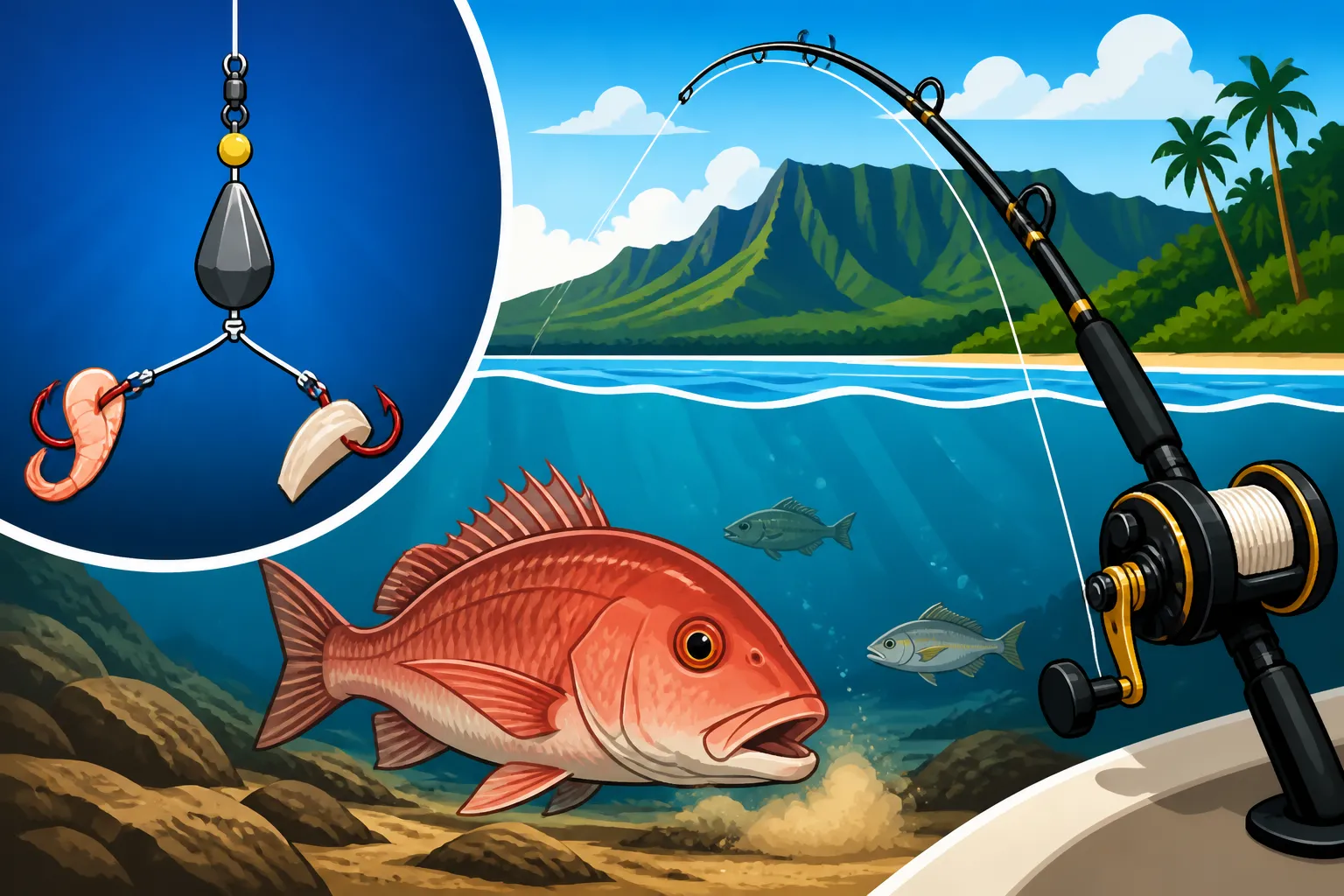
The most common rig for bottomfishing in Hawaii is a basic "dropper loop" or "three-way swivel" rig. A dropper loop rig involves tying loops directly into your leader for your hooks, with a heavier leader or section at the very bottom for your weight. A three-way swivel rig uses a swivel to connect your main line, a leader for your hooks, and a shorter leader for your sinker. This allows the weight to break off if it snags, saving your main rig. For Bottomfishing in Hawaii, many local anglers use what's often called a "local-style" rig, which is a variation designed to be robust and effective in rocky Hawaiian waters. Knowing Best jig weight for bottomfishing in deep water will also factor into your terminal tackle decisions.
Proven Techniques for Success
Getting your bait or lure down to where the fish are and presenting it effectively is an art form, especially when dealing with winter's added challenges. There's no single magic bullet, but a combination of thoughtful techniques will stack the odds in your favor.
Vertical Jigging Strategies
Vertical jigging is an incredibly effective method for winter bottomfishing, particularly when current is strong or fish are holding tight to structure. The key is to select the right jig. Heavy, slender jigs designed for fast descent (often called "knife jigs" or "speed jigs") work well in deep water and strong currents, allowing you to get to the strike zone quickly. Jigs weighing 200g to 400g (7-14 ounces) are common, but you might need even heavier depending on depth and drift speed. You can find a good range of specialized jigs suitable for Hawaiian waters on Amazon.
The technique involves dropping the jig to the bottom, then working it with a series of aggressive lifts and drops, or a more subtle yo-yo motion, depending on how the fish are reacting. Pay close attention to your retrieve; sometimes a fast, erratic retrieve triggers aggressive strikes, while other times a slower, more deliberate action is needed to entice lethargic winter fish. Always be prepared for a bite on the drop! Many anglers also tip their jigs with a small piece of squid or bait to add scent and appeal. Learning Jigging for Bottomfish in Hawaii effectively requires practice, but it's often the most active and rewarding way to catch fish.
Live Baiting Tactics
While jigs are fantastic, live bait can often be the ultimate persuader, especially for larger, more discerning bottomfish. Freshly caught opelu (mackerel scad), akule (bigeye scad), or even small squid are prime choices. The natural action and scent of live bait are hard to beat, particularly when the fish are less active. You'll often need a baitwell on your boat to keep these critters lively.
When live baiting, the presentation is crucial. Use a single, strong circle hook through the nose or back of the bait to allow it to swim naturally. You want just enough weight to get the bait down to the desired depth and keep it there, without impeding its movement too much. Sometimes, a "freelined" bait with minimal weight, allowed to drift naturally in the current, can be deadly if you're on a slow drift or anchored. Other times, a heavier lead needs to be used to quickly get past smaller bait stealers and into the strike zone where the bigger Bottomfish Species of Hawaii are lurking.
Deep Dropping for Pelagic Bottomfish
When we talk about "deep dropping" for bottomfish, we're really getting into specialized territory, targeting species that live in hundreds or even thousands of feet of water. This is where you find true deepwater gems like giant onaga, ehu (red snapper), hapu'upu'u (grouper), and even some of the really big opakapaka. This isn't your average handline fishing; it requires heavy-duty electric reels and specialized gear.
The rigs for deep dropping are often elaborate, featuring multiple hooks on snelled leaders, sometimes with lights or reflective attractors to draw fish in the extreme dark depths. Bait is typically squid, cut fish, or even whole dead opelu. The technique involves carefully monitoring your sonar to find deep ledges, seamounts, or pinnacles where these fish congregate. You drop your heavily weighted rig down, let it hit bottom, and then typically crank up a few feet to avoid snags, waiting for a bite. Because of the immense depth, bites can be subtle, sometimes just a slight tap or a momentary slackening of the line. Patience is key, as is a good understanding of How deep bottomfish species live. These trips are often conducted with experienced captains and specialized equipment that you can rent or charter.
Locating Productive Winter Bottomfishing Grounds
Finding the fish is half the battle, and in winter, it can feel like a much tougher hunt. The fish don't disappear, but they might shift their locations, making your tried-and-true summer spots less productive. You need to become a detective, using technology and local knowledge to pinpoint where the bottomfish are holding.
Reading Sonar and Fish Finders
Your sonar unit is your best friend when it comes to winter bottomfishing. Don't just look for big red blobs; learn to interpret the smaller details. Look for subtle changes in the bottom contour, bait balls (even if small), and "hard returns" that indicate rocky structure where fish might be hiding. Many anglers find that high-frequency CHIRP sonar gives them the best detail for distinguishing fish from structure. When current is strong, a good fish finder helps you stay on the mark. If you see signs of fish, but aren't getting bites, try adjusting your depth by 10-20 feet up or down.
Advanced units, especially those from brands like Garmin or Furuno, offer side-scan and down-scan imaging that can reveal structure away from directly under the boat, helping you identify potential holding areas before you even drift over them. Don't be afraid to adjust your Best sonar settings for finding structure off Kona to match the conditions. Sometimes a wider cone angle will show you more, while other times a narrower beam helps you pinpoint a specific feature. Experimentation is crucial, and logging your successful spots (and the conditions you found them in) will pay dividends in future trips.
Targeting Structure: Reefs, Ledges, and Pinnacles
Bottomfish, by their very nature, are structure-oriented. They live on and around reefs, ledges, and pinnacles for protection, ambush points, and access to food. In winter, with potentially cooler water and stronger currents, they may hunker down even more tightly to these features. Look for areas with significant depth changes – steep drop-offs, underwater canyons, or isolated rock formations on a sandy or muddy bottom. These are natural fish magnets.
When you locate a promising piece of structure on your sonar, the next challenge is to position your boat for an effective drift. This often means motoring up-current or up-wind from the structure and letting your boat drift over it, deploying your baits or jigs so they hit the sweet spot. Mark the structure's coordinates on your GPS and make multiple drifts, adjusting your starting point slightly each time to cover the entire area. Sometimes, a small isolated rock will hold a school of opakapaka that are otherwise hard to find. Remember, fish will often hold on the current-facing side of structure, so understanding the current's direction is critical for proper bait presentation.
Understanding Tides and Currents
The ebb and flow of tides and ocean currents play a massive role in bottomfishing success, and in winter, these forces can be amplified. Stronger currents can make it difficult to get your bait down and hold bottom, but they can also stimulate feeding by dislodging food and concentrating baitfish. The general rule of thumb is that moving water is good for fishing, but too much moving water can make it impossible.
Often, the hour before and after a tide change (slack tide) can be excellent for bottomfishing. The currents might ease up just enough for your bait to present naturally, giving bottomfish a chance to move out from cover and feed. Conversely, if the currents are roaring, you might need to seek out more sheltered areas or target species that prefer strong flow. Pay attention to How barometric pressure affects Hawaii bottomfishing too, as major shifts can influence fish behavior. Observing the surface chop, how your boat is drifting, and even the angle of your line will give you clues about the underlying currents. Adjust your weight, your drift, and even your fishing spot based on these vital environmental cues.
| Species | Typical Winter Depth Range (feet) | Preferred Habitat | Common Baits | Rig Type |
|---|---|---|---|---|
| Opakapaka | 200 – 600 | Deep rocky ledges, rubble, sand flats | Squid, cut fish (mackerel), opelu | Dropper Loop, Three-Way |
| Onaga | 600 – 1200+ | Deep seamounts, pinnacles, steep drops | Squid, cut fish (aku belly), whole dead opelu | Deep Drop Multi-Hook |
| Ehu | 400 – 900 | Deep rocky bottoms, slopes | Squid, cut fish | Dropper Loop, Deep Drop |
| Hapuu | 300 – 800 | Deep rocky caves, ledges, wrecks | Live or dead opelu, cut fish, large jigs | Heavy Dropper, Jigging |
| Kalekale | 250 – 700 | Sand and rubble bottoms near structure | Squid, cut fish | Dropper Loop |
Disclaimer
Fishing conditions and regulations in Hawaii can change. Always check the latest Hawaii Division of Aquatic Resources (DAR) rules and advisories before heading out. This guide provides general information and best practices, but local knowledge and current conditions should always take precedence.