How to catch uhu around reef structure
There's nothing quite like the vibrant flash of an uhu, or parrotfish, darting through Hawaii's crystal-clear reef structures. These beautiful fish are a culinary delight and a challenging catch, but if you've ever spent hours staring at the water, hoping to hook one, you know how elusive they can be. It’s a common frustration: you see them, you know they’re there, but getting them to bite is another story. This guide is here to unravel the mysteries of catching uhu around Hawaii's intricate reefs, offering practical advice and techniques to improve your success.
Understanding Uhu Behavior and Reef Habitat
To consistently catch uhu, you first need to understand them. These aren't your typical aggressive predators. Uhu are primarily herbivorous, using their distinctive parrot-like beaks to scrape algae and polyps off rocks and coral. This feeding behavior is key to understanding where they live and what bait might tempt them. Their lives are intimately tied to the reef, which offers both a food source and protection.
Uhu are part of a diverse group of fish, and you'll find various species in Hawaiian waters, each with slightly different preferences. If you want to dive deeper into identifying these beautiful fish, check out our guide on Uhu Species Identification Guide. Regardless of the specific type, they all share a strong affinity for complex reef environments. Think about areas with lots of nooks, crannies, ledges, and caves – these are their homes, their feeding grounds, and their hiding spots from larger predators.
The Uhu's Connection to Reef Structure
Reef structure isn't just a place for uhu to hang out; it's their entire world. They rely on healthy coral and rock formations for everything from food to shelter. This means you’ll find them in areas where the reef is thriving, often in relatively shallow waters, ranging from just a few feet deep to about 60 feet. They are particularly fond of areas with a mix of live coral, algal growth, and rocky crevices.
When you're out on the water, whether you're peering into the depths from shore or snorkeling, look for these specific features:
- Coral Heads and Patches: These are primary feeding grounds. Uhu will continuously graze on the algae growing on these structures.
- Ledges and Drop-offs: These provide cover from above and create currents that can bring food or shelter. Uhu often sit just under ledges.
- Caves and Overhangs: These are their safe havens. If an uhu feels threatened, it will quickly dart into a hole or under a rock. This is why fighting them can be so challenging – they bolt for cover the moment they're hooked.
- Channels and Gaps within the Reef: These act as pathways, and uhu will often move through them, especially during tidal changes.
Understanding these preferences will help you pinpoint the most productive fishing grounds. It's not just about finding any reef, but finding the right kind of reef.
Feeding Habits and Activity Periods
As herbivores, uhu aren't interested in a flashy lure meant for a pelagic predator. Their diet consists mainly of marine algae and small invertebrates found on the reef. This is a crucial distinction when choosing your bait or lure. They feed throughout the day, but often become more active during periods of strong tidal movement, which can stir up food sources.
Observing uhu behavior can tell you a lot. If you see them actively scraping rocks, their heads down, tails up, that’s a good sign they’re in a feeding mood. They can be quite skittish, though. A sudden shadow or loud noise can send them bolting for cover. Patience and a stealthy approach are essential. Remember that like many reef fish, they are more active at dawn and dusk, though you can certainly catch them mid-day if the conditions are right and you're in a productive spot.
Essential Gear for Targeting Uhu
Catching uhu around reef structure means you'll need gear that's tough enough to handle potential snags, yet sensitive enough to detect their subtle bites. It's a delicate balance, and often, anglers have to be prepared to lose a bit of tackle when fishing in these rugged environments.
Rod, Reel, and Line Selection
For shoreline fishing, a medium-light to medium action spinning rod, about 7-9 feet long, is usually ideal. This length gives you good casting distance to reach productive reef sections while still offering enough control. Pair it with a 3000 to 4000 series spinning reel. You want something with a smooth drag, because even though uhu aren't giant fighters, they make powerful, short runs for cover.
When it comes to line, a good all-around choice is 10-15 lb braided line as your main line. Braid offers superior sensitivity, which is great for feeling those light bites, and its thin diameter helps with casting distance. However, braid is highly visible and not very abrasion-resistant against sharp coral. This is where a fluorocarbon leader comes in. A 20-30 lb fluorocarbon leader, about 3-5 feet long, provides invisibility and much better abrasion resistance. Connect it to your braid with a strong knot like an FG knot or an Albright knot. You can find excellent options for both braid and fluorocarbon leader material on sites like Amazon.
| Gear Component | Recommendation | Why it's Important for Uhu |
|---|---|---|
| Rod | Medium-light to Medium, 7-9 feet spinning rod | Casting distance, fight control, sensitivity |
| Reel | 3000-4000 series spinning reel | Smooth drag for short powerful runs |
| Main Line | 10-15 lb Braided Line | Sensitivity, casting distance, less stretch |
| Leader | 20-30 lb Fluorocarbon (3-5 ft) | Abrasion resistance, invisibility to wary fish |
| Hooks | Size 1 to 2/0 circle hooks or J-hooks | Good hook-up ratio, less gut-hooking (circle) |
| Weights | 1/4 to 1 oz egg sinkers or barrel weights | Keep bait down, adjust to current |
| Bait | Limu (seaweed), crab, shrimp, bread | Mimics natural food, strong scent |
| Lures (optional) | Small soft plastics (worm/grub), small metal jigs | Mimics small prey/algae |
Hooks, Weights, and Rigs
For uhu, single hooks are generally preferred over treble hooks to minimize reef snags. Size 1 to 2/0 circle hooks are a fantastic choice. They promote lip-hooking, which is better for the fish if you plan to release it, and they often lead to a solid hook-up without needing a hard set. J-hooks of similar size can also work, but require a more precise hook set.
Weights will depend on the current and depth. Small egg sinkers or barrel weights from 1/4 oz to 1 oz are common. You want just enough weight to get your bait down to the target zone and hold it there, but not so much that it causes excessive snags.
A simple rig for uhu is often the most effective: a slip sinker rig (Carolina rig style) or a basic dropper loop rig.
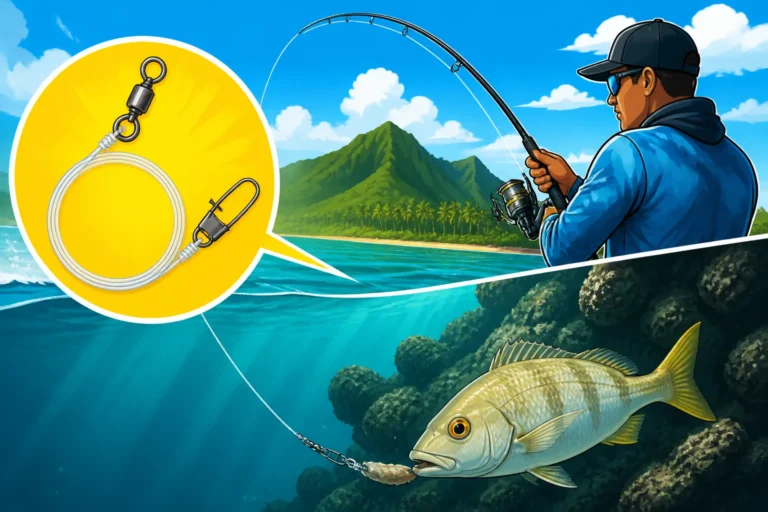
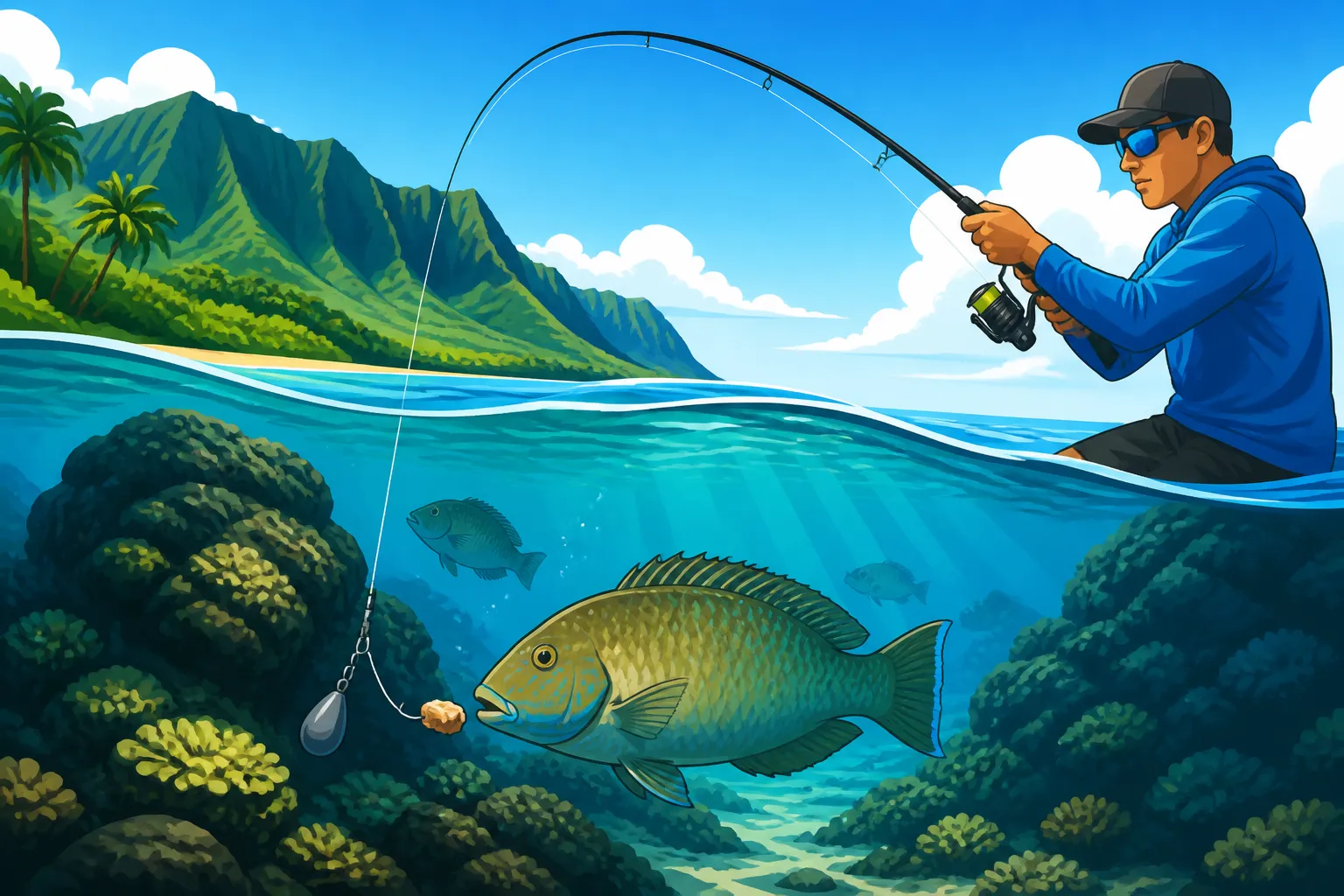
- Slip Sinker Rig: Thread an egg sinker onto your main line (or leader if you prefer), tie on a barrel swivel, then attach a 12-24 inch fluorocarbon leader with your hook at the end. This allows the fish to pick up the bait without feeling the weight immediately.
- Dropper Loop Rig: Create one or two dropper loops in your leader, attach your hooks to these loops, and then tie a weight to the bottom. This presents your baits at different depths.
Baits and Lures
This is where understanding the uhu's diet really pays off. While they are herbivores, they are also opportunistic.
- Limu (Seaweed): Hands down, fresh limu is one of the best baits for uhu. Find local seaweed that's common on the reefs you're fishing. Green or red limu can be effective. Wrap it around your hook, securing it as best you can.
- Crab and Shrimp: Small pieces of ghost shrimp, peeled shrimp, or small pieces of local crab are also excellent. Uhu won't pass up a tasty, easily digestible morsel.
- Bread/Dough Balls: Believe it or not, bread or dough balls can work, especially in areas where fish are accustomed to being fed. It mimics soft algal growth.
- Artificial Lures: While less common for uhu, small soft plastic baits like grubs or worm imitations, fished slowly and close to the bottom, can sometimes entice a bite. Small metal jigs or spoons, retrieved with a slow, erratic motion, might also draw attention if they resemble small invertebrates. Look for these on Amazon if your local tackle shop doesn't carry a wide selection.
Remember, the presentation is key. Whatever bait you use, make sure it looks natural and is presented right in their strike zone, usually within the reef structure itself.
Effective Techniques for Targeting Uhu in Reefs
Now that you're geared up and understand their habitat, let's talk about how to actually get those uhu onto your line. Stealth, patience, and precise placement are your best friends.
Shoreline Fishing: Whipping and Dunking
Shoreline fishing for uhu is incredibly popular in Hawaii, offering accessible spots even for those without a boat. You're typically targeting them in areas where the reef comes close to shore, like rocky points, coves, and shallow reef flats.
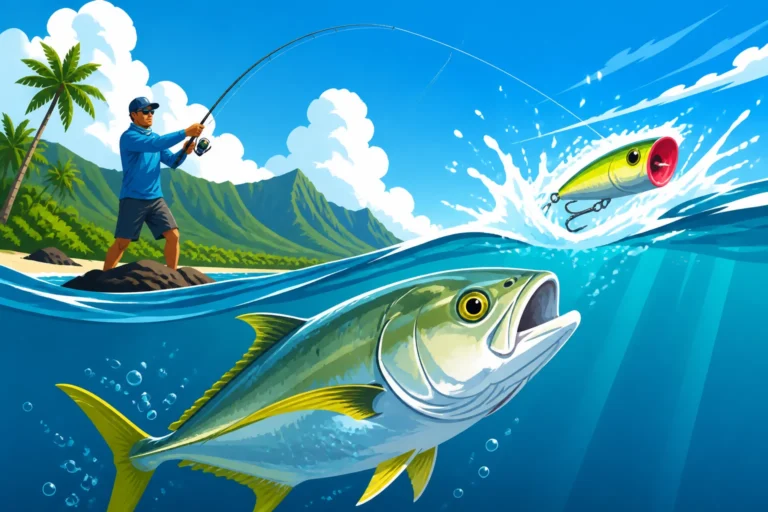
- Whipping (Light Tackle Casting): This technique involves casting small baits or lures with a light spinning rod. You want to cast into gaps in the reef, along ledges, or near coral heads. Let your bait sink slowly, then retrieve it with a gentle twitching motion, mimicking a foraging creature. The goal is to keep your bait in the "fish zone" for as long as possible. Many local anglers prefer this for papio, but it can work for uhu too. For more on this, check out Shore Fishing Techniques for Hawaii.
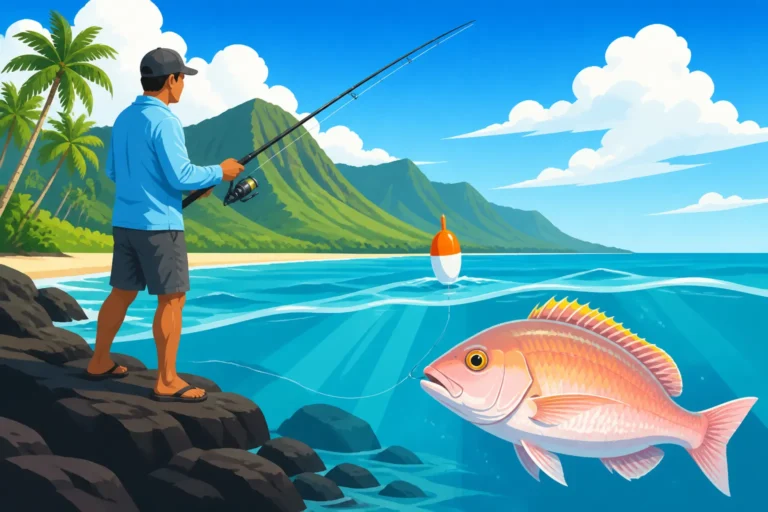
- Dunking (Bait Fishing): This is a more stationary approach. Find a good spot on a rocky outcropping or a small sand patch adjacent to a reef. Cast your baited rig out and let it settle on the bottom or drift with the current through a channel. It's often effective to gently lift and drop your rod tip, just enough to slightly move the bait and create a puff of sand, simulating a feeding fish. This technique requires patience, as you're waiting for an uhu to come across your offering.
- Chumming: A little bit of chum can go a long way. Small bits of bread, mashed limu, or tiny pieces of shrimp, tossed sparingly into the water, can draw uhu out of their hiding spots and closer to your bait. Don't overdo it; you want to attract them, not feed them entirely.
Spearfishing for Uhu
Spearfishing is another highly effective method for targeting uhu, but it comes with its own set of skills, equipment, and regulations. Spearfishing allows you to actively seek out uhu in their reef environments. Many spearfishermen consider the uhu one of the most rewarding catches due to their cunning nature and delicious meat.
When spearfishing for uhu, you need to be stealthy. Uhu are very aware of their surroundings and will quickly retreat into holes if they spot you. Free diving (breath-hold spearfishing) is the most common and often preferred method, as Hawaii SCUBA Spearfishing Ban prevents the use of SCUBA gear for spearfishing.
- Stalking: Slowly approach promising reef structures, looking into crevices and under ledges. Polarized sunglasses can help you spot fish from the surface.
- Ambushing: Often, it's best to position yourself quietly near a known uhu hangout, like a large coral head or a cave entrance, and wait for them to emerge or swim by.
- Shot Placement: Aim for the head or spine for a quick, humane kill. Be prepared for them to bolt – having a good reel or float line is crucial to retrieve a speared fish that tries to hide in the reef.
- Regulations: Always, always be aware of Hawaii Spearfishing Regulations, as well as specific Hawaii Uhu (Parrotfish) Size and Bag Limits. Fishing in Marine Life Conservation Districts (MLCDs) is often highly restricted or prohibited. Learn What a Marine Life Conservation District means for anglers before you head out.
Net Fishing Considerations
While less common for recreational anglers seeking a single uhu, net fishing, particularly throw netting, is a traditional method used by some in Hawaii. However, it's important to understand that Hawaii Net Fishing Restricted Areas are prevalent, and regulations regarding net size, mesh size, and types of nets are very strict. This method is usually more about catching schools of smaller fish or baitfish rather than targeting individual uhu in reef structures. If you're interested in traditional methods, make sure you're fully compliant with all local laws and respectful of customary practices.
Fighting Uhu in Close Quarters
Once you hook an uhu, the fight is on – and it's usually short, but intense. Their immediate instinct is to bolt for the nearest hole or piece of coral to try and cut your line.
- Maintain Pressure: The moment you feel the bite and set the hook, apply consistent, firm pressure. Don't give them slack.
- Lift and Reel: Try to lift their head and reel them away from the structure as quickly as possible. This is where a good rod with backbone and a smooth drag are essential. If they make it into a hole, it's often game over.
- Work the Angles: If they do get into a hole, try to change your angle, pull from a different direction, or gently pump the rod to coax them out. Sometimes, backing off the drag slightly and letting them calm down can help, allowing you to try again.
Timing and Conditions for Uhu Fishing
Beyond gear and technique, understanding the best times and conditions can significantly impact your success rate when targeting uhu. Like all fish, their activity is influenced by environmental factors.
Tides, Moon Phases, and Currents
Tidal movement is a huge factor for reef fish, including uhu. Generally, the incoming and outgoing tides (the hours leading up to and immediately following high or low tide) are the most productive. These moving currents stir up food, making it easier for uhu to graze. Slack tide, when the water is relatively still, often sees a decrease in activity.
While not as critical as tides, moon phases can also play a role. Many anglers believe that the days around the new moon and full moon can be particularly productive due to stronger tidal currents. However, consistent tidal movement is more important than the specific phase of the moon.
Water Clarity and Weather
Uhu rely heavily on their eyesight for feeding and detecting predators. Therefore, clear water is usually best. If the water is murky from heavy rains or a big swell, uhu might be harder to find and less likely to bite. They also won't be as active, as their ability to spot food is compromised.
Calm, sunny days are often ideal for uhu fishing. The clearer water allows for better visibility, and the calmer conditions make it easier for you to spot fish and for them to feel secure feeding. However, don't shy away from fishing on slightly overcast days, as this can reduce glare and make fish less wary. Strong winds can make casting difficult and create choppy water, which isn't ideal for seeing or targeting uhu.
Safety Considerations on the Reef
Fishing or spearfishing around Hawaii's reef structures requires careful attention to safety.
- Footwear: Wear sturdy reef shoes or tabis to protect your feet from sharp coral, rocks, and sea urchins.
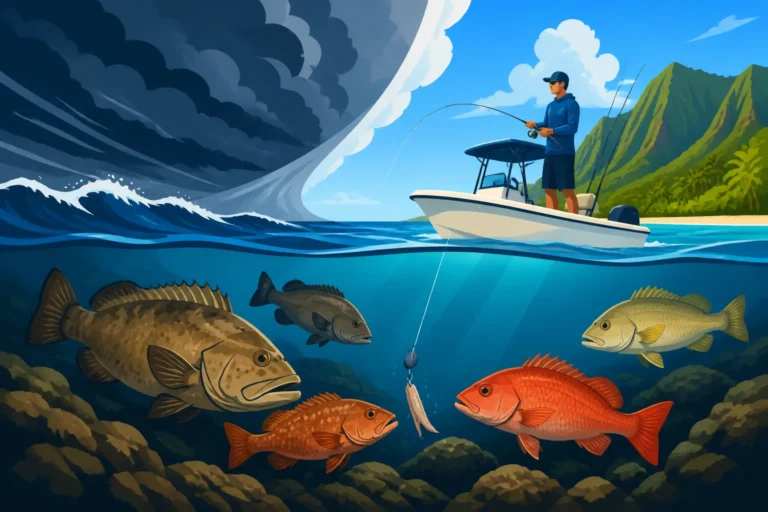
- Ocean Conditions: Always check the surf forecast, tide charts, and local conditions before heading out. Never turn your back on the ocean. Rogue waves are a real danger.
- Marine Life: Be aware of local marine life, including venomous creatures like cone shells and stonefish, as well as sharks. While shark attacks are rare, it's always wise to be vigilant, especially if spearfishing.
- Buddy System: If possible, fish with a buddy, especially when entering the water.
- Respect the Environment: Avoid standing on live coral. Practice proper rubbish disposal. The health of the reef directly impacts the health of the uhu population.
By understanding the uhu's world, equipping yourself with the right gear, and refining your techniques, you'll greatly increase your chances of landing these beautiful and delicious parrotfish. And always remember to check the current Hawaii Fishing Regulations Explained to ensure you're fishing legally and sustainably.
Disclaimer
The information provided in this guide is for general informational purposes only and does not constitute professional advice. Fishing regulations, conditions, and best practices can change rapidly. Always consult the latest official Hawaii Division of Aquatic Resources (DAR) regulations and local weather and ocean forecasts before engaging in any fishing activity. Safety should always be your top priority.