Best technique for fishing pocket water on Kokee streams
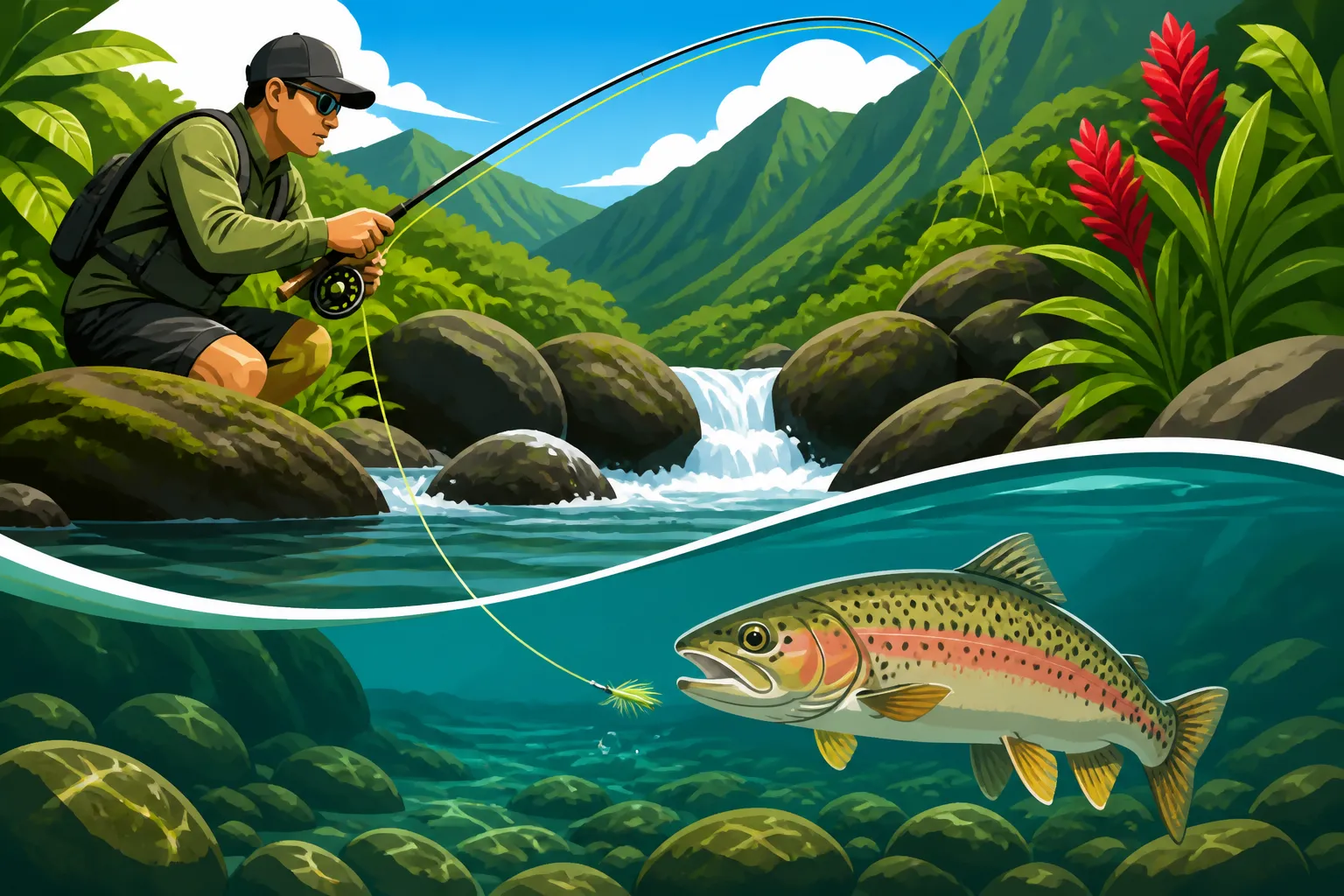
Anyone who's ever dreamed of fishing for trout in a Hawaiian paradise knows the unique allure of Kauai's Kokee State Park. But beneath the stunning canopy and cascading waterfalls, the narrow, fast-moving streams present a challenge, especially those often-overlooked "pocket water" sections. This comprehensive guide is here to break down the most effective techniques to conquer these tricky spots, helping you understand how trout behave in these environments and ultimately, how to land some beautiful Kokee rainbow trout.
The Unique Challenge of Kokee's Pocket Water
When you first approach Kokee's mountain streams, the sheer beauty might be distracting. But beneath that beauty lies a complex aquatic environment, and the pocket water sections are particularly demanding. These aren't your typical wide-open river stretches; they're intricate puzzles that require a specific approach.
What is Pocket Water, Anyway?
Pocket water refers to those sections of a stream or river characterized by a series of small, turbulent pools and runs, often created by large rocks, boulders, or fallen logs. Imagine the stream as a chaotic obstacle course: the water flows quickly, crashing into features that divert its path, creating calmer "pockets" of water downstream or to the sides of these obstructions. These pockets, despite their small size and often turbulent appearance, are prime feeding and resting lies for trout. They offer a break from the main current, often holding more food that gets washed in, and provide cover from predators. It's easy to overlook them, but that would be a huge mistake.
Fishing pocket water is a constant exercise in reading the water, anticipating currents, and making precise, short casts. The water can be deceptively deep in some pockets, while others are mere inches. The challenge is in the rapid changes from one pocket to the next and the need to adapt your strategy almost moment-to-moment. It's a game of inches and quick reflexes, but incredibly rewarding when you hook into a feisty Kokee trout that just hammered your lure from a tight eddy.
Why Kokee's Streams Are Different
Kokee's streams, nestled high in the mountains of Kauai, aren't like the broad, meandering trout rivers you might find on the mainland. These are rainforest-fed waterways, often relatively narrow, with steep gradients that contribute to their fast flow. The bedrock and volcanic rock formations create countless natural obstructions, meaning pocket water isn't just a section; it's often the dominant feature of the stream. You won't find long, smooth runs very often. Instead, you'll encounter a continuous series of riffles, small waterfalls, and, yes, endless pockets.
The lush tropical vegetation lining the banks also plays a significant role. Overhanging branches and dense undergrowth can make casting extremely challenging, often requiring specialized techniques like roll casts or bow-and-arrow casts. This means your typical long, sweeping fly cast is often impractical, forcing you to think differently about how you present your bait or lure. Furthermore, the water can be crystal clear, especially on days without recent heavy rain, making stealth paramount. Any sudden movements or clumsy casts can easily spook the wary trout.
Understanding the Trout's Behavior in Fast Water
Trout in pocket water behave differently than their counterparts in slower, more uniform currents. Their primary goal is efficiency: expending the least amount of energy to get the most food. This means they will position themselves in the calmer "pockets" or "holding lies" where the current is significantly reduced, allowing them to conserve energy. From these strategic positions, they wait for food to drift into their strike zone, often just a foot or two from their nose.
They’re also incredibly opportunistic feeders. Anything that tumbles into their pocket – insects, larvae, small crustaceans – is fair game. This aggressive feeding behavior in a confined space means that when they decide to strike, it's often with ferocity. However, the same fast current that delivers their food can also be their enemy, quickly sweeping away a poorly presented fly or lure. Understanding this balance between energy conservation and opportunistic feeding is key to predicting where they'll be and how they'll react.
Gearing Up for Kokee Stream Success
Having the right equipment can make all the difference when tackling the demanding pocket water of Kokee. It's not about having the most expensive gear, but rather the most appropriate tools for the job. You're dealing with tight spaces and strong currents, so your setup needs to reflect that.
Rods, Reels, and Line Choices
For Kokee's pocket water, shorter, lighter rods are generally preferred. A fly rod in the 6'6" to 7'6" range, rated for a 2 or 3-weight line, is often ideal. These shorter rods allow for easier maneuvering under overhanging branches and make those precise, short casts much more manageable. While a longer rod might offer better line control in some situations, the constant obstruction in Kokee makes brevity your friend. For spin fishing, ultra-light spinning rods in a similar length, paired with a small, lightweight reel, are perfect. You want something sensitive enough to feel subtle takes but with enough backbone to handle a strong current and a fighting trout.
When it comes to line, weight-forward floating lines are standard for fly fishing, as they help with presentation and mending. For spin fishing, a light monofilament or fluorocarbon line, perhaps 4 to 6-pound test, is a good starting point. The clear waters and wary trout necessitate a line that isn't too visible, and the light breaking strength is usually adequate for the size of trout found here. You can find a great selection of these specialized rods and lines on Amazon, ensuring you get gear perfectly suited for these unique conditions.
Leader and Tippet: The Stealth Factor
This is where stealth truly comes into play. For fly fishing, your leader and tippet system should be designed to turn over your fly gently and provide a nearly invisible connection. A longer leader, around 7.5 to 9 feet, tapered down to a fine tippet (5X or 6X, or even 7X if the fish are particularly spooky), is generally effective. Fluorocarbon tippet is often preferred due to its low visibility underwater and its abrasion resistance, which can be a lifesaver around all those rocks.
Spin anglers will also benefit from a fluorocarbon leader. Even if your main line is monofilament, tying on a 2-4 foot section of lighter fluorocarbon leader can significantly increase your strike rate. The clear water conditions in Kokee mean fish have ample opportunity to inspect your offering. A heavy, visible line will send them darting for cover faster than you can say "aloha." Having a variety of tippet sizes on hand, which you can easily find in a good fishing tackle section on Amazon, allows you to adapt to how finicky the trout are on any given day.
Fly and Lure Selection for Kokee Trout
Kokee's rainbow trout are opportunistic feeders, so a variety of flies and small lures can be effective. For fly anglers, a balanced approach is best. Nymphs are often the most productive, as trout in pocket water spend much of their time feeding on subsurface insects. Patterns like the Pheasant Tail Nymph, Hare's Ear Nymph, or Prince Nymph in sizes 12-18 are usually good bets. Sometimes, a tiny dry fly like a Parachute Adams or Elk Hair Caddis can elicit a strike if fish are rising in calmer eddies. Streamers, particularly small woolly buggers, can also tempt larger, more aggressive trout.
Spin fishermen will find success with small spinners and spoons. Panther Martin, Rooster Tail, or Mepps spinners in sizes #0 to #2 are classic choices. Their flash and vibration are excellent for attracting attention in turbulent water. Small, ultralight spoons, such as a Kastmaster or Little Cleo, can also be very effective, especially for getting down into deeper pockets quickly. Experimentation is key, but generally, natural colors or those with a bit of flash tend to perform well.
Here's a quick look at some popular choices:
| Fly/Lure Type | Description | Best Use Case in Kokee Pocket Water |
|---|---|---|
| Small Spinners | Compact, weighted lures with a spinning blade (e.g., Rooster Tails, Mepps) | Casting into deeper pockets, targeting aggressive fish, good visibility |
| Small Spoons | Classic metal lures that wobble (e.g., Kastmasters, Little Cleos) | Deeper pools and runs, imitating baitfish, can be cast a good distance |
| Nymphs | Imitate immature aquatic insects (e.g., Pheasant Tail, Hare's Ear, Prince Nymph) | Primary technique for subsurface feeding, dead drift through pockets |
| Dry Flies | Imitate adult insects on the surface (e.g., Caddis, Adams, Royal Wulff) | Slower seams, eddy lines, when fish are visibly rising |
| Small Streamers | Imitate baitfish or larger aquatic insects (e.g., Woolly Bugger) | Aggressive trout, probing deeper holes, enticing reaction strikes |
Precision Casting and Stealthy Approach
Fishing pocket water isn't about distance; it's about accuracy and delicate presentation. You'll rarely need to cast more than 20-30 feet, and often much less. The real skill lies in putting your fly or lure exactly where it needs to be without creating a splash or spooking the fish.
Mastering the Short Cast and Roll Cast
For fly anglers, the traditional overhead cast is often hampered by the dense vegetation. This is where the short cast and the roll cast become indispensable. A short cast involves minimal false casting, just enough line to load the rod and present the fly. It's quick, efficient, and keeps your line out of the trees. The roll cast is even more specialized, allowing you to cast without any backcast, simply by forming a D-loop with your line on the water and rolling it forward. This is a game-changer when you have a solid wall of jungle behind you. Practice these casts in your backyard – getting proficient will save you endless frustration on the stream.
Spin fishermen also need to focus on accuracy. Underhand casts or sidearm casts can help keep your lure low and out of overhead obstructions. The goal is to drop your spinner or spoon into a small pocket or seam with minimal disturbance. Over-casting and dragging your lure through unproductive water is a waste of time and energy; aim for those prime spots with surgical precision. Sometimes a simple lob or pendulum cast is all you need, especially for those really tight spots.
The Art of Drifting and Mending
Once your fly or lure is in the water, the challenge shifts to presentation. For fly fishing, a natural, drag-free drift is crucial. This means your fly should be moving at the same speed as the current in the specific pocket you're targeting, without your line pulling it unnaturally. This often requires "mending" – quickly flipping a loop of line upstream to correct for conflicting currents and keep your fly drifting naturally. In turbulent pocket water, quick, small mends are frequently necessary to achieve even a short natural drift.
Spin anglers also need to consider drift, particularly when using light lures. Allowing your spinner or spoon to tumble naturally through a pocket, perhaps with a very slow retrieve, can be incredibly effective. The key is to keep just enough tension to feel the lure working and detect a strike, but not so much that you pull it out of the natural flow. Often, the strike will come right as the lure enters or exits a pocket, or as it sweeps past an obstruction. Sometimes, a short twitch of the rod tip can impart just enough action to trigger a reluctant bite.
Approaching the Water Without Spooking Fish
Kokee's trout are survivors; they're adapted to clear water and constant threats. This means they're incredibly wary. Your approach to the stream is just as important as your cast. Always approach a new section of water from downstream, moving slowly and quietly. Fish naturally face upstream, so coming from behind them reduces your chances of being seen. Stay low, use bankside vegetation for cover, and avoid making sudden movements or casting large shadows over the water.
Wearing drab or camouflaged clothing can also help. Think of yourself as a predator, trying to ambush your prey. Every step, every movement, should be deliberate and thoughtful. Before you even make your first cast, take a moment to observe the water, identify potential holding lies, and plan your approach and casting angle. Often, the first cast into an untouched pocket is your best chance, so make it count. Don't be afraid to crawl on your hands and knees if it means getting into a better, stealthier position.
Reading the Water and Maximizing Your Chances
The ability to read the water effectively is arguably the most important skill for fishing pocket water. It's about understanding where the fish will be, why they're there, and how the currents will affect your presentation.
Identifying Prime Holding Lies
In pocket water, trout will gravitate towards areas that offer a combination of reduced current, food delivery, and cover. Look for the calm "soft spots" immediately downstream of large boulders, logs, or ledges. These are classic holding lies where fish can rest out of the main flow but still have a conveyor belt of food washing past them. The deeper parts of these pockets are often more productive. Also, pay attention to current seams – the line where fast water meets slow water. Trout will often sit right on these seams, darting into the fast water to grab a meal and then retreating to the calmer water.
Any abrupt change in depth, even a small one, can also create a holding lie. Look for darker patches of water which might indicate deeper spots. Undercut banks, where the stream has eroded the soil beneath the bank, provide excellent overhead cover and sanctuary. Don't overlook the turbulent white water itself; sometimes larger, more aggressive trout will hold in the churn, especially if it conceals their presence from predators or provides a bounty of dislodged insects. Fishing these areas effectively means understanding that trout are almost always where the effort-to-reward ratio is highest.
Working the Current to Your Advantage
The current in pocket water is a double-edged sword. It can drag your line and ruin your drift, but it can also be your best friend. Instead of fighting it, learn to work with it. Use the currents to help deliver your fly or lure into hard-to-reach pockets. For example, you might cast upstream of a pocket and allow the current to carry your offering directly into the strike zone. This requires careful line management and often a precise "reach cast" or an upstream mend to extend your drift.
Pay attention to how different currents converge or diverge. Eddies, which are swirling currents that move upstream or in a circular motion, are particularly important. Trout often sit at the very edge of an eddy, waiting for food to be swept in. Understanding the nuances of these micro-currents will allow you to present your offering in the most natural and enticing way possible, maximizing your chances of a take. It's a continuous mental chess game, anticipating the water's movement and positioning your bait or fly accordingly.
Adapting to Changing Conditions
Kokee's streams, being rainforest-fed, are highly susceptible to changes in weather. A sudden downpour can quickly raise water levels, increase turbidity, and change the entire dynamic of the pocket water. After heavy rain, the water might be discolored, and fish might move to the very edges of the main current or into calmer backwater eddies to escape the strong flow. In these conditions, brighter, more visible lures or larger, darker flies might be more effective, as fish rely more on scent and vibration than sight.
Conversely, during prolonged dry spells, water levels might drop, making the fish even more wary in the clearer, shallower pockets. This is when the finest tippets, smallest flies, and most delicate presentations become absolutely critical. Always be prepared to adapt your strategy. Carry a selection of different lures and flies, be ready to change your leader and tippet, and adjust your casting technique based on what the stream is telling you. The trout of Kokee will reward the angler who is observant, patient, and flexible. Remember to check regulations for Hawaii Kokee Trout Fishing Season Dates and make sure you have your Hawaii Freshwater Fishing License and Rules in order. If you're wondering about specific trout sizes or stocking numbers, information on Average size of stocked trout at Kokee or Rainbow Trout Stocking at Kokee can be helpful.
Disclaimer
This article is for general informational purposes only and does not constitute professional advice. Laws, prices and regulations vary by location and change over time. Consult a qualified professional for guidance on your specific situation.