Best bottomfishing spots off the Big Island
For anglers visiting or living on the Big Island, one of the most rewarding and often challenging pursuits is finding those prime deep-water honey holes for bottomfish. It's not always about the flashy pelagics; sometimes, the real prize lies hundreds of feet beneath the surface, and knowing where to drop your lines makes all the difference between a bountiful cooler and a disappointing day. This guide will take you through the best bottomfishing spots off the Big Island, helping you navigate the unique ocean floor topography that makes this island a bottomfisher's dream.
Understanding Big Island's Unique Bottomfishing Terrain
The Big Island, or Hawaiʻi Island, is a geological marvel, and its volcanic origins extend far beneath the surface, creating incredibly diverse and dynamic underwater landscapes. This isn't your typical sandy shelf fishing; we're talking about dramatic drop-offs, lava tubes, pinnacles, and ledges that act as natural havens for a wide array of deep-water species. These structures create current breaks and upwellings that bring nutrient-rich water from the deep, attracting baitfish and, consequently, the larger predatory bottomfish we all love to target.
The Significance of Depth and Structure
When we talk about bottomfishing around the Big Island, we're often looking at depths ranging from 100 feet all the way down to over 1,000 feet, especially for the prized "deep-7" species. The key to success isn't just depth, though; it's about finding structure within those depths. Submerged seamounts, lava flows that have cascaded into the ocean, and ledges carved by millennia of volcanic activity all provide the hiding spots and feeding grounds that these fish depend on. Without these underwater features, the ocean floor can be a barren expanse, but with them, it transforms into a vibrant, hidden ecosystem. Learning to read your sonar for these subtle changes in the bottom is an art form in itself, revealing the contours that hold fish.
Identifying Key Bottomfish Species
The waters around the Big Island are home to an incredible variety of bottom-dwelling fish, each with its own preferred habitat and depth. The "deep-7" bottomfish are particularly sought after, known for their delicious white flesh and often challenging fight. These include opakapaka (pink snapper), onaga (ruby snapper), ehu (red snapper), kalekale (lavender snapper), gindai (flower snapper), hogo (longtail snapper), and lehi (silverjaw snapper). Beyond these, you might also encounter uku (grey snapper), hapuʻupuʻu (sea bass), various trevally species like ulua when fishing shallower bottom structures, and even moana kali (yellowstripe goatfish) closer to the reef edges. Each species has its nuances, but generally, targeting areas with good structure and bait presence will increase your chances across the board. If you're keen to learn more about these fascinating creatures, check out our guide on Bottomfish Species of Hawaii.
Kona Coast: The Bottomfishing Hotbed
Without a doubt, the leeward (west) side of the Big Island, particularly the Kona Coast, stands out as the premier destination for bottomfishing. The dramatic underwater topography here is directly influenced by the towering volcanoes of Mauna Loa and Hualālai, which plunge steeply into the Pacific, creating an immediate deep-water environment just offshore. This proximity to deep water means less travel time to reach prime fishing grounds, giving anglers more time with lines in the water.
Deep Drop-offs Near Honokohau Harbor
Just a short run out of Honokohau Harbor, the main launching point for many Kona charters, anglers can access incredible deep-water ledges and drop-offs. These areas are characterized by steep, almost vertical walls that plunge from relatively shallow depths to well over 1,000 feet. It's in these transition zones, where the seafloor changes abruptly, that many of the prized deep-7 bottomfish like onaga and opakapaka congregate. The currents here can be swift, so heavier weights and stout tackle are essential to keep your bait in the strike zone. Many experienced captains will have their favorite marks, often discovered over decades of fishing, where they know the fish hold consistently. If you're planning a trip, looking for charters specializing in bottomfishing on platforms like FishingBooker can help you connect with these knowledgeable guides.
Submerged Pinnacles and Seamounts Off Keauhou
South of Honokohau, around the Keauhou and Kailua-Kona area, the underwater landscape shifts to include more distinct pinnacles and smaller seamounts that rise from the ocean floor. These isolated structures act as magnets for baitfish, which in turn attract larger predators. For ehu and kalekale, these spots are often incredibly productive. These pinnacles might not be as expansive as the ledges further north, but their concentrated nature means that if you find one, you're often right on top of a school of fish. Fishing these spots requires precision, as drifting even a short distance off the pinnacle can take your bait out of the productive zone. Local knowledge is invaluable here, and a skilled captain can use their boat's GPS and sonar to keep you perfectly positioned. The Best Bottomfishing Charters in Hawaii often depart from these areas.
The FAD Buoys and Their Deepwater Connections
While primarily known for attracting pelagic species like ahi and mahimahi, the Fish Aggregating Devices (FADs) positioned off the Kona Coast also have deepwater implications for bottomfishing. These buoys are anchored to the seafloor, often in thousands of feet of water, and the anchor lines themselves can create structure that attracts bottom-dwelling fish in specific areas. It’s less about fishing directly at the buoy for bottomfish, and more about understanding that the FADs are strategically placed over interesting underwater features. Sometimes, fishing the fringes or shallower shelves around the FAD mooring can yield unexpected bottomfish results. However, be mindful of local regulations concerning Hawaii Pelagic Species Bag Limits if you're targeting tuna or mahi around these buoys, as they often roam the same general vicinities.
East Side and South Point: Hidden Gems for Bottomfishing
While the Kona Coast gets most of the bottomfishing glory, the east side (Hilo side) and the southernmost tip of the Big Island, Ka Lae (South Point), also offer unique and productive bottomfishing opportunities. These areas present different challenges and rewards, often requiring a more adventurous spirit and careful attention to weather patterns.
Hilo Bay Approaches and Offshore Ledges
The waters outside Hilo Bay, while not as immediately deep as Kona, still feature significant ledges and drop-offs further offshore. These areas are less frequently fished for bottom species by recreational anglers compared to Kona, making them potential secret spots. Here, you might find uku (grey snapper) on rocky ledges at shallower depths (100-300 feet), alongside the deep-7 species if you venture further out. The Hilo coast is exposed to the tradewinds, so picking your weather window carefully is crucial. The ocean conditions can get rough quickly, but on calm days, the rewards can be substantial. For those who brave these waters, the deep contours created by the submerged slopes of Mauna Kea and Mauna Loa offer fertile ground. Understanding the local Hawaii Fishing Season Dates and Closures is especially important when exploring less trafficked areas like these to ensure sustainable practices.
South Point (Ka Lae) Deepwater Access
Ka Lae, or South Point, is the southernmost tip of the Big Island and the United States, known for its strong currents and often challenging conditions. However, it also offers some of the most immediate deep-water access from shore anywhere on the island, and by boat, even more so. The water here drops off dramatically, and the upwelling currents are incredibly rich in nutrients, making it a hotspot for baitfish and, consequently, large predatory bottomfish. While often targeted by shore fishing techniques for Hawaii for species like ulua, boats venturing slightly offshore can tap into untouched bottomfish grounds. The structures here are rugged, characterized by sharp lava formations and deep trenches. Fishing these waters requires serious seamanship and heavy tackle, as the currents can be ferocious. Charters that operate in this area, often found on platforms like FishingBooker, are typically run by captains who have a deep understanding of the unique and sometimes hazardous conditions.
Bottomfishing Near Puna and Kapoho
Moving along the southeastern coast towards Puna and the Kapoho area, the recent lava flows have dramatically reshaped the shoreline, and consequently, the underwater landscape. While the newest flows are still cooling and altering, older flows have created intricate reef systems and deep crevices that offer excellent habitat for certain bottomfish. These areas are less explored for conventional deep-7 bottomfishing but can hold great potential for uku and other reef-associated species like kumu (goatfish) and weke (goatfish) in shallower to mid-depths. The continuous geological activity means the bottom can change, making it a dynamic and exciting area for persistent anglers. Be aware of any new Hawaii Marine Life Conservation Districts Explained or restricted areas that may emerge as the environment evolves.
Techniques and Gear for Big Island Bottomfishing
Success in bottomfishing off the Big Island hinges not just on finding the right spot, but also on employing the correct techniques and having appropriate gear. The depths and currents demand specialized approaches.
Essential Gear and Rigging
Bottomfishing here isn't for light tackle. You'll need stout rods, often rated for 50-80 lb test or even heavier, paired with powerful conventional reels capable of holding several hundred yards of braided line. Electric reels are common for deep dropping, especially when targeting fish at 500+ feet, as manually reeling up heavy weights from those depths can be exhausting. Your main line should be braided, typically 60-100 lb test, for its strength and lack of stretch, which allows you to feel subtle bites. A heavy fluorocarbon or monofilament leader (80-150 lb) is crucial to withstand abrasion from the rocky bottom and the sharp mouths of fish.
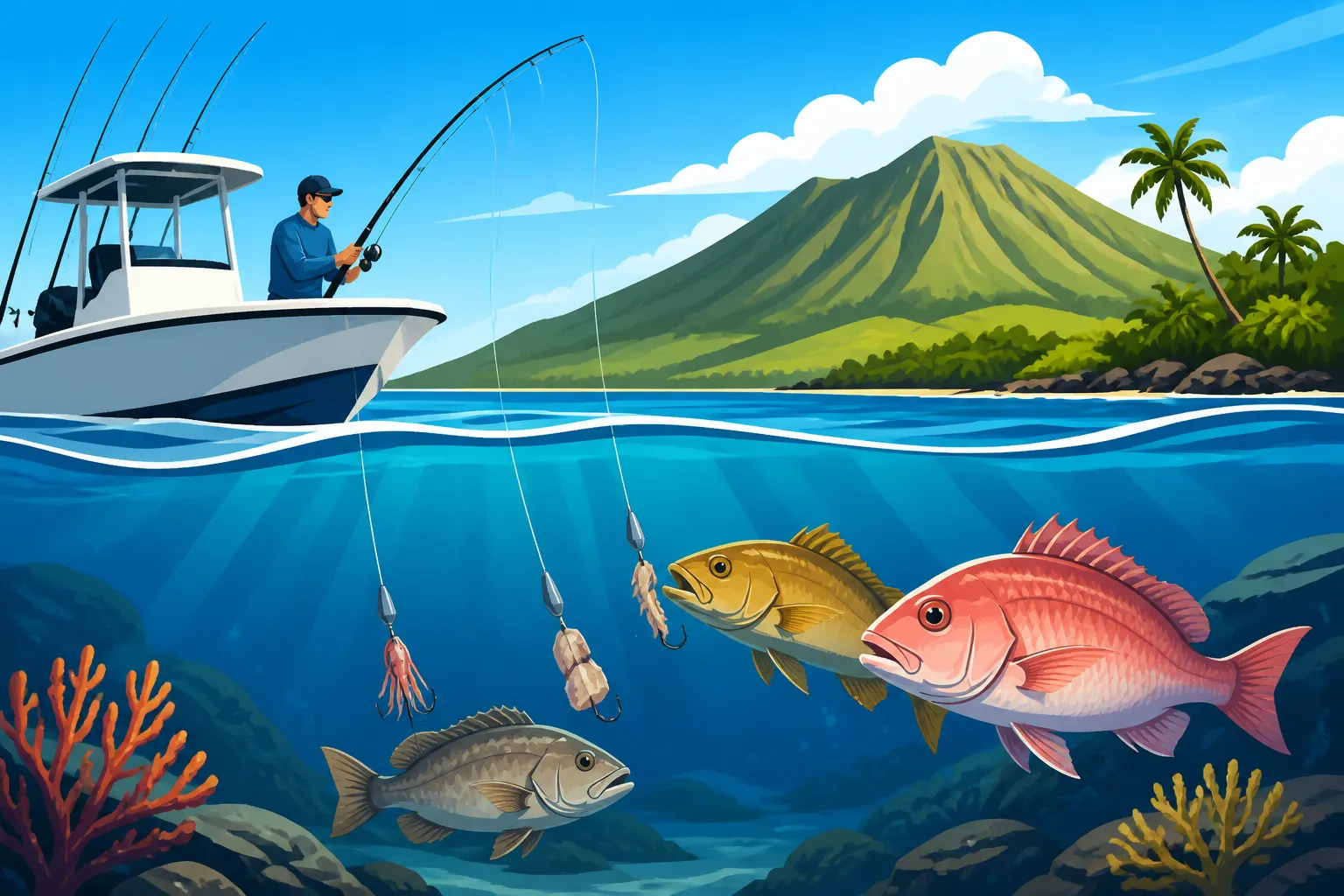
For terminal tackle, a simple two or three-hook dropper rig with circle hooks is often preferred, allowing you to present multiple baits at different depths close to the bottom. Sinker weights can range from 1 to 5 pounds, sometimes even more depending on current and depth, to ensure your bait reaches and stays on the bottom. When choosing your hooks, remember to consult Hawaii Bag and Size Limits by Species to ensure you're using appropriate gear for responsible fishing.
Best Baits and Lures
Natural baits are kings for Big Island bottomfishing. Fresh opelu (mackerel scad), akule (bigeye scad), or ika (squid) are incredibly effective. These baits can be rigged whole or cut into chunks, presented on your dropper rig. The scent and natural appearance of fresh bait are often irresistible to deep-water dwellers. Many anglers will catch bait on site before heading to the deep drops.
While natural bait is primary, jigging for bottomfish in Hawaii can also be highly effective, especially for opakapaka and uku. Large metal jigs, often in glow-in-the-dark or reflective patterns, can be dropped to the bottom and worked with an aggressive retrieve. This technique can be less messy than bait and offers an exciting, active way to fish. The best bait often depends on the species you're targeting. For example, specific Best Bait for Deep Drop Onaga Fishing will involve small, oily fish or squid.
Optimal Times and Conditions
Bottomfishing can be productive year-round on the Big Island, but certain conditions can increase your chances. Best Time of Year to Fish in Hawaii for bottomfish often aligns with calmer ocean conditions, which can be more prevalent during certain seasons, though local weather patterns can be unpredictable. Light currents are generally preferred, as strong currents make it difficult to hold bottom and present your bait effectively. Moon phases can also play a role, with some anglers preferring darker nights for certain species, but this can vary. Ultimately, local knowledge from experienced captains, many of whom are listed on services like FishingBooker, will be your best resource for understanding the daily nuances of when and where to drop.
Local Knowledge and Charters
While this guide provides a starting point, nothing beats the wisdom of local experts. The deep-water world is constantly changing, and what was a hot spot last week might be barren this week.
| Region | Target Species (Primary) | Typical Depth Range | Key Feature | Best for |
|---|---|---|---|---|
| Kona Coast | Onaga, Opakapaka, Ehu | 300-1000+ ft | Steep Drop-offs, Pinnacles | Deep-7 Snappers, Consistent Action |
| Hilo Side | Uku, Opakapaka, Lehi | 200-800 ft | Offshore Ledges, Volcanic Slopes | Uku, Less Pressure |
| South Point | Onaga, Ulua, Hapuu | 100-700+ ft | Extreme Drop-offs, Strong Currents | Large Predators, Challenging |
The Value of a Good Charter Captain
For visitors and even many residents, booking a charter is often the most effective way to experience the Big Island's bottomfishing. A good captain brings decades of experience, intimate knowledge of secret spots (often marked by GPS coordinates that are closely guarded secrets), and all the necessary specialized equipment. They understand the nuances of the currents, the best baits for the day, and how to safely navigate the waters. Before you embark on your adventure, ensure you understand Do You Need Your Own Fishing License for a Hawaii Charter? and any other regulations. Finding the right charter can significantly increase your chances of a successful and memorable trip. Platforms like FishingBooker are an excellent resource for comparing captains, their specialties, and reviews, helping you find the perfect match for your bottomfishing aspirations.
Shore-Based Bottomfishing Opportunities
While most discussions about Big Island bottomfishing focus on boat-based deep dropping, there are limited, albeit challenging, opportunities for shore-based bottomfishing. Areas like South Point, with its immediate deep water, can yield ulua (giant trevally) and other strong fighters from the rocks. This often involves sliding bait techniques for ulua to get baits out to deeper ledges and currents. It requires heavy-duty surf rods, powerful reels, and a lot of patience. This style of fishing targets different species and depths than offshore bottomfishing but offers a unique, accessible challenge for the dedicated shore angler. However, for the true deep-7 species, a boat is almost always necessary.
Ultimately, the Big Island offers some of the most exciting and productive bottomfishing in the world. With its incredible underwater topography and diverse fish species, every trip holds the promise of a trophy catch.
Disclaimer
Please remember that fishing regulations in Hawaii are subject to change. Always consult the latest rules and regulations from the Hawaii Division of Aquatic Resources (DAR) before heading out on your fishing trip. Adhering to bag limits, size restrictions, and season closures helps ensure the sustainability of Hawaii's precious marine resources for generations to come.