Cold Front Fishing Tactics for Hawaii Bottomfish
Imagine planning that dream Hawaii fishing trip, picturing serene waters and plentiful bottomfish, only for a dreaded cold front to roll in. It's a frustrating reality for many anglers, as these unexpected weather shifts can throw a serious wrench into your carefully laid plans, making the fish seem to vanish overnight. But don't despair! While cold fronts certainly present challenges, they don't have to mean the end of your fishing day. This guide will dive deep into understanding how these fronts impact Hawaii's treasured bottomfish species and, more importantly, equip you with the specialized tactics and knowledge you need to adapt and still find success when the weather takes a turn.
Understanding Cold Fronts in a Tropical Paradise
When you hear "cold front," your mind might immediately jump to images of blizzards or freezing temperatures, especially if you're from a mainland climate. However, here in Hawaii, a "cold front" is a different beast entirely. It’s less about snow and ice and more about significant, often rapid, changes in atmospheric pressure, wind direction and strength, and ocean conditions, which can still send a shiver down the spine of even the most seasoned bottomfish. These changes, though seemingly subtle to us above the surface, can create a ripple effect that dramatically alters the underwater world and, consequently, the behavior of the fish we're after.
Defining a "Cold Front" in a Tropical Climate
In Hawaii, a cold front typically manifests as a noticeable drop in air temperature, perhaps only a few degrees, but accompanied by a dramatic shift in wind patterns, often from a calm southerly flow to a brisk northerly or easterly tradewind. You might also experience an increase in rainfall, cloud cover, and choppier seas. What feels like a refreshing change of pace for us can be a major upheaval for fish living in a relatively stable warm-water environment. These fronts are often associated with larger weather systems moving across the Pacific, bringing with them a whole new set of environmental cues that fish are incredibly sensitive to. They're not just a minor inconvenience; they signal a fundamental shift in their habitat.
For bottomfish, which typically inhabit deeper, more stable environments, these surface changes can still penetrate the water column. Increased wind creates larger swells and stronger currents that extend downwards, stirring up the bottom and changing light penetration. The shift in atmospheric pressure, in particular, is a well-documented trigger for changes in fish behavior worldwide, and Hawaii's bottomfish are no exception. They sense these shifts through their lateral lines and swim bladders, interpreting them as signals to conserve energy, seek shelter, or perhaps even feed aggressively just before the full impact hits.
The Subtle Changes in Water Temperature and Current
While the surface air temperature might only drop slightly, the ocean's surface temperature can follow suit, even if by just a degree or two. For warm-blooded humans, that's negligible, but for cold-blooded fish whose metabolism is directly tied to water temperature, it can be a significant change. Bottomfish thrive within specific temperature ranges, and any deviation can make them uncomfortable, leading them to seek out more stable thermal layers. This often means moving deeper where the water temperature is more consistent and less influenced by surface conditions.
Beyond temperature, the change in current is often a more immediate and impactful factor during a cold front. Stronger winds generate larger waves, and these waves, in turn, create stronger subsurface currents. These currents can disorient fish, make it harder for them to hold their position near structure, and even sweep away their typical food sources. Anglers might notice their boat drifting much faster, or their lines getting pulled more severely, making it challenging to keep bait in the strike zone. Understanding these current shifts is crucial, as it dictates how you present your bait and where you anticipate fish might be seeking refuge from the increased flow.
Barometric Pressure Swings and Their Impact
Of all the environmental changes associated with a cold front, barometric pressure fluctuations are arguably the most influential for fish behavior. Fish, particularly those with swim bladders, are incredibly sensitive to changes in atmospheric pressure. A rapid drop in pressure, often preceding the arrival of a cold front, can sometimes trigger a flurry of feeding activity. This is because fish feel the need to "equalize" the pressure in their swim bladders, and an increase in gas production or a move to shallower water might make them feel more comfortable, often coinciding with an urge to feed before conditions worsen.
However, once the cold front has settled in and the atmospheric pressure stabilizes at a lower, or even a rapidly rising, level, fish often become lethargic and less willing to bite. They may move deeper to find more stable pressure zones, or simply reduce their activity as their bodies adjust to the new conditions. Imagine feeling a headache from a sudden pressure change; fish experience something similar, prompting them to conserve energy. This post-front lull in activity is where most anglers struggle, as the fish become much pickier, requiring a complete overhaul of your usual tactics.
How Cold Fronts Affect Bottomfish Behavior
The arrival of a cold front doesn't just change the weather; it fundamentally alters the underwater world, causing Hawaii's various bottomfish species to react in predictable, yet challenging, ways. Understanding these shifts in behavior is the first step toward adapting your fishing strategy and still finding success when the weather turns sour. It’s not just about what they do, but why they do it, based on their inherent survival instincts.
Movement to Deeper, More Stable Waters
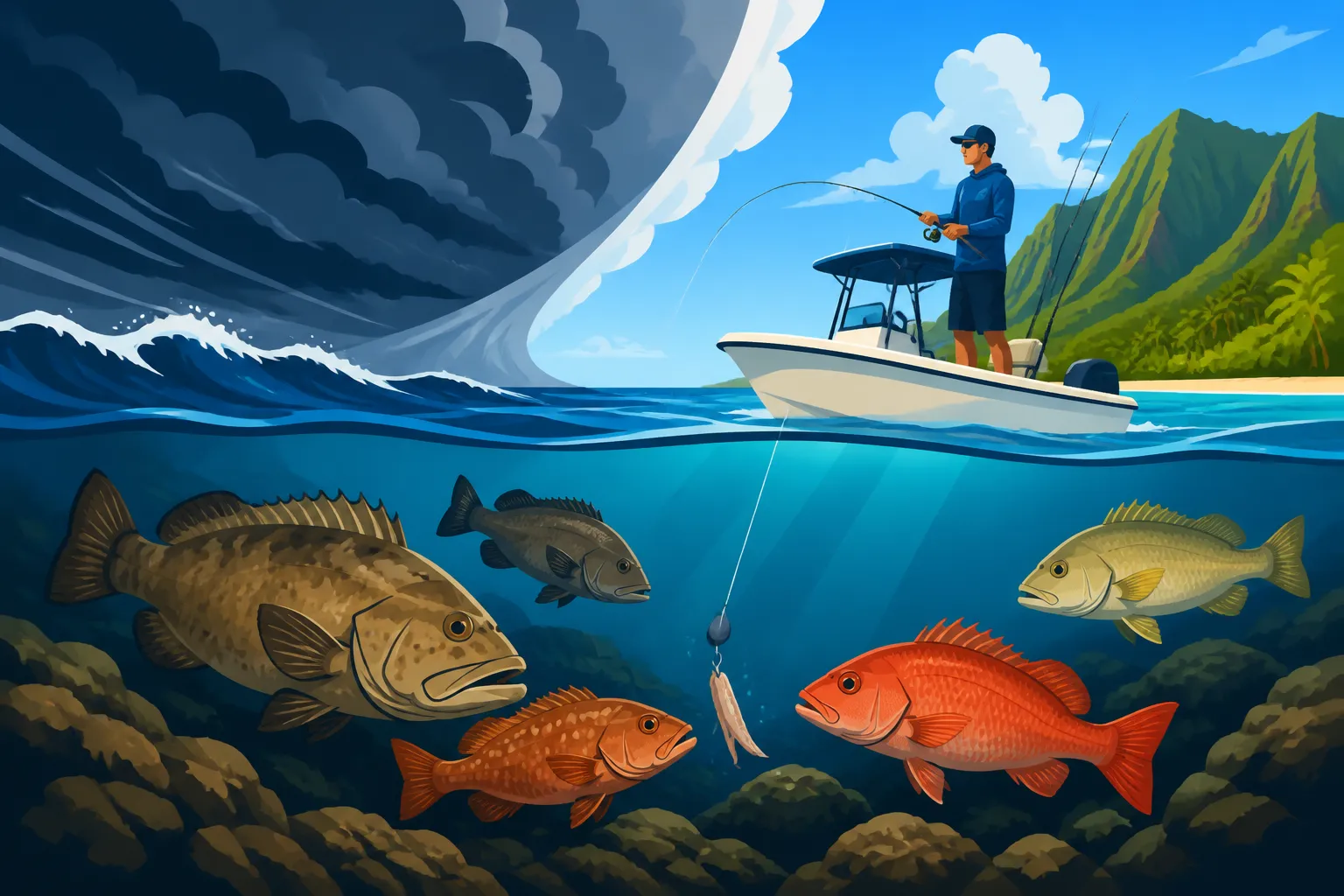
One of the most common reactions of bottomfish to a cold front is to retreat to deeper, more stable environments. This isn't just about escaping colder surface temperatures; it's also about finding refuge from increased wave action, stronger currents, and rapidly fluctuating barometric pressure. Deeper water acts as a thermal buffer, maintaining a more consistent temperature range that is less impacted by the surface. It also provides a more stable pressure environment, which is critical for species like opakapaka, onaga, and ehu, whose swim bladders are sensitive to these changes.
When a front moves in, fish that were previously holding on shallower ledges or pinnacles might descend several fathoms, or even move to entirely different, deeper structures. This means anglers might need to adjust their GPS marks, looking for those deeper contours on their sonar where fish can feel more secure. They might hug the bottom tighter, seeking crevices or the lee side of large underwater rocks, making them harder to entice with a typical presentation. If your usual 80-foot spot goes quiet, it's a strong indicator that it's time to bump out to 120 or even 200 feet, focusing on the steepest drop-offs and the most complex deepwater structures available.
Reduced Feeding Activity and Picky Bites
Perhaps the most frustrating aspect of fishing during a cold front is the significant reduction in feeding activity. Fish become lethargic, their metabolism slows, and their instinct to conserve energy overrides their desire to chase down a meal. This doesn't mean they stop eating entirely, but they become incredibly selective. What worked yesterday—a lively whole squid or a rapidly jigged metal lure—might be completely ignored today.
These "picky bites" are so subtle you might not even realize a fish is on the line until you reel up to check your bait. Instead of aggressive strikes, you'll feel faint taps, a slight increase in weight, or just a lack of the usual current drag on your line. You're no longer trying to trigger a reaction strike; you're trying to offer an irresistible, easy meal that requires minimal effort from a sluggish fish. This shift demands extreme patience, sensitive gear, and a meticulous approach to bait presentation, making every single detail count. Even the way your bait moves in the water column can be the difference between a bite and nothing.
Schooling Changes and Dispersal
Different species react differently, but many bottomfish species that typically school, such as opakapaka or lehi, might disperse or tighten their schools significantly during a cold front. Dispersal can make them harder to locate with sonar, as individual fish might scatter across a wider area, rather than concentrating in a dense school. Conversely, some schools might tighten up, packing together more densely on structure, but becoming less active as a collective.
This change in schooling behavior affects your approach. Instead of dropping directly onto a large red blob on the fish finder and expecting multiple hookups, you might need to make more exploratory drops, covering more ground, or focusing on smaller, isolated marks. The key is to remember that while they might be less active, they haven't vanished entirely; they've simply changed their patterns. Targeting these fish effectively requires an understanding of their deepwater habitat, as explored in articles like Bottomfishing in Hawaii, and knowing where they might seek shelter.
Adjusting Your Strategy: Gear and Bait Changes
Successfully targeting Hawaii bottomfish during a cold front isn't about brute force; it's about finesse, subtlety, and a complete re-evaluation of your usual approach. The gear and bait you rely on during fair weather conditions often need to be swapped out for more sensitive, lighter options. It's a game of inches and gentle nudges, not powerful pulls.
Lighter Lines and More Sensitive Rods
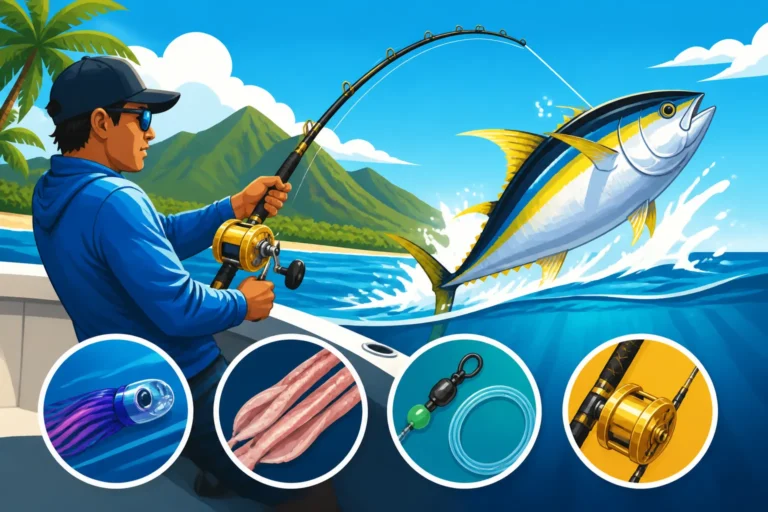
When fish are lethargic and biting timidly, you need every advantage to detect those almost imperceptible takes. This means ditching the heavy, broomstick-like rods and thick mainlines you might use for aggressive offshore pelagics. Instead, opt for lighter bottomfishing setups. A medium-heavy conventional or spinning rod with a fast tip action can transmit even the slightest tap. Carbon fiber or graphite blanks offer superior sensitivity compared to fiberglass. Many anglers swear by specific models found on platforms like Amazon, praising their ability to feel the texture of the bottom and the gentle mouthing of a finicky fish.
Pair these sensitive rods with lighter braided mainlines, perhaps 30-50 lb test, which offers excellent sensitivity due to its minimal stretch and thin diameter. For your leader material, step down a size or two. Instead of 80 lb fluorocarbon, try 50 or 60 lb. Fluorocarbon's low visibility is always a plus, but its stiffness can sometimes hinder a natural presentation. Experiment with different leader lengths; sometimes a longer leader allows the bait to drift more naturally. The goal is to reduce any resistance that a sluggish fish might feel, making it easier for them to inhale your offering without immediately detecting your line.
Smaller Baits and Finesse Presentations
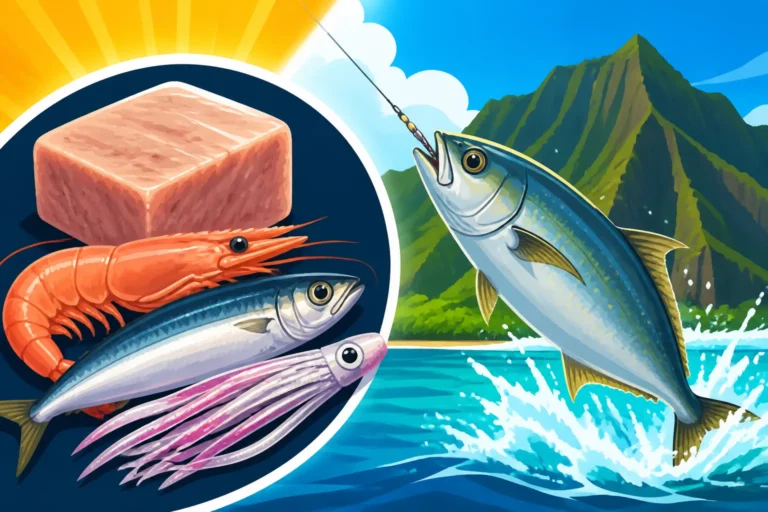
During a cold front, the "bigger is better" philosophy for bait often goes out the window. Fish aren't actively hunting large meals; they're looking for an easy snack. Downsize your bait considerably. Instead of a whole squid, try a small strip of squid, a piece of dead opelu, or a chunk of fresh mackerel. Live bait, if you can get it, is often incredibly effective because its natural movement can entice even the most reluctant fish. However, ensure your live bait is healthy and swimming naturally, not just languishing on the hook.
Presentation becomes paramount. Instead of using large, heavy hooks that might feel clunky to a hesitant fish, opt for smaller, sharper circle hooks. A 4/0 or 5/0 circle hook might be more effective than an 8/0. Ensure your bait is hooked cleanly and naturally, allowing it to move freely in the current. Avoid overly flashy or noisy presentations. Think subtle, enticing movements that mimic an injured or vulnerable prey item. This might mean using less weight to allow for a slower, more natural fall, or positioning your bait just off the bottom rather than directly on it, where it could get lost in sediment.
Slower Jigging and Drifting Techniques
Aggressive jigging or fast retrieves, which work wonders when fish are active, will often scare them away during a cold front. The name of the game is slow and deliberate. If you're using jigs, switch to smaller, lighter models and employ a much slower, more subtle retrieve. Instead of sharp upward jerks, think gentle lifts and drops, allowing the jig to flutter tantalizingly in the water column. Sometimes, simply letting the jig sit still for extended periods can trigger a bite from a curious but lazy fish.
For bait fishing, controlled drifting is key. You want your bait to present as naturally as possible, almost as if it's just a piece of food wafting by effortlessly. If the current is strong, use just enough weight to get your bait to the bottom, then let your boat drift slowly over structure. Consider using a sea anchor or drift sock to slow your drift down, allowing your bait to soak in the strike zone longer. This also helps keep your line more vertical, making it easier to feel those subtle bites. When you feel a bite, resist the urge to immediately set the hook aggressively. Instead, allow the fish to take the bait, and let the circle hook do its job as the fish moves away. Patiently reeling in to put pressure on the hook is often the best approach. Mastering techniques like these will give you a significant edge when tackling bottomfish, as detailed in guides on Jigging for Bottomfish in Hawaii and specific advice on Best jig weight for bottomfishing in deep water.
Prime Fishing Spots During a Cold Front
While the general rule of thumb for cold fronts is that fish move deeper, knowing which deep spots are most likely to hold fish can save you valuable time and fuel. During these challenging conditions, certain underwater geographies become hotspots because they offer the stability and shelter bottomfish instinctively seek. It’s all about finding comfort zones within the chaos.
Deepwater Ledges and Drop-offs
When surface conditions get rough and temperatures fluctuate, the reliable deepwater ledges and abrupt drop-offs become prime real estate for bottomfish. These underwater cliffs and shelves offer a consistent environment below the thermocline (the layer where water temperature changes rapidly), providing stable temperatures and often less intense current. Fish will often "hang" on these ledges, either just above the bottom or tucked into crevices, waiting for conditions to improve.
Anglers should focus on the steepest sections of these ledges, particularly where there are overhangs or significant changes in topography. These areas provide excellent ambush points for predators and safe havens for smaller prey. Your fish finder is your best friend here; look for significant schools or even individual large marks directly on or very close to the structure. Learning How to locate bottomfish structure with sonar is an invaluable skill that pays dividends, especially during cold fronts. The key is to position your boat so your bait drifts naturally down the face of the ledge or directly along its base, increasing your chances of a subtle pick-up from a stationary fish.
Submerged Seamounts and Pinnacles
Hawaii's volcanic origins bless us with numerous submerged seamounts and pinnacles that rise from the ocean floor, often far offshore. These underwater mountains are natural magnets for marine life and become even more critical sanctuaries during a cold front. Much like deepwater ledges, they offer a consistent environment, but their isolated nature often means they host a thriving ecosystem of baitfish, which in turn attracts larger bottomfish.
Targeting these spots requires accurate navigation and a good understanding of the local bathymetry. Look for the highest points of these structures, as well as the surrounding plateaus and saddles, which can concentrate fish. The currents around seamounts can be complex, so pay close attention to your drift. Dropping anchor directly on top might be too disruptive, so a controlled drift, potentially using a sea anchor, that takes your bait over the most promising sections is often more effective. These structures are often where you'll find prized species like onaga, so be prepared with your specialized Best bait for deep drop onaga fishing tactics.
Sheltered Leeward Sides of Islands
While many cold fronts bring stronger winds and larger swells, particularly to the exposed windward sides of the islands, the leeward sides often offer a degree of shelter. This protection from the prevailing winds and rough seas can result in calmer waters, which can be a significant advantage for both angler comfort and fish behavior. Bottomfish might not necessarily move to shallower depths on the leeward side, but they might be more inclined to feed if the water column feels more stable and less turbulent.
Think of areas like the Kona Coast of the Big Island, which is famously sheltered by Mauna Loa and Hualalai, often maintaining calmer conditions even when other parts of the state are experiencing strong winds and heavy seas. Similarly, the leeward sides of Maui or Oahu can offer pockets of tranquility. While you'll still be fishing deep for most bottomfish, the ability to maintain a consistent boat position and feel subtle bites in calmer water can dramatically increase your success rate. This also makes it a better option for those looking to fish comfortably, perhaps even with a Best Bottomfishing Charters in Hawaii guide who knows these specific sheltered deepwater spots well. Even if the fish are still sluggish, the calmer conditions reduce external variables, allowing for a more focused and effective presentation.
Safety First: Navigating Challenging Conditions
Fishing during a cold front in Hawaii isn't just about changing your tackle; it's about prioritizing safety above all else. The very conditions that make fishing challenging for the fish can make it outright dangerous for anglers. The ocean here is powerful, and sudden weather shifts demand respect and thorough preparation.
Monitoring Weather and Ocean Forecasts
This cannot be stressed enough: always check multiple weather and ocean forecasts before you even think about heading out. In Hawaii, conditions can change rapidly and unpredictably. Don't just rely on a single weather app; cross-reference forecasts from NOAA (National Oceanic and Atmospheric Administration), the National Weather Service, and local Hawaiian news channels. Pay close attention to wind speed and direction, swell height and period, and any small craft advisories or gale warnings. What starts as a manageable chop can quickly escalate into dangerous seas, especially in exposed channels or around rocky points.
It's not just about the current conditions, but also the forecast for the duration of your trip and beyond. A cold front might bring clear skies initially, but the underlying ocean conditions could still be rough from previous winds. Understand how these fronts move and their potential impact on local currents and wave refraction around the islands. If there's any doubt, it's always better to err on the side of caution and postpone your trip. No fish is worth risking your life over, and the bottomfish will still be there when conditions improve.
Essential Safety Gear and Preparedness
Once you've decided to venture out, ensure your vessel is properly equipped and everyone on board knows how to use the safety gear. This isn't just a suggestion; it's a legal requirement. Make sure you have enough personal flotation devices (PFDs or life jackets) for everyone on board, and that they are easily accessible and in good condition. You can find excellent, comfortable inflatable PFDs for sale on Amazon that don't hinder your casting or reeling. Beyond PFDs, a comprehensive list of required safety equipment includes visual distress signals (flares), a sound-producing device (horn or whistle), fire extinguishers, and navigation lights. For more detailed information on mandatory equipment, consult the Hawaii Required Boat Safety Equipment Checklist.
Beyond the bare minimum, consider bringing extra items like a well-stocked first-aid kit, a waterproof VHF radio (with a charged battery) in addition to your cell phone, and an emergency position indicating radio beacon (EPIRB) or personal locator beacon (PLB) for offshore trips. Inform someone on shore of your float plan, including your intended destination, estimated return time, and the number of people on board. If something goes wrong, this information can be crucial for search and rescue efforts. Remember, being prepared means having the tools and knowledge to handle unexpected situations, which are far more likely to arise during a cold front.
Recognizing and Avoiding Hazardous Areas
Cold fronts often bring increased swell and stronger currents, making certain areas particularly hazardous. Exposed shorelines, shallow reefs, and narrow channels can become deadly traps. Even if you're an experienced angler, unfamiliar waters can hide unseen dangers. Learn to read the ocean: identify breaking waves, rip currents, and areas of confused sea state. Avoid hugging coastlines too closely, especially near rocky cliffs where rogue waves can unexpectedly crash.
Understanding Hawaii Boating Laws for Anglers is also crucial, not just for legal compliance but for safety. Be aware of no-wake zones, restricted areas, and marine life conservation districts where fishing might be prohibited or heavily regulated. These rules are often in place to protect both marine life and human safety. If you're fishing from shore, be incredibly vigilant about sudden increases in wave action, especially during a high tide combined with a cold front swell. Never turn your back on the ocean, and always have an escape route planned. When in doubt, retreat to safer waters or call it a day; the ocean's power during a cold front is not to be underestimated.
Post-Front Recovery: When Things Get Back to Normal
Just as fish react to the arrival of a cold front, they also respond to its departure and the return to more stable conditions. The "post-front bite" can often be spectacular, but it requires patience and a keen understanding of how fish transition back to their normal feeding patterns. It's not an instant flip of a switch, but a gradual process.
Timing the Return to Normal Feeding
The recovery period after a cold front is often characterized by a gradual increase in fish activity. Once the wind dies down, the swells subside, and the barometric pressure stabilizes (or begins a slow, steady rise), bottomfish will start to move out of their deepwater refuges and resume more active feeding. This usually doesn't happen immediately after the storm clears; it often takes 24 to 48 hours, sometimes even longer, for the fish to shake off their lethargy and recalibrate to the normalized environment.
Experienced anglers know to watch the forecasts closely, not just for the front's arrival but for its complete departure and the subsequent period of stable weather. Often, the day after a cold front has truly passed and conditions have calmed is when the fishing can be most productive. The fish, having been suppressed during the front, are often hungry and more willing to chase down a meal. This is when you can gradually return to your more aggressive techniques and larger baits, though a little caution with your presentation still pays off, as they might still be a bit wary.
Targeting Transition Zones
As bottomfish emerge from their deepwater havens, they don't usually sprint back to their pre-front locations. Instead, they'll often hold in "transition zones"—areas that are slightly shallower than their cold-front refuges but still offer some depth and structure. These might be shallower ledges just above the deepest drop-offs, or the fringes of seamounts rather than their absolute peaks. They're testing the waters, so to speak, gradually moving back towards their prime feeding grounds.
This means you might find success by fishing those in-between depths. If you were fishing 200 feet during the front, try 150-180 feet during the recovery. Look for isolated structure, patches of rubble, or smaller contours that would offer a good mix of safety and feeding opportunities. These areas are where you might find a variety of Bottomfish Species of Hawaii gathering before fully dispersing. Keep a close eye on your fish finder for baitfish schools in these areas, as that's a strong indicator that the larger bottomfish are also moving in to feed.
Species-Specific Recovery Patterns
It's important to remember that not all bottomfish species react identically to a cold front or recover at the same pace. Some species, like the highly migratory pelagics (which, while not bottomfish, can influence baitfish behavior), might move through the area quickly, while others, like deepwater snappers, might be more localized and slower to return to normal activity. For specific guidance on different species, reviewing guides on Best bait for opakapaka bottomfishing and Best bait for deep drop onaga fishing can provide valuable insights into their typical behaviors.
Opakapaka, for instance, might become active a bit sooner than onaga, which tend to hold even deeper and might take longer to respond to improved conditions. Knowing these subtle differences, often gained through years of local experience, can help you prioritize your target species during the post-front recovery. Don't be afraid to experiment with different baits and presentations during this period, as the fish might still be somewhat particular. The key is persistence, observation, and adaptability, eventually leading to a rewarding catch when the ocean finally calms down.
Cold Front Fishing Strategy Comparison
Here's a quick look at how your approach should ideally shift when a cold front impacts Hawaii's bottomfish grounds.
| Factor | Pre-Cold Front (Rising Pressure) | During Cold Front (Falling/Low Pressure) | Post-Cold Front (Stabilizing Pressure) |
|---|---|---|---|
| Fish Behavior | Aggressive feeding, active | Lethargic, deeper, picky bites | Increased activity, moving to feed |
| Target Depth | Varied, sometimes shallower | Deeper ledges, structure, seamounts | Transition zones, slightly shallower |
| Bait/Lure Size | Standard to larger | Smaller, natural, live bait | Standard |
| Presentation | Active jigging, quicker retrieves | Slow, subtle, finesse, soak time | Moderate jigging, steady retrieves |
| Line/Gear | Standard heavy tackle | Lighter leaders, sensitive rods | Standard |
| Best Time | Dawn/Dusk, tide changes | Midday, slack tide for current control | Dawn/Dusk, tide changes |
| Safety Focus | Standard | Heightened awareness, avoid rough seas | Standard |
Disclaimer
The information provided in this guide is for general informational purposes only and does not constitute professional advice. Fishing conditions, regulations, and safety requirements in Hawaii can change frequently. Always consult the latest rules and guidelines from the Hawaii Department of Land and Natural Resources (DLNR) Division of Aquatic Resources (DAR) before fishing. Exercise extreme caution, prioritize safety, and ensure you have all necessary licenses and permits.