Hawaii papio minimum size limit
It can be incredibly frustrating to head out for a day of fishing in Hawaii, only to realize you’re unsure about the specific rules that apply to your catch. One of the most common questions, and a crucial one for responsible angling, revolves around the minimum size limit for papio. This guide is here to clear up any confusion, explain why these rules exist, and help you ensure every papio you keep is a legal one.
Understanding Papio: The Juvenile Giant Trevally
When we talk about "papio" in Hawaii, we're generally referring to the younger, smaller stage of what will eventually become the majestic ulua, or giant trevally (Caranx ignobilis). These fish are highly prized for their fighting spirit and delicious meat, making them a popular target for both shore casters and boat anglers across the islands. However, their popularity also means they need careful management to ensure future generations can enjoy this incredible fishery.
Why Size Limits Matter for Papio
Imagine a garden where everyone harvests vegetables before they've had a chance to fully grow and produce seeds. Soon enough, there wouldn't be much left, right? It's a similar concept with fish. Size limits for species like papio aren't just arbitrary rules designed to make your fishing trip harder; they're a cornerstone of sustainable fisheries management.
The primary reason for a minimum size limit is to allow fish to reach sexual maturity and reproduce at least once before being harvested. Papio, like many other species, need to grow to a certain size before they can successfully spawn and contribute to the next generation. If too many young fish are removed from the population before they can breed, the overall stock can decline, eventually leading to fewer fish for everyone. This is especially true for long-lived, slow-growing species. By protecting these juveniles, we're ensuring that the fishing legacy in Hawaii, one that holds so much cultural and recreational value, remains vibrant for years to come. It’s all about finding that balance between enjoying today’s catch and safeguarding tomorrow’s abundance. If you're interested in the broader picture of how these regulations are set, you might find our guide on Hawaii Fishing Regulations Explained very insightful.
Identifying Papio vs. Ulua
The terms "papio" and "ulua" are often used interchangeably, but for regulatory purposes, and especially when considering size limits, it's essential to understand the distinction. Essentially, papio are juvenile giant trevally. They are the same species, but at different life stages.
A papio typically refers to a giant trevally that is under the legal minimum size for an ulua, and often, under its own specific papio limit if one exists separately. Visually, papio have the same powerful, compressed body shape, large eyes, and characteristic scutes near their tail as their larger ulua counterparts. However, they are, of course, smaller. Their coloring might also be a bit lighter or less defined than a mature ulua. The key is their length. A fish that's clearly under the 10-inch mark, for example, is unequivocally a papio. As they grow beyond that initial threshold and approach the larger sizes, they begin to transition into what anglers commonly refer to as ulua. Understanding this growth trajectory is part of the deep connection anglers have with the ocean, watching these fish go through their full lifecycle. For a more detailed look at these growth stages, check out our article on Papio Growth Stages Into Trophy Ulua.
Hawaii's Official Papio Minimum Size Limit
Navigating fishing regulations can sometimes feel like trying to untangle a particularly stubborn fishing knot. But when it comes to papio, the rules are thankfully straightforward, though sometimes misunderstood because of the common usage of the term.
The Current Regulation and What It Means
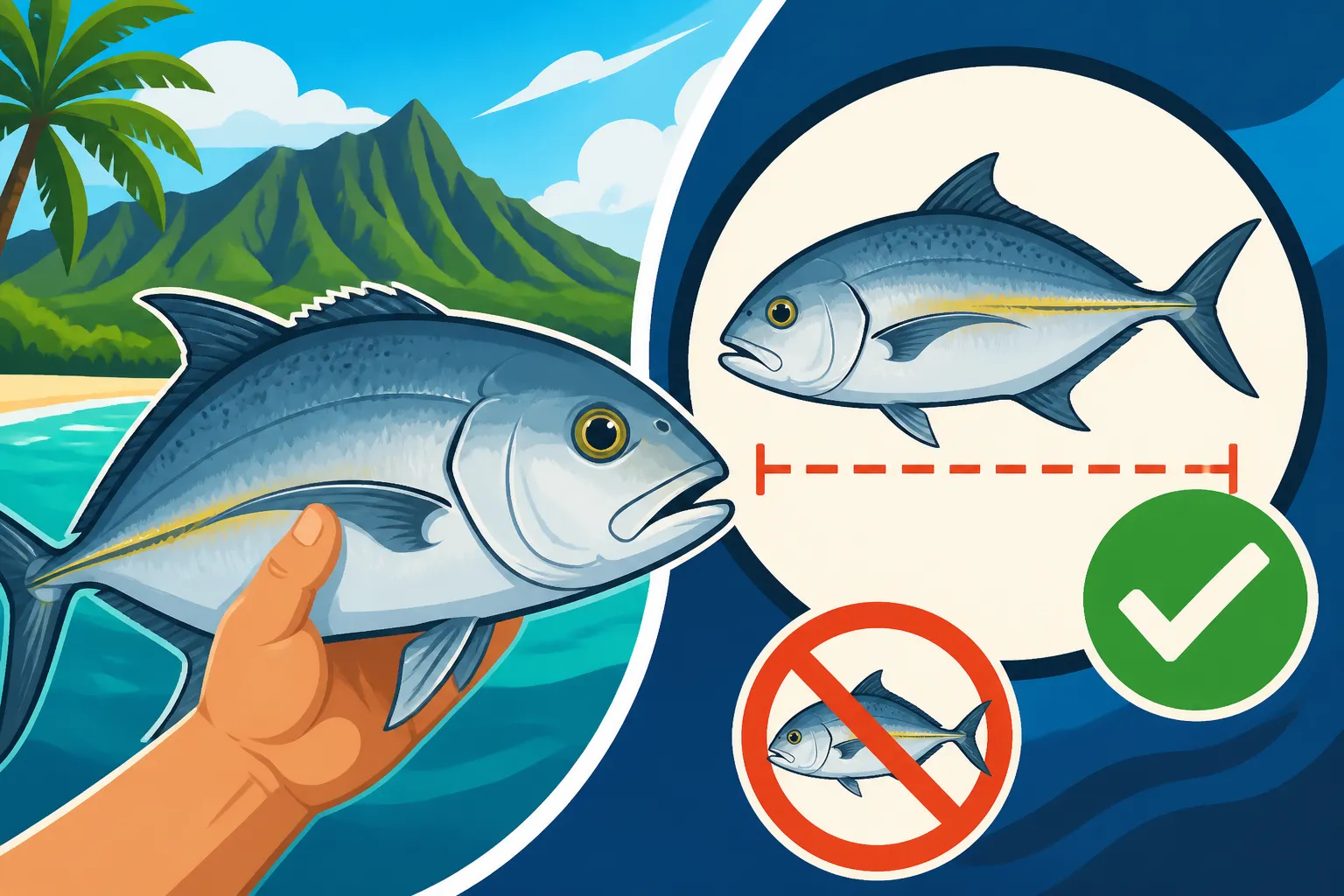
Here's the critical information you need to know: For giant trevally (Caranx ignobilis), which includes both papio and ulua, the minimum size limit in Hawaii is 10 inches (25.4 cm) fork length. This means that any giant trevally you catch, regardless of whether you call it a papio or an ulua, must measure at least 10 inches from the tip of its snout to the fork in its tail.
Let’s break down "fork length." It's not the total length from snout to the end of the longest tail fin lobe. Instead, you measure from the tip of the fish’s nose (with the mouth closed) to the deepest part of the V-shape in its tail fin. This specific measurement ensures consistency and eliminates ambiguity when checking fish size.
This 10-inch minimum size limit is in place year-round throughout all Hawaiian waters. There are no specific closed seasons for papio or ulua, but adherence to this size is strictly enforced. It applies to all methods of take, whether you're whipping from the shore, casting from a kayak, or even spearfishing (though spearfishing has its own set of rules, of course). The state's Division of Aquatic Resources (DAR) continuously monitors fish populations and adjusts these regulations as needed, so it's always a good idea to stay updated, perhaps by regularly consulting a guide like Hawaii Fishing License Guide for 2026.
Consequences of Not Adhering to Size Limits
Ignoring or unknowingly violating fishing regulations in Hawaii can lead to some pretty serious consequences, and it's definitely not a memory you want to take home from your fishing trip. The state of Hawaii takes its natural resources seriously, and that includes protecting its fish stocks.
If you are found in possession of an undersized papio, the penalties can range from substantial monetary fines to the confiscation of your catch, and in some cases, even your fishing gear. The exact fine can vary depending on the severity of the violation, whether it's a first offense, and the discretion of the enforcement officer. For example, a single undersized fish might incur a fine of several hundred dollars, and repeated offenses can escalate significantly. Beyond the immediate financial hit, there’s also the potential for negative impacts on your reputation within the local fishing community, where respect for the ocean and its resources is paramount. Nobody wants to be seen as someone who doesn't care about sustainable practices. It's a stark reminder that understanding and following regulations like the Hawaii Papio and Ulua Size Rules isn't just about avoiding a ticket; it's about being a responsible steward of Hawaii's precious marine environment. The penalties for fishing without a required license are also quite severe, so make sure you're always properly licensed before you even cast a line.
Practical Tips for Measuring Papio Accurately
Getting an accurate measurement of your catch quickly and efficiently is a skill every responsible angler should master. It's not just about staying legal; it's about minimizing stress on the fish, especially if you need to release it.
Essential Gear for Responsible Anglers
To measure your papio accurately, you'll need the right tools. The most basic and widely used tool is a simple tape measure or a rigid ruler. For smaller fish like papio, a sturdy measuring tape or a plastic/metal ruler that won't bend easily is ideal. Many tackle boxes or fishing vests come with built-in measuring decals, or you can pick up a specialized fish ruler that adheres to your cooler or boat deck. You can find excellent, marine-grade rulers designed for quick measurements on sites like Amazon, which often feature clear markings and durable materials that stand up to saltwater conditions.
When choosing a measuring device, look for one that has clear, easy-to-read markings in both inches and centimeters, as some regulations might be listed in metric. A bright color can also be helpful for visibility, especially if you're measuring in low light or amidst the excitement of a catch. Many experienced anglers prefer a bump board – a flat measuring device with a fixed end that you can butt the fish's nose against for a precise fork length measurement. This helps prevent errors from a wiggling fish or an unsteady hand. Having this gear readily accessible is just as important as your rod and reel, making you a more prepared and ethical angler.
Best Practices for Handling and Releasing Undersized Fish
When you hook a papio that turns out to be undersized, or any fish you intend to release, the goal is always to minimize stress and ensure its best chance of survival. This means handling it with care and getting it back into the water as quickly as possible.
Here’s a step-by-step approach:
- Minimize Air Time: Keep the fish in the water as much as possible. If you must lift it for measurement or hook removal, do so quickly. Their gills and internal organs are not designed for air exposure, and prolonged time out of water can cause significant damage.
- Wet Hands/Gloves: Always wet your hands thoroughly before touching the fish. Dry hands can remove the protective slime layer (mucus) from the fish's skin, making it vulnerable to infection. Better yet, consider using specialized fish handling gloves or a lip gripper for larger papio, which can provide better control and reduce direct contact with the body.
- Support the Fish: If you need to lift the fish, support its full body weight horizontally. Avoid holding it by just the jaw or tail, especially for larger specimens, as this can cause internal organ damage or spinal injury. A good practice is to support the belly with one hand while holding the base of the tail with the other.
- Quick Measurement: With your wet ruler or bump board ready, quickly place the fish on it, aligning its snout with the zero mark, and take your fork length measurement to determine if it meets the Hawaii papio minimum size limit.
- Gentle Hook Removal: Use a de-hooker or needle-nose pliers to remove the hook carefully. If the hook is deeply swallowed, and the fish is undersized, it might be better to cut the line as close to the hook as possible rather than trying to aggressively rip it out, which often causes more internal damage. Barbless hooks can also make removal much easier.
- Revival (If Needed): If the fish seems sluggish or disoriented after handling, gently hold it in the water, facing into the current, and move it back and forth to force water over its gills. Only release it when it shows signs of strength and can swim away on its own.
By following these practices, you're not only adhering to regulations but also contributing to the health and vitality of Hawaii's treasured fish populations. Knowing how to correctly How to Catch Papio on Hawaii's Shoreline is only half the battle; knowing how to care for them is just as important.
Beyond Size Limits: Other Papio Regulations
While the minimum size limit is a primary concern, responsible angling for papio in Hawaii involves understanding a few other regulatory aspects. These additional rules are all part of the larger conservation strategy to protect our marine ecosystems.
Bag Limits and Protected Areas
Beyond the minimum size, you also need to be aware of bag limits. For giant trevally (ulua/papio), there is currently no daily bag limit in Hawaii for recreational anglers. This means that as long as each fish meets the 10-inch minimum size requirement, you can keep as many as you legally catch. However, this is always subject to change based on scientific assessments and management goals, so it's wise to double-check the latest regulations with the Hawaii Division of Aquatic Resources (DAR). While there's no bag limit, it's always encouraged for anglers to practice common sense and only take what they need, especially for personal consumption. A freezer full of fish is great, but mindful harvesting ensures there's enough for everyone.
It's also crucial to be aware of Marine Life Conservation Districts (MLCDs) and other restricted areas. These are designated zones where fishing activities, including the taking of papio, are either severely restricted or completely prohibited. Places like Hanauma Bay or certain areas within Kealakekua Bay are prime examples of MLCDs where all or most fishing is forbidden to protect marine biodiversity. Always consult local signage or a detailed map of Hawaii's conservation areas, such as those covered in Hawaii Marine Life Conservation Districts, Explained, before casting your line. Fishing in these areas, even if you're releasing the fish, can lead to significant penalties. Make sure you understand Where fishing is still allowed within Kealakekua Bay's boundaries if you plan to fish there.
Seasonal Considerations and Spawning Periods
Fortunately, for papio and ulua, there are no specific closed seasons in Hawaii. This means you can target them year-round, as long as you adhere to the minimum size limit. However, this doesn't mean we should ignore the natural cycles of these fish.
While official regulations don't mandate a closed season, responsible anglers often pay attention to known spawning periods. While giant trevally are thought to spawn throughout the year, with peaks around certain moon phases or warmer water temperatures, there isn't a universally recognized "closed season" like there is for some other species. The continuous 10-inch minimum size limit is the primary tool used by resource managers to ensure enough individuals survive to contribute to reproduction.
As a thoughtful angler, recognizing when fish might be congregating to spawn, or if a particular area seems unusually thick with very small juveniles, can guide your personal fishing decisions. Sometimes, choosing to release all fish during these sensitive times, even legal-sized ones, is a way to contribute to conservation above and beyond what the law requires. This kind of voluntary stewardship helps ensure the health of the fishery for the long run. Understanding the broader Hawaii Bag and Size Limits by Species will give you an even more complete picture of the state's conservation efforts.
| Feature | Papio (Juvenile Giant Trevally) | Ulua (Adult Giant Trevally) |
|---|---|---|
| Size Range | Typically < 10 inches FL | Typically > 10 inches FL |
| Minimum Size Limit | 10 inches Fork Length (FL) | 10 inches Fork Length (FL) |
| Bag Limit | No daily recreational limit | No daily recreational limit |
| Primary Habitat | Nearshore reefs, estuaries | Nearshore reefs, offshore structures |
| Growth Stage | Juvenile | Mature |
| Conservation Goal | Allow to reach maturity/spawn | Sustain spawning stock |
Note: Fork Length (FL) is measured from the tip of the snout to the deepest indentation of the caudal (tail) fin.
Disclaimer
Please note that fishing regulations are subject to change by the State of Hawaii Department of Land and Natural Resources (DLNR), Division of Aquatic Resources (DAR). While we strive to provide the most accurate and up-to-date information, it is always the angler's responsibility to verify current regulations before engaging in any fishing activity. Consult the official Hawaii DAR website or printed regulation pamphlets for the latest rules and amendments.