Trolling Techniques for Hawaii Pelagics
Trying to dial in the perfect trolling spread for Hawaii's vast, deep blue waters can feel like an endless puzzle, especially when you're targeting those elusive pelagic powerhouses. It's not just about dragging a lure behind the boat; it's an art form, a science, and a whole lot of local knowledge rolled into one. This guide is going to take a deep dive into the most effective trolling techniques, gear choices, and ocean-reading skills you need to boost your chances of landing magnificent game fish like marlin, ahi, ono, and mahimahi right here in the Hawaiian Islands.
Understanding Hawaii's Pelagic Giants
When we talk about "pelagic fishing" in Hawaii, we're really focusing on those incredible open-ocean predators that spend their lives cruising the blue water, often far from shore. These aren't your reef fish; these are the highly migratory, powerful species that attract anglers from all over the world. Getting to know their habits, preferred diets, and typical hangouts is the first step to a successful trolling trip.
Mahimahi, Ono, and Tuna: Speed and Agility
These three species are often the bread and butter of a good trolling day in Hawaii, especially for those venturing out on half-day charters. They're fast, aggressive, and incredibly fun to catch.
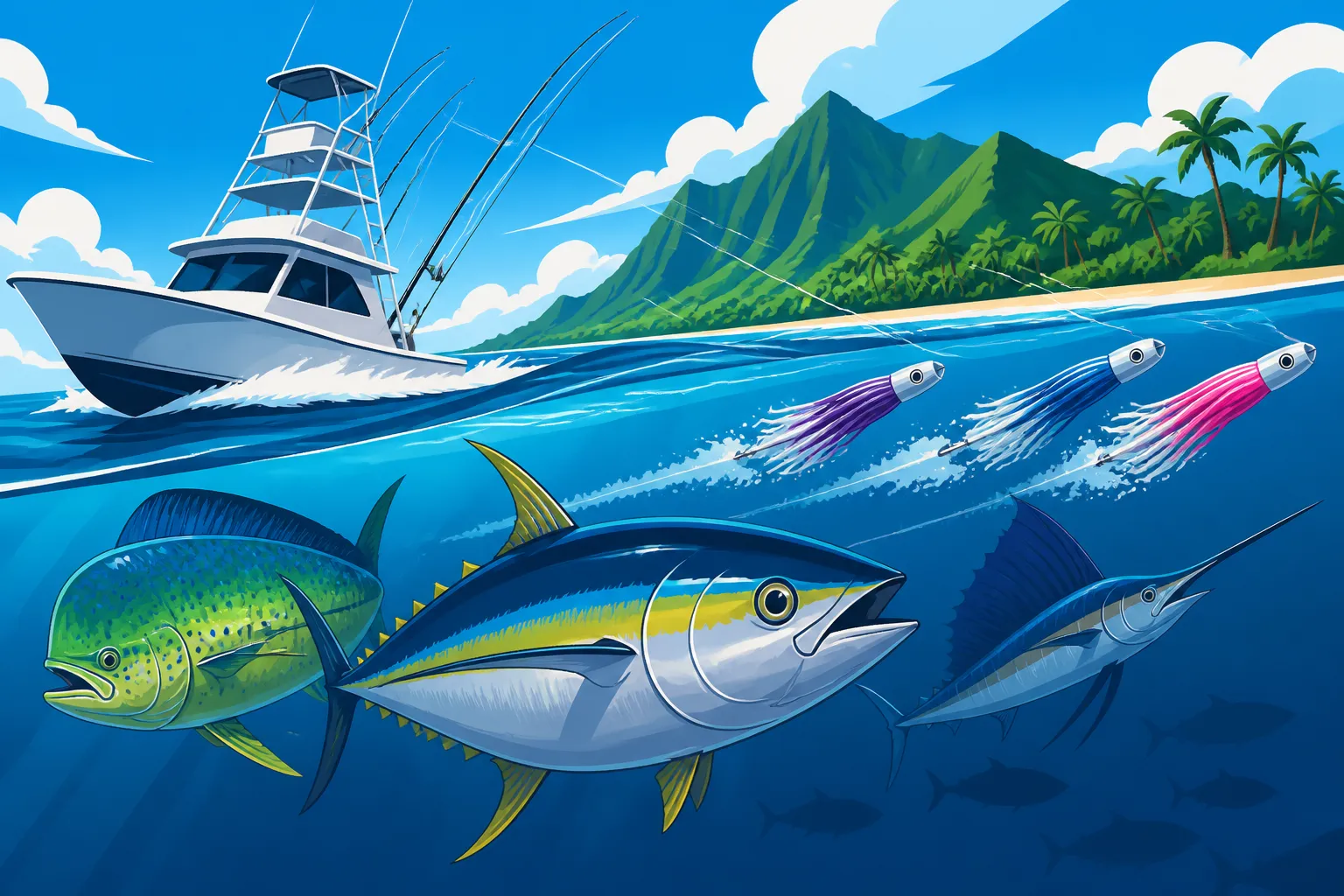
Mahi-mahi, with their vibrant colors and acrobatic fights, are notorious for congregating around floating debris, FADs (Fish Aggregating Devices), and current lines. They're opportunistic feeders, and a well-presented lure skipping across the surface near these features is often irresistible. Ono, also known as wahoo, are absolute speed demons, identifiable by their slender bodies and razor-sharp teeth. They hit lures with incredible force and can strip line faster than almost anything else. You'll often find them patrolling current edges or deep drop-offs. Then there are the various tunas, with the ahi (yellowfin tuna) being the most prized. Ahi are powerful, deep-diving fighters that often school together, sometimes in massive numbers, and they are a primary target for many offshore operations. They respond well to both high-speed trolling and more subtle presentations. Understanding their distinct behaviors is key to tailoring your approach.
Marlin: The Apex Predators of the Pacific
For many anglers, the ultimate prize in Hawaiian waters is a marlin. We have several species here, but the blue marlin is the undisputed king. These magnificent fish can grow to enormous sizes, often referred to as "grandeur" when they exceed 1,000 pounds, and their power and stamina are legendary. They're apex predators, patrolling the deep blue, often along temperature breaks, ledges, and areas where baitfish congregate. Striped marlin are also common, especially in cooler months, and offer a spirited fight on lighter tackle. Black marlin are less common but still present.
Targeting marlin requires a different level of commitment and specialized techniques. They're not always easy to find, and hooking one is just the beginning of what can be an epic battle. Knowing when and where they're most active, such as during the peak Marlin Fishing off the Kona Coast season, dramatically improves your odds. These giants are attracted to larger, flashier lures, often trolled at higher speeds, and they'll strike with a force that'll make your heart pound.
Seasonal Patterns and Migration
Hawaii's pelagic fishing can be good year-round, but specific species do have their peak seasons driven by migration, spawning, and bait availability. For instance, while you can find marlin throughout the year, the summer months, roughly June through September, are often considered prime time for larger blue marlin off the Kona Coast of the Big Island. This is when the waters are typically warmer, and baitfish schools are abundant.
Ono tend to be more prevalent during the warmer months as well, often from spring into fall. Mahimahi are also warmer-water dwellers and can appear in great numbers, especially when there's an influx of floating debris. Ahi, on the other hand, can be caught consistently throughout the year, but their activity levels and sizes can fluctuate with seasonal patterns. Understanding Hawaii Fishing Season Dates and Closures for different species helps you plan your trip for the best possible outcome. Staying informed about these patterns from local fishing reports and experienced captains is invaluable for tailoring your trolling efforts to what's biting.
Essential Trolling Gear for Hawaiian Waters
Having the right equipment is absolutely non-negotiable when you're heading out to tackle Hawaii's pelagic species. These fish are powerful, fast, and can put an incredible strain on your gear. Skimping on quality here can lead to heartbreak.
Rods, Reels, and Line: Power and Capacity
For serious offshore trolling in Hawaii, you're going to need heavy-duty conventional tackle. For marlin and larger tuna, think 50-pound to 80-pound class outfits, and even 130-pound gear for the biggest blues. These reels, like those from trusted brands such as Penn or Shimano, need high line capacity and smooth, powerful drag systems to handle long, blistering runs. Rods should be stout, designed for trolling, with roller guides to reduce friction on the line during a fight. A good trolling rod has a sturdy backbone to apply pressure but enough tip action to absorb the shocks of a fish striking a lure.
For mahi-mahi and ono, you might opt for slightly lighter 30-pound or 50-pound class tackle, which still provides plenty of fight while offering a bit more sporting challenge. The line itself is crucial. Monofilament is traditional for its stretch and shock absorption, typically 50 to 130-pound test. Many anglers are now also incorporating braided line for its thinner diameter and zero stretch, often topped with a long monofilament or fluorocarbon leader, especially for species like ahi, where sensitivity can make a difference. Make sure your lines are fresh, well-maintained, and regularly checked for nicks or abrasions. Finding reliable heavy-duty line and leader material can be done easily on platforms like Amazon, ensuring you have the strength needed for these powerful fish.
Lures and Skirts: The Eye-Catchers
The world of trolling lures is vast and exciting, but in Hawaii, some types consistently outperform others. Skirted lures are a staple for pelagic trolling. These lures, often made of resin or metal heads adorned with colorful vinyl or rubber skirts, create an enticing commotion in the water, mimicking baitfish or squid. Popular shapes include bullet heads, chuggers, and plungers, each creating a different action. Colors are crucial, with green-and-yellow, blue-and-silver, purple, and black-and-red being perennial favorites.
For marlin, larger lures (8-14 inches or more) are often preferred, designed to track straight and produce a significant smoke trail. For Best Lures for Marlin Trolling off Kona, you'll see a lot of these big, flashy options. For mahi-mahi and ono, smaller skirted lures (5-8 inches) or lipped diving plugs can be incredibly effective. Jet heads, which create a bubble trail, are also popular for their ability to attract strikes. Often, a combination of colors and sizes in your spread is the best approach to see what the fish are keying in on that day. Don't forget to have a good supply of replacement skirts and leader material, as these toothy critters can make quick work of your tackle.
Outriggers, Downriggers, and Planers: Spreading the Love
To maximize your trolling spread and present multiple lures effectively, specialized equipment is often employed. Outriggers are long poles mounted on the sides of the boat that allow you to spread lines wide, away from the prop wash. This creates a much wider "strike zone" and also prevents lines from tangling. They utilize release clips that hold the line under tension until a fish strikes, at which point the line pops free, allowing you to fight the fish directly from the rod tip.
Downriggers are essential for presenting lures at specific depths below the surface, which is critical when fish are holding deeper, or when targeting species like ahi that often feed further down. They use a heavy weight to carry your line down, again with a release clip, allowing you to troll lures precisely where the fish are. Planers, like the #4 or #8 planers, achieve a similar depth-finding effect without the need for a mechanical downrigger, using water resistance to pull the lure down. Each of these tools plays a vital role in creating a dynamic and varied trolling spread, making your presentation much more appealing to a wider range of pelagic species.
Mastering Different Trolling Lure Spreads
Once you have your gear sorted, the next step is understanding how to arrange your lures in the water, known as your "spread." This isn't random; a well-designed spread mimics a school of baitfish, creates a complex and enticing presentation, and prevents lines from tangling.
Standard Spreads for Mixed Bags
A versatile, standard spread is designed to attract a variety of pelagic species. A common setup involves positioning lures at varying distances behind the boat and at different positions (long, short, outrigger, flat line).
Typically, you'll have:
- Short Corner: A lure run closest to the boat on the flat line, often just outside the prop wash. This usually gets a lot of strikes from aggressive fish.
- Long Corner: Another flat line, further back than the short corner.
- Short Rigger: A lure run from the outrigger, relatively close to the boat but spread wide.
- Long Rigger: The furthest lure run from an outrigger, creating the widest and longest presentation.
- Shotgun/Center Rigger: This lure is run directly down the center, far behind all other lures, often in the cleanest water. This position is frequently effective for large marlin or ahi that might be tracking the spread from a distance.
This staggered approach ensures that each lure is running in "clean water" (water not disturbed by other lures or the boat's wake) and creates a convincing illusion of a scattering bait school. Varying lure sizes and colors within this spread can appeal to different species simultaneously. Some anglers like to put a particularly noisy chugger or splashy lure in the short corner to attract attention, then follow it with subtler presentations further back.
Specialized Spreads for Marlin and Tuna
When you're specifically targeting grander marlin or large ahi, you'll often adjust your spread to match their preferences. For marlin, many captains lean towards a spread of larger, often darker-colored skirted lures. The goal is to imitate bigger baitfish or squid, something substantial enough to entice a massive predator. The "shotgun" position, way back in the clean water, is a classic spot for a big marlin lure. Sometimes, a "stinger" lure, a smaller offering fished on ultra-light leader but far, far back, can also draw a marlin that's inspecting the spread.
For tuna, especially ahi, while they'll hit the same lures as marlin, some specific adjustments can be made. High-speed trolling with smaller, bullet-head lures is very effective for tuna, as is targeting them with feathered or jet-head lures. Using a spreader bar, which creates the illusion of an entire school of baitfish, can be a game-changer for ahi. These bars, often rigged with multiple plastic squids and a "stinger" lure at the end, are irresistible to schooling tuna. It's about presenting a compelling buffet that's too good to pass up.
Adjusting Spreads for Weather and Sea Conditions
The ocean is constantly changing, and a truly skilled troller knows how to adapt their spread to the conditions. In choppy or rough seas, lures might "wash out" or tangle more easily. In these conditions, you might want to bring your lures closer to the boat, use heavier lures that stay in the water better, or choose lures with more aggressive actions that can handle the turbulence. Some captains might even reduce the number of lines out to minimize tangles.
Conversely, on a calm, glassy day, the fish might be more wary. This is when longer leaders, subtler lure actions, and perhaps even scaling down lure size can be beneficial. In very clear water, fluorocarbon leader material, which is nearly invisible, can make a significant difference. Wind direction also plays a role; trolling directly into a strong headwind can make lures jump erratically, while trolling with the wind can allow for a faster, smoother presentation. Always observe how your lures are running and make adjustments – it's a dynamic process that requires constant attention.
Advanced Trolling Strategies for Specific Species
Beyond the basic spreads, there are specific techniques that can greatly increase your success rate for particular species in Hawaii's waters. These often involve tweaking speed, lure type, or incorporating natural baits.
High-Speed Trolling for Ono and Tuna
Ono, or wahoo, are built for speed, and they often react aggressively to lures trolled at higher velocities. While typical trolling speeds for marlin might range from 6 to 9 knots, for ono, you're often pushing 10 to 15 knots, sometimes even higher. This requires lures specifically designed for high-speed use – heavy, bullet-shaped heads that track true and don't blow out of the water. Often, stainless steel jet heads or torpedo lures are favored for their stability.
This technique is also very effective for pelagic species like tuna, especially when trying to cover a lot of ground quickly to locate schools. High-speed trolling creates a lot of commotion, which can attract these fast-moving predators from a distance. It's exhilarating when an ono hits a lure at 15 knots – the rod doubles over with incredible force! The key is to ensure your connections, swivels, and leader material are all top-notch to withstand the immense pressure of such a strike. Many anglers find high-quality swivels and clips from fishing supply stores, or even online via Amazon, are essential for maintaining tackle integrity during high-speed runs.
Slow Trolling Live Bait for Marlin
While artificial lures are incredibly effective, nothing quite beats the appeal of live bait for a big marlin. Slow trolling involves rigging a large, live baitfish – like a skipjack tuna (aku), mackerel scad (opelu), or even a small mahimahi – and slowly pulling it through prime marlin territory. This technique is often employed when a marlin is spotted on the surface, or when working known marlin haunts like the FADs or temperature breaks.
The key here is presentation. The live bait needs to swim naturally, not be dragged lifelessly. This usually involves rigging it with a heavy-duty circle hook either through the nose or dorsal fin, ensuring it stays lively. The boat's speed is reduced to a crawl, just enough to keep the bait swimming effectively. This method allows the marlin to get a good look at the bait, increasing the chances of a solid strike. It requires patience and a keen eye to watch the bait's behavior, as well as the water for any signs of a lurking predator. When you're targeting big fish, sometimes the subtle, natural approach is the most potent.
Chunking and Churning: Attracting the Bite
"Chunking" is a technique primarily used for tuna, especially ahi, but it can also attract other pelagics. It involves drifting (or slow-trolling) while continuously throwing out small pieces of cut bait, or "chum," into the water. This creates a scent trail and an easy meal that draws fish up from the depths and holds them near the boat.
As the fish become active on the chum line, you present your hooked baits, often rigged on a fluorocarbon leader with a small, sharp circle hook, to drift naturally alongside the chum. This can be incredibly effective for targeting ahi, particularly when they're not actively striking trolled lures. "Churning" is another method where you create a vigorous baitfish school illusion by throwing live bait (often opelu or akule) into the water to excite predators, then presenting your hooked live bait or a lure among the chaos. Both methods require a good supply of fresh bait and an understanding of how to read the fish's reaction to your chum. It's often employed near the Hawaii Fish Replenishment Area boundaries in West Hawaii or around FADs where bait is plentiful and tuna are known to gather.
Reading the Ocean: Locating Prime Trolling Grounds
One of the biggest differences between just dragging lures and consistently catching fish is the ability to "read the ocean." The ocean isn't uniform; it has highways, neighborhoods, and feeding grounds for pelagic fish. Knowing how to identify these areas is paramount.
Currents, Eddies, and Temperature Breaks
Pelagic fish are highly influenced by oceanographic features. Currents act like conveyor belts, bringing baitfish and nutrients, and fish will often patrol the edges of these currents. Look for current lines, which are often visible as distinct color changes, debris lines, or even areas where the chop changes direction. Fish will often hold on the "clean" side of a current line, ambushing bait caught in the faster flow.
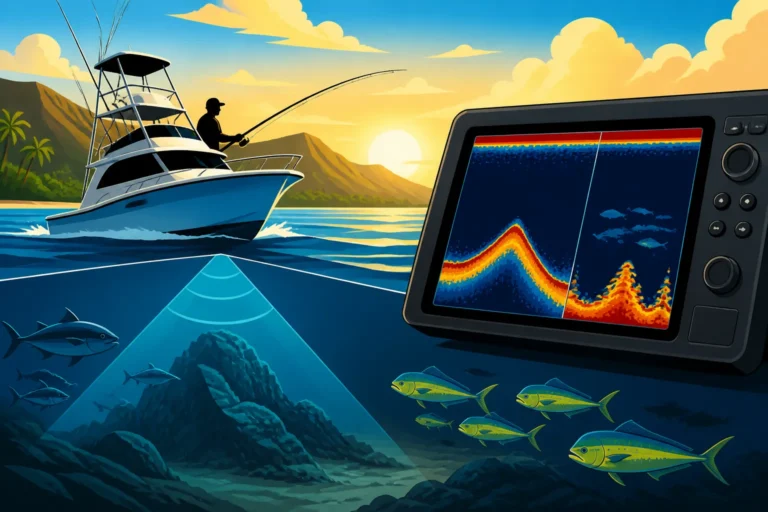
Eddies, which are swirling circular currents, can concentrate baitfish and nutrients, making them hotspots for predators. Satellite imagery, if available, can sometimes show these large-scale features. Temperature breaks, where warmer and cooler water masses meet, are also prime targets. Fish, especially marlin and tuna, have preferred temperature ranges, and they will congregate along these thermal edges where different water masses mix, bringing together food sources. Utilizing a boat's fish finder and temperature gauge, along with real-time ocean data (which some charter boats have access to), helps pinpoint these subtle but crucial transitions.
Bait Balls and Bird Activity
The simplest and often most reliable sign of pelagic fish activity is the presence of baitfish and birds. Where there's bait, there are predators. Keep a keen eye on your sonar for dense schools of baitfish, often appearing as large, dense blobs on the screen. If you mark a significant bait ball, work your lures around its edges or directly through it.
Bird activity is an even more obvious indicator. Frigate birds, boobies, and terns diving and circling indicate that baitfish are being pushed to the surface from below, often by feeding tuna, mahi-mahi, or marlin. A group of birds frenziedly crashing into the water means a serious feeding frenzy is underway. Head straight for the action, but approach carefully so as not to spook the fish or the bait. Remember, fish pushing bait to the surface are often concentrated and actively feeding, making them excellent targets for your trolling spread. This often happens near spots mentioned in guides like the Best Fishing Spots in Hawaii.
FADs (Fish Aggregating Devices) and Structure
Hawaii has a well-maintained network of FADs (Fish Aggregating Devices) deployed by the Department of Land and Natural Resources (DLNR). These buoys act as artificial reefs, attracting baitfish and, consequently, larger pelagic predators like ahi, mahi-mahi, and ono. Trolling around these FADs is a go-to strategy for many local fishermen. You'll typically make several passes around the FAD at various distances, sometimes starting wide and then working closer, looking for signs of activity.
Beyond FADs, offshore structure, even if it's deep and not visible, can hold fish. Submerged seamounts, ledges, and deep-water drop-offs create current breaks and upwellings that concentrate nutrients and bait. These are often known to experienced local captains or can be identified on detailed bathymetric charts. For example, specific areas off the Kona Coast are known for their deep-water structure that attracts marlin and ahi. Understanding these underwater landscapes is a vital part of locating prime fishing grounds. Checking your fishfinder for "marks" – individual fish or schools – around these structures is crucial.
Safety and Etiquette while Trolling in Hawaii
Fishing in Hawaii is an incredible experience, but it comes with responsibilities. Practicing good safety and etiquette ensures everyone has a positive time on the water and helps preserve our precious marine resources.
Vessel Safety and Communication
Before you even leave the harbor, ensure your boat is sea-worthy and equipped with all necessary safety gear. This includes life jackets for everyone on board (and correctly sized for children), flares, a first-aid kit, a VHF radio, and a fully charged cell phone. Filing a float plan with a responsible person on shore, detailing your intended fishing grounds and estimated return time, is always a smart move.
When you're out trolling, especially in busy fishing areas like off the Kona Coast, communication is key. Use your VHF radio to listen to channel 68 or 71 for local fishing chatter, which can offer valuable insights into fish activity or hazards. If you're encountering another boat's spread, give them plenty of room, and be clear about your intentions if you need to pass. Always be aware of your surroundings and other vessels, and never assume they see you. Hawaii Boating Laws for Anglers provides important regulations to ensure everyone's safety on the water.
Sharing the Fishing Grounds Respectfully
Hawaii's fishing grounds are a shared resource, and respect is paramount. Whether you're at a popular FAD or just trolling a promising stretch of water, other boats will likely be there too.
- Give Space: Don't troll directly into another boat's spread or cut them off. Allow ample room for them to work their lures.
- Follow the Pattern: If there's an established trolling pattern (e.g., all boats trolling in a specific direction around a FAD), join the pattern. Don't go against the flow, as it can lead to tangles and frustration.
- Be Patient: If a boat is hooked up, give them a wide berth. Fighting a big fish can involve long runs and maneuvering, so give them the space they need. It's common courtesy and helps prevent accidents.
- Listen to the Locals: Hawaiian fishing culture is rich with tradition. Listen to local advice, observe how others fish, and you'll learn a lot. Respectful behavior goes a long way.
Conservation Practices and Catch Care
As anglers, we are stewards of the ocean. Practicing responsible fishing ensures that future generations can enjoy the same incredible experiences we do.
- Know the Regulations: Always be aware of current Hawaii Bag and Size Limits by Species and other regulations for the species you're targeting. The Hawaii DLNR website is an excellent resource for this.
- Release Wisely: For species you don't intend to keep, or if you've already filled your bag limit, practice careful catch and release. Have the right tools ready (dehookers, bolt cutters for hooks) to minimize harm to the fish. For marlin, many anglers prefer to release them, especially the larger ones, after a quick photo.
- Utilize Your Catch: If you keep fish, ensure you utilize it fully. Proper handling from the moment it's caught (bleeding, icing down) ensures the best quality meat. Don't waste.
- Reduce Bycatch: Try to minimize catching non-target species. If you do catch something unintended, release it quickly and gently.
By embracing these principles, we contribute to healthy fish populations and a vibrant fishing community that respects the ocean and all its inhabitants.
Disclaimer
Please remember that fishing regulations, conditions, and best practices can change. Always consult the latest rules and advisories from the Hawaii Department of Land and Natural Resources (DLNR) Division of Aquatic Resources (DAR) before heading out. Safety should always be your top priority on the water.