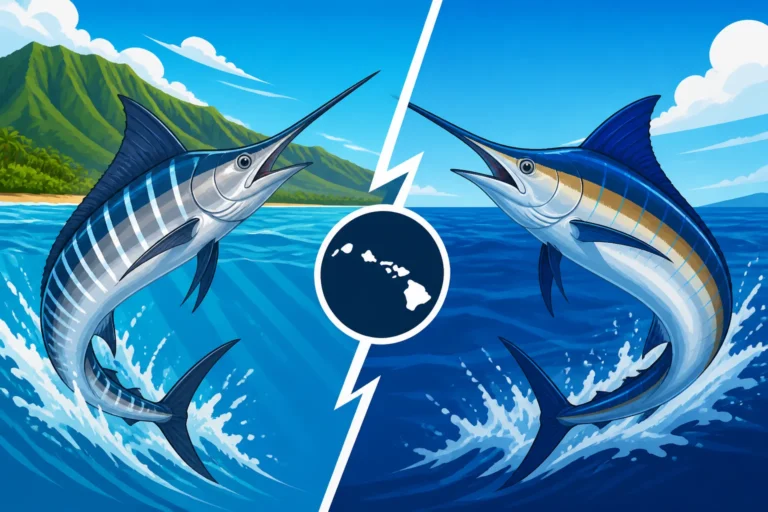
Blue Marlin vs Striped Marlin Identification
It’s an angler’s dream to hook into a powerful marlin in the waters off Hawaii, but in the heat of the moment, with adrenaline pumping and a magnificent fish thrashing at the end of your line, distinguishing between a Blue Marlin and a Striped Marlin can be trickier than you'd think. This guide is here to help you understand the subtle yet crucial differences, so you can confidently identify your catch, appreciate its unique characteristics, and ensure you're always fishing within regulations.
The Thrill of the Marlin Fight: Why Identification Matters
There’s nothing quite like the raw power and acrobatic displays of a marlin on the line. The sheer excitement can sometimes overshadow the need for careful observation, but knowing exactly what species you're battling is incredibly important for several reasons. It’s not just about bragging rights; it's about respecting the fish, the environment, and the law.
Instant ID for Regulation Compliance
Hawaii has specific fishing regulations designed to protect its marine life, and these often include differing size and bag limits for various species. Imagine the frustration of reeling in a magnificent marlin, only to realize later that you weren't certain if it met the legal requirements for its specific species. Having a solid grasp of identification points means you can make informed decisions quickly, especially if you plan to keep your catch or if you’re fishing a tournament with species-specific rules.
For instance, understanding the differences between a Blue Marlin and a Striped Marlin helps you comply with regulations outlined in resources like Hawaii Bag and Size Limits by Species or broader guidelines found in Hawaii Fishing Regulations Explained. Misidentification could lead to penalties, but more importantly, it means you might inadvertently harm a protected species or keep a fish that should have been released due to its size or status. It's about being a responsible steward of these incredible ocean resources.
Understanding Species-Specific Behaviors and Habitats
Beyond regulations, identifying your marlin quickly offers deeper insight into the fish itself. Each species has its own unique characteristics, preferred habitats, and even fighting styles. Knowing what you’ve hooked helps you understand why it's behaving a certain way and where you might find its brethren in the future. This knowledge can transform your fishing strategy, making you a more effective and intuitive angler.
For example, if you know you're targeting Blue Marlin, you'll focus on deeper, more pelagic waters, often trolling large lures or baits far offshore, as detailed in guides like Marlin Fishing off the Kona Coast. Conversely, Striped Marlin might be found in slightly different temperature bands or closer to certain underwater structures, influencing where you drop your lines. Understanding these nuances helps you adapt your techniques, from lure choice to trolling speed, giving you an edge on the water and deepening your appreciation for these magnificent ocean predators.
Key Physical Characteristics: A Head-to-Tail Comparison
When these majestic creatures are splashing at the surface, it can be tough to notice the fine details. However, there are several key physical traits that, once you know what to look for, make distinguishing between a Blue Marlin and a Striped Marlin much clearer. It's often about looking at the body as a whole, rather than focusing on just one feature.
Dorsal Fin Distinctions
One of the most immediate and telling differences between a Blue Marlin and a Striped Marlin lies in their dorsal fins. This feature often provides the first clear clue, even from a distance, as the fish jumps or swims near the boat. It's a hallmark trait that experienced anglers learn to spot instantly.
The Blue Marlin typically has a dorsal fin that is relatively short and rounded, with a more pronounced curve. Critically, this fin is designed to fold almost completely flat into a groove along its back, creating a very streamlined profile when the fish is swimming at high speeds. When you see a Blue Marlin, even if it's thrashing, the dorsal fin won't stand up like a rigid sail, but rather remain somewhat tucked or partially flattened.
In stark contrast, the Striped Marlin boasts a much taller, more pointed dorsal fin. This fin is often described as "sail-like" because it's more rigid and typically remains at least partially erect, even when the fish is swimming rapidly or fighting hard. It doesn’t retract nearly as much as the Blue Marlin’s dorsal, giving the fish a distinct, high-finned silhouette. If you see a marlin with a prominent, almost continuously visible dorsal fin while it’s speeding across the surface, chances are you’re looking at a Striped Marlin.
Pectoral Fins and Body Shape
Beyond the dorsal fin, the pectoral fins and the overall body shape offer additional critical clues for identification. These characteristics speak to the different evolutionary paths and swimming styles of these two powerful species. Looking at how these fins are held and the general profile of the fish can reveal a lot.
The Blue Marlin possesses pectoral fins that are quite rigid and relatively fixed. Unlike some other billfish, these fins do not easily fold flat against the body. They typically stick out somewhat, even when the fish is resting or swimming. This rigidity, combined with their generally more robust and heavy-bodied physique, gives the Blue Marlin a distinct, almost "barrel-chested" appearance. They are built for immense power and sustained deep dives, which is reflected in their thick, muscular build. When you're dealing with a large specimen, you'll immediately notice the sheer bulk.
On the other hand, the Striped Marlin has more flexible pectoral fins that can be folded flat against its body with relative ease. This anatomical difference contributes to its more streamlined, slender, and compressed body shape. Rather than "barrel-chested," a Striped Marlin appears more like a sleek, elongated torpedo, built for incredible speed and acrobatic maneuvers. Their more graceful, agile form allows for the spectacular jumps and tail-walking that they are so famous for, often making them a favorite for anglers who appreciate a visually dramatic fight.
Lateral Line and Scale Patterns
While perhaps not the first features you'd notice on a fast-moving, fighting fish, the lateral line and subtle scale patterns can also provide definitive identification markers, especially once the fish is alongside the boat or if you have a moment to observe more closely. These are less about the dramatic visual and more about the anatomical specifics.
For the Blue Marlin, the lateral line, which is a sensory organ running along the side of the fish, is generally less visible, especially in larger, mature individuals. It typically forms a single, simple loop above the pectoral fin before continuing along the mid-flank. The scales themselves are relatively small and embedded, giving the skin a smoother, almost seamless appearance that doesn't highlight any particular pattern. This contributes to the overall sleekness of its formidable frame.
Conversely, the Striped Marlin often features a much more prominent and clearly visible lateral line. It can sometimes appear wavy or zigzagging along the body, standing out more against its background coloration. While their scales are also relatively small, there can sometimes be subtle, distinctive scale patterns that are more apparent than on a Blue Marlin. This level of detail might require a calmer fish or a clearer view, but it’s another piece of the puzzle that helps in How to tell a blue marlin from a striped marlin when you're making a positive identification. These fine details, when combined with the more obvious fin and body shape differences, remove any doubt.
Coloration, Stripes, and Markings
One of the most striking ways to differentiate between these two magnificent species is by observing their coloration and, most notably, the presence and vibrancy of their vertical stripes. When the light hits them just right, or when they are particularly excited, these colors and patterns truly pop.
Blue Marlin Color Palette
The Blue Marlin, as its name suggests, is characterized by a deep, iridescent cobalt blue or almost black coloration on its back and upper flanks. This dark hue provides excellent camouflage from above, allowing it to blend into the deep ocean waters. Below the lateral line, its belly transitions to a silvery-white, creating a stark contrast.
What's crucial to note about Blue Marlin is the absence or extreme faintness of vertical bars or stripes. While they might occasionally display very subtle, dusky, or faded vertical bands when stressed or coming out of the water, these are never as distinct or as iridescent as those found on a Striped Marlin. In many instances, especially on a healthy, active fish, you'll observe a uniform, almost solid blue back. The overall impression is one of powerful, understated grandeur, reflecting its position as a true apex predator of the open ocean.
Striped Marlin's Vivid Patterns
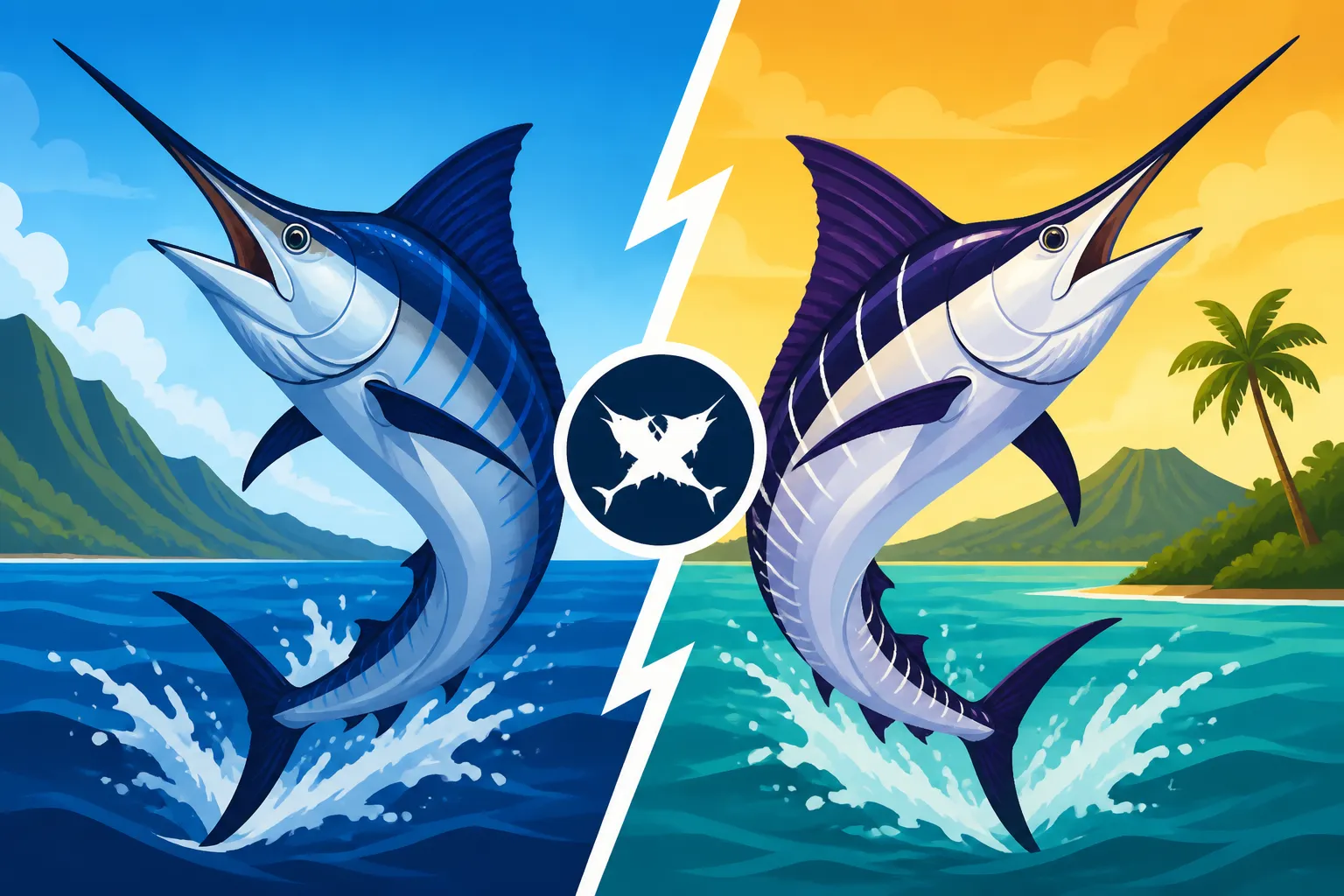
The Striped Marlin, in contrast, is an absolute showstopper when it comes to coloration and markings. Its back is typically a vibrant blue-black or a lighter, more metallic blue than the Blue Marlin, fading into silvery sides and a white belly. However, the defining characteristic is its incredible display of vivid, iridescent lavender or light blue vertical bars or stripes that run down its sides.
These stripes are not just faint suggestions; they are often incredibly pronounced and seem to "light up" or glow when the fish is excited, stressed, or actively feeding. When a Striped Marlin is thrashing or jumping, these stripes shimmer with an almost electric intensity, making it an unforgettable sight. This dynamic coloration is perhaps the easiest and most reliable visual cue for identification, especially when you catch a glimpse of the fish speeding through the water or leaping into the air. If you see those unmistakable glowing stripes, you've almost certainly got a Striped Marlin on your hands.
Size, Weight, and Geographic Tendencies
Beyond visual cues, the sheer size and typical habitats of Blue and Striped Marlin also offer strong indicators for identification. While both are impressive game fish, there's a significant difference in their average and maximum sizes, which often provides the first clue to an experienced angler. Their preferred hunting grounds can also guide your initial expectations.
Average Size and Potential Maximums
When it comes to size, the Blue Marlin is truly in a league of its own. These magnificent creatures are known to grow to immense proportions, making them one of the ocean's most sought-after trophy fish. In Hawaii, especially off the Kona Coast, Blue Marlin can frequently exceed several hundred pounds, with "grander" status (a fish weighing over 1,000 pounds) being the ultimate prize. While not an everyday occurrence, hooking into a blue weighing 500 to 800 pounds is certainly within the realm of possibility in these prolific waters. Their sheer mass and power are legendary, and when you feel that kind of weight on the line, it's often your first hint that you're connected to a true giant.
The Striped Marlin, while still a formidable game fish and an incredibly fun fight, is significantly smaller than its blue counterpart. They rarely exceed a few hundred pounds, with many fish caught in Hawaii weighing between 80 and 200 pounds. While there are always exceptions, if you're battling a fish that feels powerful but doesn't have the "train-like" pull of a true monster, it might very well be a Striped Marlin. Understanding Marlin Growth Rate to Grander Size helps put these size differences into perspective, showing just how much bigger Blue Marlin can get.
Preferred Habitats and Fishing Grounds
The choice of hunting grounds also varies between these two species, which can sometimes give you a strong indication of what you might encounter before you even get a bite. Knowing where to find them is key to effective angling, whether you're chasing the biggest or the most acrobatic.
Blue Marlin are highly pelagic, meaning they prefer the open ocean, often frequenting deeper, offshore waters far from land. They are frequently found congregating around deep-water structures like seamounts, ledges, or Fish Aggregating Devices (FADs), which attract baitfish. The Kona Coast of the Big Island, for example, is world-renowned for its deep-sea canyons and close-to-shore deep water, making it a prime location for Blue Marlin, as explored in articles like Best Deep Sea Fishing Spots in Hawaii. They thrive in warm tropical and subtropical waters, following bait concentrations across vast oceanic expanses. Targeting them often involves long runs offshore and trolling large lures or rigged baits.
Striped Marlin, while still an offshore species, tend to be found in slightly cooler, more temperate waters than Blue Marlin, and often closer to shore or over shallower offshore banks and reefs. They are known to form schools and are often found hunting in areas where upwellings or current lines concentrate baitfish, such as opelu and akule, which you can learn more about in What marlin eat off the Kona Coast. While you can certainly catch Striped Marlin off the Kona Coast, they are also prevalent in other areas of Hawaii and throughout the Pacific. Their tendency to be found in slightly shallower or more coastal offshore waters, sometimes in schools, can be another subtle indicator of their presence. Anglers targeting them might focus on different types of structure or depth ranges compared to those exclusively chasing the biggest blues.
Practical Identification Tips on the Water
When you're out on the water, the moment of truth often comes down to quick observations under dynamic conditions. A fish on the line is rarely stationary, so honing your ability to pick out key visual cues in real-time is invaluable.
Observing the Fight and Jumps
The way a marlin fights and jumps is often a strong indicator of its species, providing thrilling clues as you battle it out. Each species has a characteristic style that reflects its physiology and hunting prowess.
The Blue Marlin is renowned for its sheer power and deep, relentless dives. When hooked, a Blue Marlin typically makes long, powerful runs, stripping line off the reel at an alarming rate. They engage in strong headshakes and often perform spectacular "greyhound" jumps, where they breach the surface in a series of powerful, arcing leaps, covering significant distances. Their jumps are usually heavy, full-body explosions, demonstrating their immense bulk. If you're struggling to crank the reel and the fish is making long, unstoppable runs interspersed with powerful, albeit sometimes less frequent, aerial displays, you're likely in a wrestling match with a Blue Marlin.
The Striped Marlin, by contrast, is known for its incredible acrobatics and agility. While they also make powerful runs, they are far more prone to frequent, high-flying jumps and spectacular tail-walking across the surface. A Striped Marlin might spend more time out of the water than in it during a fight, putting on an unforgettable aerial show. Their jumps are often lighter, more graceful, and happen in rapid succession, as they try to throw the hook. If your fight involves a fish that’s constantly airborne, displaying its shimmering stripes and incredible agility, it's very likely a Striped Marlin. It's a truly magnificent display that keeps anglers on their toes.
A Quick Reference Table for Anglers
To help you quickly recall the key differences when you're on the water, here’s a handy comparison table. Keep these points in mind, and you'll be identifying your marlin like a seasoned pro in no time! This table summarizes the most reliable characteristics to help you make an informed decision swiftly.
| Characteristic | Blue Marlin | Striped Marlin |
|---|---|---|
| Dorsal Fin | Shorter, rounded, folds easily into a dorsal groove | Taller, more pointed, sail-like, often erect |
| Pectoral Fins | Rigid, difficult to fold flat against the body | Flexible, folds easily flat against body |
| Body Shape | Robust, heavy-bodied, often described as "barrel-chested" | Slender, more compressed, "torpedo-like" |
| Coloration | Deep cobalt blue back, silvery sides/belly | Blue-black back, silvery sides/belly |
| Stripes | Faint or absent vertical bars | Distinct, iridescent lavender/blue vertical bars |
| Lateral Line | Less visible, single simple loop | Prominent, often wavy, visible |
| Average Max Size | Much larger (often 400-800+ lbs, capable of 1000+ lbs) | Smaller (typically 80-200 lbs, rarely over 300 lbs) |
| Jumping Style | Powerful, strong headshakes, greyhound jumps | Acrobatic, frequent high jumps, tail-walking |
Photography for Post-Fight Confirmation
Sometimes, in the excitement of a catch, it’s hard to make a definitive identification, especially if you're focused on a quick release. This is where modern technology can be your best friend. Having a waterproof camera or phone readily accessible can be incredibly useful for capturing quick shots of your catch.
Before releasing a fish, if it's safe and responsible to do so, try to get a clear photo that captures its key features: the dorsal fin, pectoral fins, and any visible stripes. These photos can be invaluable for confirming your identification later, or for sharing with fellow anglers for their input. Remember the importance of responsible handling for Marlin catch and release survival tips, so prioritize the fish's well-being and a quick release. A quick snap can provide a lasting memory and clarity without undue stress on the fish. You can even use these photos to look for specific patterns or details you might have missed in the moment, perhaps comparing them to images of known species online or in fishing guides you might have downloaded to your phone, purchased on Amazon, or packed in your tackle box.
No matter which marlin species you encounter in Hawaii's beautiful waters, the experience is bound to be unforgettable. By learning these key identification differences, you'll not only enhance your knowledge but also become a more responsible and observant angler, ready for whatever the ocean throws your way. Remember to check resources like Best Time of Year to Fish in Hawaii and Best Lures for Marlin Trolling off Kona to maximize your chances of encountering these magnificent fish.
Disclaimer
This article is for general informational purposes only and does not constitute professional advice. Laws, prices and regulations vary by location and change over time. Consult a qualified professional for guidance on your specific situation.