Where to Find Blue Marlin off Kona
For many anglers, the dream of hooking into a colossal blue marlin off the Kona Coast is a powerful one, often accompanied by the frustration of knowing these magnificent fish are out there, but not quite knowing where "there" is. It's a vast ocean, and pinpointing these elusive giants can feel like searching for a needle in a haystack. This guide is here to demystify the blue marlin's preferred haunts in Kona's legendary waters, helping you understand their environment and behavior so you can increase your chances of that once-in-a-lifetime encounter.
Understanding the Kona Coast for Blue Marlin
The Kona Coast of the Big Island isn't just picturesque; it's a geological marvel that creates a uniquely perfect habitat for blue marlin. Unlike many other prime marlin destinations, Kona benefits from its leeward position, sheltered from the prevailing tradewinds, which results in remarkably calm seas for much of the year. This combination of deep, nutrient-rich waters and tranquil conditions sets the stage for a thriving pelagic ecosystem that blue marlin absolutely adore. It's not just luck that makes Kona famous for these incredible fish; it's the very structure of the ocean floor and the consistent weather patterns that draw them in.
The Deep Ocean Canyons and Upwellings
The dramatic underwater topography off Kona plays a crucial role in attracting blue marlin. The island's volcanic slopes plunge thousands of feet directly into the Pacific, creating incredibly deep ocean canyons remarkably close to shore. These deep waters are home to nutrient-rich currents that sweep up from the abyssal plains, leading to what we call "upwellings." These upwellings bring cold, fertile water closer to the surface, sparking a chain reaction in the food web. Microscopic organisms bloom, attracting baitfish, which in turn attract larger predatory fish, and ultimately, the top predators like blue marlin.
Think of it like an underwater mountain range with fertile valleys. The marlin aren't just swimming aimlessly; they are following these underwater highways and feeding grounds. These deep trenches and seamounts create natural congregation points where baitfish feel secure yet are also funneled into concentrated areas, making them easier targets for a fast-swimming hunter like a blue marlin. Understanding where these underwater features are located is the first step in unlocking Kona's marlin potential.
Kona's Unique Leeward Climate and Calm Waters
One of the most defining characteristics of the Kona Coast is its exceptionally calm waters. Positioned on the leeward side of the Big Island, it is shielded from the strong northeast tradewinds that typically buffet the rest of the Hawaiian islands. This creates a "Kona glass" effect, especially in the mornings, where the ocean surface is often as smooth as a mirror. While calm waters might seem like a minor detail, it has profound implications for marlin and those who pursue them. For marlin, it means less energy expended swimming through turbulent seas, and potentially easier conditions for spotting prey.
For anglers, these calm conditions make it much easier to spot surface activity – a marlin crashing bait, a dorsal fin slicing through the water, or birds diving into a baitball. It also means more comfortable fishing, which translates into more time on the water and better focus for the crew. These predictable, often tranquil, conditions allow captains to run precise trolling patterns and maintain optimal lure presentations, which is critical when targeting finicky apex predators like blue marlin.
Seasonal Movements and Water Temperatures
While Kona boasts year-round marlin fishing, there are definite peaks in activity influenced by seasonal movements and subtle shifts in water temperature. Blue marlin are warm-water creatures, and they tend to follow the baitfish that thrive in specific temperature bands. Generally, the late spring through fall months (roughly May to November) are considered prime time for blue marlin, with August and September often being exceptional. During these months, the water temperatures are consistently warm, and baitfish like skipjack tuna and opelu are abundant, drawing the marlin in closer to shore and making them more accessible.
However, don't discount the "off-season." Even in the winter months, blue marlin can be found, particularly if a strong current brings warmer water or schools of bait closer to the coast. Experienced captains constantly monitor water temperature charts, satellite imagery, and local reports to track these subtle shifts. A few degrees difference in water temperature can often mean the difference between a slow day and a hot bite. Understanding Best Time of Year to Fish in Hawaii can provide a broader context, but for blue marlin, it’s all about chasing that warm, food-rich water.
Key Hotspots for Blue Marlin Activity
Kona's reputation as the "Marlin Capital of the World" isn't built on a single spot, but rather a series of well-known, highly productive areas that consistently hold bait and, consequently, big blues. These hotspots are often defined by their proximity to deep water, natural current breaks, or artificial structures that aggregate marine life. Knowing these areas and what makes them attractive to marlin is fundamental to a successful trip, whether you're heading out on a charter or trying your luck with a private boat.
The "Grander Lane" and the 100-Fathom Line
If you've spent any time researching Kona fishing, you've likely heard of the "Grander Lane" and the "100-fathom line." These aren't just catchy phrases; they represent prime marlin territory. The "Grander Lane" is essentially the stretch of water off the Kona Coast where many of the world's largest blue marlin (those over 1,000 pounds, or "granders") have been caught. This area is characterized by its close proximity to shore, where the ocean floor drops rapidly from a few hundred feet to thousands.
The "100-fathom line" refers to the depth contour where the ocean is approximately 600 feet deep. This line often runs parallel to the coastline, and it's a critical depth for pelagic predators like marlin because it marks a significant transition zone. It's often where baitfish school, and where upwelling currents push nutrients and cooler water towards the surface. Many Kona captains will meticulously troll along this depth contour, as it's a proven highway for blue marlin. The steep drop-offs provide both feeding opportunities and deep-water sanctuary for the marlin. You'll often find the most consistent action here, sometimes just a few miles offshore from places like Honokohau Harbor.
FADs and Buoys: Artificial Aggregating Devices
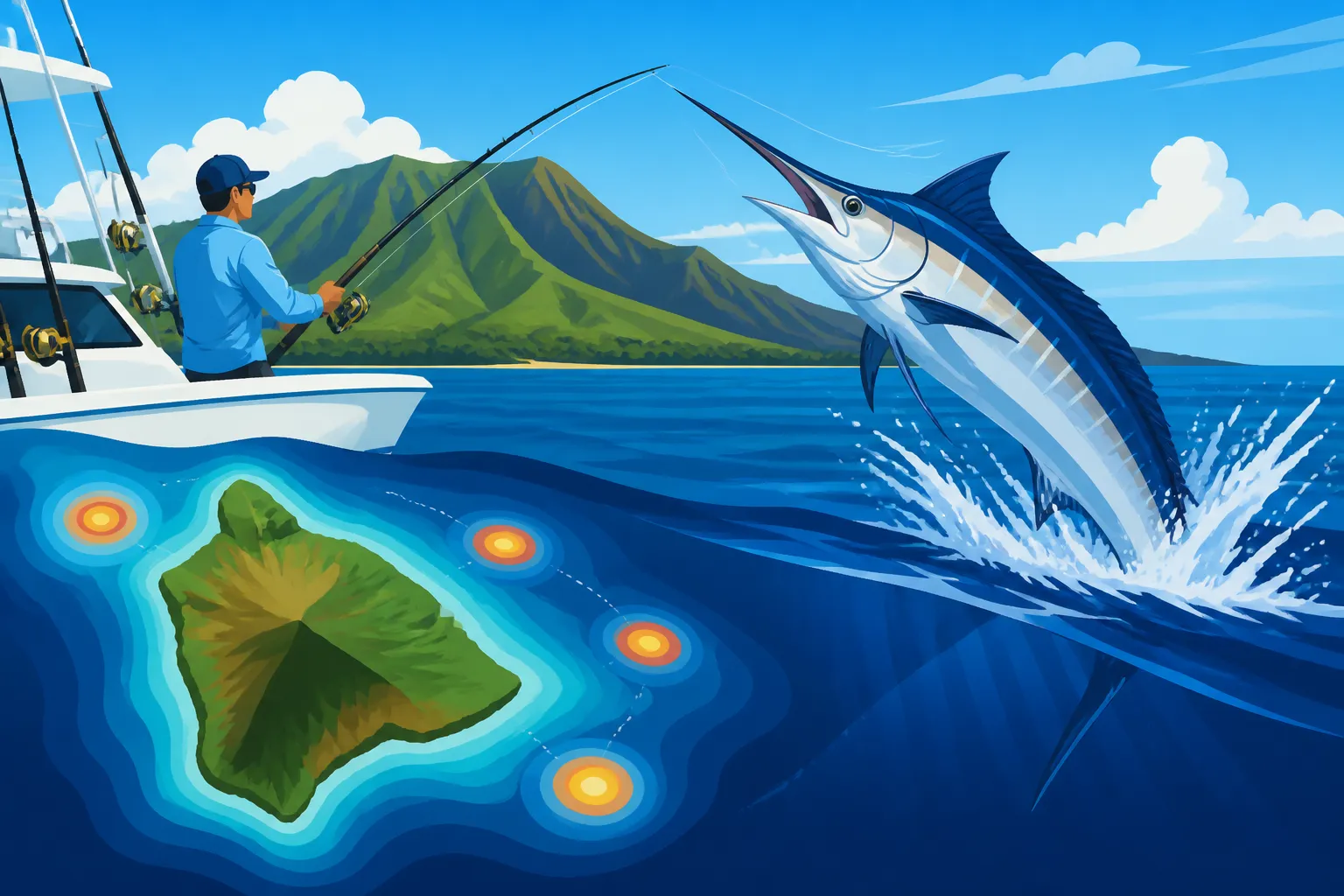
Fish Aggregating Devices (FADs), often simply called buoys, are man-made structures anchored in deep offshore waters. These FADs are designed to attract and hold baitfish, which then draw in larger predatory species, including blue marlin, ahi (yellowfin tuna), and mahimahi. The idea is that the FADs provide cover and a navigational reference point in the otherwise vast, open ocean, creating a mini-ecosystem around them. While they can attract all sorts of pelagic life, blue marlin are frequent visitors, patrolling the perimeters for an easy meal.
Fishing around FADs requires a slightly different approach than trolling a depth contour. Anglers might troll around them, drop live bait, or even jig the depths nearby. It's crucial to approach FADs with respect, as they are often public property or maintained by local fishing associations. Always check the current status of FADs (sometimes they break loose or are under repair) before planning your trip around them. You might find great success around these buoys, especially if you're targeting multiple pelagic species, as detailed in articles like Hawaii Pelagic Species Bag Limits.
Seamounts and Underwater Ridges
Beyond the immediate coastal drop-offs, the waters off Kona are dotted with numerous seamounts (underwater mountains) and ridges. These submerged structures act like magnets for marine life. As currents flow over these features, they create localized upwellings and turbulence that concentrate nutrients and baitfish. For blue marlin, these seamounts represent offshore oases – reliable feeding grounds in the middle of the open ocean. Some of these are well-known, while others are closely guarded secrets of local captains who have spent years mapping the ocean floor.
Fishing these seamounts often requires longer runs offshore, but the rewards can be significant, particularly for larger, more solitary marlin. The depths around these structures can vary wildly, offering diverse habitats for different bait species, which in turn attract a variety of predators. Utilizing advanced sonar equipment, often available on high-end fishing charters found on platforms like Amazon, becomes invaluable for identifying these subtle underwater features and the baitfish concentrations they hold, making it easier to pinpoint where the marlin might be cruising.
The Role of Baitfish in Locating Marlin
Ask any seasoned marlin angler, and they'll tell you that finding marlin isn't really about finding marlin; it's about finding bait. Blue marlin are apex predators, and their movements are almost entirely dictated by the availability and movement of their prey. If you can locate dense schools of the right baitfish, you're more than halfway to locating a hungry blue marlin. Understanding the behavior of these smaller fish is a critical skill for any angler hoping to score a Kona blue.
Preferred Forage: Skipjack Tuna, Mahimahi, and Ono
Blue marlin have a diverse diet, but they have distinct preferences, and certain baitfish are absolute magnets for them. Skipjack tuna, known locally as aku, are perhaps one of the most important food sources. These fast-moving, schooling tuna are often found in large numbers offshore, and marlin will follow their migrations. When you find a healthy school of skipjack, especially if they're feeding aggressively, you can be sure that bigger predators like marlin aren't far behind.
Mahimahi (Dorado) and Ono (Wahoo) are also high on the blue marlin's menu. Mahimahi are common around FADs and floating debris, and marlin will readily target them. Ono, with their incredible speed, are another favorite, often found along current lines and temperature breaks. Learning What marlin eat off the Kona Coast gives you a vital insight into what to look for on the water. When these species are abundant and active, it significantly increases your chances of encountering a blue marlin.
Tracking Bait Schools and Bird Activity
One of the oldest and most reliable methods for finding pelagic fish, including marlin, is to observe bird activity. Seabirds, particularly frigates, terns, and boobies, have an incredible ability to spot baitfish schools from high above. When you see a flock of birds diving, circling, or frantically feeding, it's a strong indicator that baitfish are being pushed to the surface by predators from below. Often, those predators are tuna or mahimahi, but just as often, a blue marlin might be lurking beneath, waiting for its opportunity.
Keep a keen eye on the horizon for "bird piles" – large concentrations of birds. Head towards them, but do so quietly and carefully. As you approach, look for signs of splashing, jumping baitfish, or even the tell-tale dorsal fins of larger fish. Sometimes, the baitfish schools themselves are visible as dark masses in the water. Paying attention to these natural indicators is far more effective than simply trolling blindly across the ocean.
Current Lines and Temperature Breaks
The ocean is a dynamic environment, and subtle shifts in currents and water temperature can create invisible highways and feeding zones for marlin. Current lines, often visible as streaks of foamy water, weed lines, or debris, indicate where two different currents meet. These lines often concentrate baitfish, as the currents sweep food and smaller organisms together. Marlin will patrol these current lines, using them as ambush points or simply following the easy food source.
Similarly, temperature breaks – where warmer water meets cooler water – are often highly productive. These thermal boundaries are typically where different water masses with varying nutrient levels and marine life populations converge. Modern boats often have sophisticated temperature gauges, and captains will look for these breaks, sometimes only a degree or two difference, as prime fishing grounds. A good captain will pay meticulous attention to these subtle oceanographic features, knowing they can be the key to finding where the marlin are holding.
Reading the Ocean: Signs of Marlin Presence
Even with all the technological advancements in fishing, nothing beats the ability to "read the ocean" – to interpret the subtle (and sometimes not-so-subtle) signs that indicate the presence of large game fish. For blue marlin, this involves everything from visual cues on the surface to interpreting what your electronics are telling you beneath the waves. Developing this observational skill is a hallmark of truly successful marlin anglers and captains.
Surface Activity: Jumps, Tail-Walks, and Bill Slashes
Sometimes, the marlin will announce their presence in spectacular fashion. A full breach, where a marlin leaps entirely out of the water, is an unmistakable sign. While they might do this when hooked, they also do it when actively feeding or simply agitated. A "tail-walk" – where the marlin propels itself across the surface on its tail – is another clear indicator of its presence. Less dramatic but equally important are bill slashes, where a marlin cuts through a baitball, often leaving a shimmering trail of scales or injured fish.
Keep your eyes constantly scanning the horizon, not just for birds, but for any unusual disturbance on the surface. A sudden splash, a dark shadow, or even a ripple that looks out of place could be a blue marlin. These visual cues are often fleeting, so quick reaction and keen observation are essential. Even a subtle change in the ocean's texture or color can sometimes hint at something bigger beneath.
Sonar and Fishfinder Interpretation
While old-school observation is vital, modern electronics are invaluable tools for locating marlin and their prey. High-quality sonar and fishfinders allow you to "see" what's happening beneath the surface. You'll be looking for large baitballs, individual marks of larger fish, and the tell-tale "arches" that indicate game fish. A good fishfinder can differentiate between types of baitfish, show the depth at which they are holding, and even indicate if larger predators are lurking nearby.
Interpreting these readings takes practice. Marlin often don't show up as distinct, solitary arches on a fishfinder in the same way a bottomfish might. Instead, you might see them as large, fast-moving marks near bait schools, or sometimes they might be so deep that they only register as faint signals. A deep-penetrating transducer, often found on reputable fishing gear sites like Amazon, is crucial here. Understanding your electronics and knowing what to look for can significantly improve your chances, especially when trolling along the Best Deep Sea Fishing Spots in Hawaii.
Understanding Ocean Currents and Drifts
Ocean currents are the lifeblood of the pelagic ecosystem. They transport nutrients, influence water temperatures, and carry baitfish along predictable paths. Blue marlin are incredibly efficient swimmers, and they use these currents to their advantage, often migrating with them or holding in areas where currents create advantageous feeding conditions. Understanding the general flow of currents off Kona, and how they interact with the underwater topography, can help you predict where bait and marlin might be found.
For example, a strong current pushing against a seamount can create an upwelling effect that brings deep-dwelling bait to the surface. Similarly, eddies and whirls formed by currents can concentrate baitfish in specific areas. Drifting with currents can also be an effective strategy, allowing your boat to cover a wide area while presenting baits naturally. Paying attention to current direction and speed, and how it's affecting your boat's drift and your lure presentation, is an often-overlooked but crucial aspect of marlin fishing.
Strategic Approaches to Targeting Kona Blue Marlin
Knowing where to find blue marlin is only half the battle; knowing how to approach and effectively fish for them is the other. Kona's unique conditions and the sheer size of its marlin often dictate specific strategies, from the types of lures and baits used to the way a boat trolls. Success often comes down to a combination of proven techniques, a willingness to adapt, and the expertise of your crew.
Trolling Spreads and Lure Selection
Trolling is the most common and often most effective method for targeting blue marlin off Kona. This involves dragging a spread of lures or rigged baits behind the boat at a specific speed, designed to mimic fleeing baitfish. The "spread" refers to the arrangement of lines and lures at different distances and positions behind the boat, creating a wide, enticing presentation. A typical Kona spread might include 6-8 lines, with a mix of large, brightly colored Hawaiian-style lures and sometimes rigged natural baits.
Lure selection is crucial and can vary depending on the day, water conditions, and what the marlin are feeding on. Popular choices are large bullet-head lures, chuggers, and jet heads, often in colors like blue and silver, black and purple, or pink and white. Many anglers spend countless hours researching Best Lures for Marlin Trolling off Kona to find the perfect combination. The goal is to create a commotion and a visual feast that triggers the marlin's predatory instincts, making it irresistible for them to come up and strike.
Live Baiting Techniques
While trolling lures is highly effective, live baiting can sometimes be the ticket, especially for finicky marlin or when targeting particularly large fish. Live baiting involves slow-trolling or drifting large, live baitfish – typically skipjack tuna or large scad – that are rigged to swim naturally. The distressed movements of a live baitfish are incredibly attractive to a marlin, often resulting in a more aggressive and committed bite.
Captains often catch fresh bait on the way out to the fishing grounds or in specific areas where baitfish congregate. The technique might involve slow-trolling one or two large live baits on dedicated outriggers, allowing them to swim freely but stay within the strike zone. This method requires patience but can be incredibly rewarding. It's a more nuanced approach than lure trolling, often favored when marlin are present but not aggressively chasing artificials.
The Importance of a Skilled Captain and Crew
Ultimately, the most critical factor in finding blue marlin off Kona, and successfully bringing one to the boat, is the expertise of your captain and crew. A seasoned Kona captain has spent thousands of hours on these waters, accumulating an intimate knowledge of the currents, the underwater topography, the seasonal patterns of baitfish, and the subtle signs of marlin presence. They understand the nuances of How to Catch Marlin off the Kona Coast better than anyone.
A skilled crew isn't just there to gaff fish; they are constantly watching the spread, adjusting lures, monitoring electronics, and communicating with the captain. They know how to read the water, identify current lines, and react instantly when a marlin strikes. Their collective experience, honed over years, is an invaluable asset. While you can certainly learn a lot on your own, chartering a reputable boat with an experienced crew dramatically increases your chances of finding and fighting a Kona blue marlin. Many top-rated charters, often reviewed on travel sites and found by searching terms like Best Marlin Charters off the Kona Coast, prioritize an experienced team to ensure a successful outing.
Here's a quick overview of Kona's marlin hotspots:
| Hotspot Name | Primary Attraction | Typical Depth Range (Approx.) | Best Conditions for Marlin |
|---|---|---|---|
| The "Grander Lane" | Steep drop-offs, nutrient-rich upwellings | 600 – 3,000+ feet | Calm waters, consistent bait presence |
| 100-Fathom Line | Depth contour, current breaks | 600 – 900 feet | Any conditions with active bait schools |
| FADs (Buoys) | Artificial baitfish aggregation | 1,000 – 6,000+ feet | Clear water, active baitfish |
| Seamounts & Ridges | Underwater topography, current interaction | Varies greatly (500 – 5,000+ feet) | Strong currents pushing bait over structure |
| Current Lines | Concentration of bait, debris, temperature breaks | Surface to 100 feet | Active bait movement, visible weed lines |
| Temperature Breaks | Thermal boundaries, nutrient convergence | Surface to 300 feet | Clear distinction between water masses |
Disclaimer
This article is for general informational purposes only and does not constitute professional advice. Laws, prices and regulations vary by location and change over time. Consult a qualified professional for guidance on your specific situation.