Are There Protected or Endangered Fish Species in Hawaii?
Accidental hookups with protected or regulated sea life can ruin an otherwise perfect day on the island waters. Navigating the complex web of federal conservation laws and local DLNR rules often leaves shore casters and boaters anxious about what is actually legal to land. This guide clears up the confusion surrounding protected fish and ocean life so you can fish responsibly, avoid massive regulatory fines, and protect Hawaii’s fragile marine ecosystem.
Protected Marine Species and Regulated Fish in Hawaiian Waters
When casting a line into Hawaii’s Pacific waters, it is easy to assume that anything biting your bait is fair game for the cooler. However, island waters serve as a sanctuary for several vulnerable species, many of which are shielded by state legislation or the federal Endangered Species Act. Distinguishing between a prized game fish and a legally protected creature is one of the most vital skills an island angler can develop.
Protected Elasmobranchs: Sharks, Manta Rays, and Stingrays
In Hawaiian culture, sharks hold a complex and revered place, often regarded as aumakua (family ancestral spirits). From a legal standpoint, state regulations strictly prohibit the intentional capture, entanglement, injury, or killing of any shark species within state marine waters. While anglers targeting pelagics off the Kona Coast or shore-casting for giant trevally may inadvertently hook a shark, keeping or intentionally harming one violates local marine laws.
Manta rays and stingrays enjoy similar elevated protections under Hawaii state law. The ocean giant manta ray (Mobula birostris) and the reef manta ray (Mobula alfredi) are protected from harvesting, harassment, or commercial capture. If you accidentally hook a manta ray while drift-fishing near coastal drop-offs, the law requires immediate release with minimal injury to the animal.
Anglers often ask Do Hawaii Waters Have Great White Sharks? or ask about ocean predators when prepping offshore heavy tackle. While large white sharks are rare visitors to Hawaii’s warm waters, other pelagic species like the oceanic whitetip shark (Carcharhinus longimanus) are listed as threatened under the Endangered Species Act. Furthermore, strict state legislation enforces Hawaii shark feeding and finning laws, meaning any landing, possession, or shark-attracting tour tactic using bait chumming in state waters carries severe legal consequences.
Protected Reef Fish, Groupers, and Marine Mammal Interactions
While true bony fish listed as federally endangered are relatively uncommon along shallow Hawaiian reefs, certain giant species and unique reef residents fall under strict conservation mandates. The giant grouper, often referred to locally as the brindlebass, is exceptionally rare and fully protected from taking or harvest. Coastal species that experience heavy harvesting pressure, such as the Hawaiian turkeyfish or rare endemic wrasses, are continuously monitored by the Division of Aquatic Resources (DAR), with severe bag limits or complete harvest bans in designated zones.
More commonly, anglers face ethical and legal dilemmas when non-fish species target their bait or lures. Green sea turtles (honu), hawksbill sea turtles (honuea), and the Hawaiian monk seal (iwa) frequently inhabit the same rocky ledges and shallow flats where shore casters throw whipping rigs for jack species.
IMPORTANT: Hawaiian monk seals and sea turtles are strictly protected under federal law.
Unintentional hookups must be handled by cutting line as close to the hook as safely possible.
Understanding Hawaii monk seal protected status near fishing grounds is crucial when casting from high lava cliffs or sandy beaches. If a monk seal approaches your fishing spot, the law requires maintaining a safe distance and reeling in your gear until the animal clears the area. Reviewing Hawaii turtle and monk seal proximity rules for anglers before heading down to shoreline access points will prevent accidental federal violations that carry hefty monetary fines.
How to Safely Handle Incidental Hookups of Protected Species
There is nothing quite as heart-stopping as realizing the massive weight on the end of your line is not a record-breaking bottomfish, but a protected sea turtle or an oceanic whitetip shark. Understanding how to handle these stressful situations protects both you and the animal, keeping you on the right side of conservation officers.
Unhooking and Line Cutting Procedures
When a protected marine animal takes your bait, your primary goal is to minimize distress and prevent physical trauma. Dragging a heavy green sea turtle or a large ray onto jagged basalt rock can shatter their shell or inflict fatal wounds. Instead, attempt to work the animal into shallow, calm water while keeping a safe distance from powerful flippers or thrashing tails.
- Do not pull on the line forcefully: Yanking a line caught in a turtle’s mouth or a ray’s wing can worsen the embedment or tear soft tissue.
- Use specialized line-cutting gear: If removing the hook requires flipping the animal, excessive force, or putting yourself in physical danger, it is best to cut the leader as close to the eye of the hook as possible.
- Avoid leaving long trailing lines: Long monofilament or braided lines left dragging behind a released turtle or monk seal can tangle in coral structures, leading to entanglement and drowning.
To streamline this process on high lava ledges or unstable shorelines, keep a dedicated pair of heavy-duty wire cutters or a long-reach dehooking tool in your tackle bag. A sturdy set of rust-resistant pliers or long-arm line cutters ordered on Amazon can easily snip thick monofilament or heavy wire leaders in seconds, giving protected marine life the best possible chance of survival.
State Regulations and Reporting Requirements
The Hawaii Department of Land and Natural Resources (DLNR) works alongside federal agencies to track gear interactions with protected marine life. If you accidentally hook a Hawaiian monk seal, green sea turtle, or dolphin, you are legally obligated to report the interaction to the local marine animal response hotline, even if the animal swims away apparently unharmed.
Familiarizing yourself with broader Hawaii Fishing Regulations Explained helps clarify what actions are legally required during incidental catches. Specialized harvesting techniques also carry strict gear constraints; reading up on Hawaii Spearfishing Regulations ensures freedivers and breath-hold spearos do not target protected species hiding inside underwater caves or ledge undercut zones.
| Species / Group | Legal Protection Status | Regulating Authority | Mandatory Angler Action on Hookup |
|---|---|---|---|
| Hawaiian Monk Seal | Endangered | Federal (NOAA) & State (DLNR) | Reel in immediately; if hooked, cut line close to hook and report to hotline. |
| Green Sea Turtle (Honu) | Threatened | Federal (NOAA) & State (DLNR) | Do not haul onto rocks; cut line close to hook safely; report gear interactions. |
| All Shark Species | Protected from intentional take | State of Hawaii (DLNR) | Immediate barbless release; no retention, tail-roping, or killing allowed. |
| Manta & Stingrays | Protected from intentional capture | State of Hawaii (DLNR) | Immediate release with minimal harm; do not drag across dry land or rocks. |
| Giant Grouper | Rare / Fully Protected | State of Hawaii (DLNR) | Zero possession limit; immediate release in water without removing from sea. |
Protected Fishing Zones and Marine Life Conservation Districts
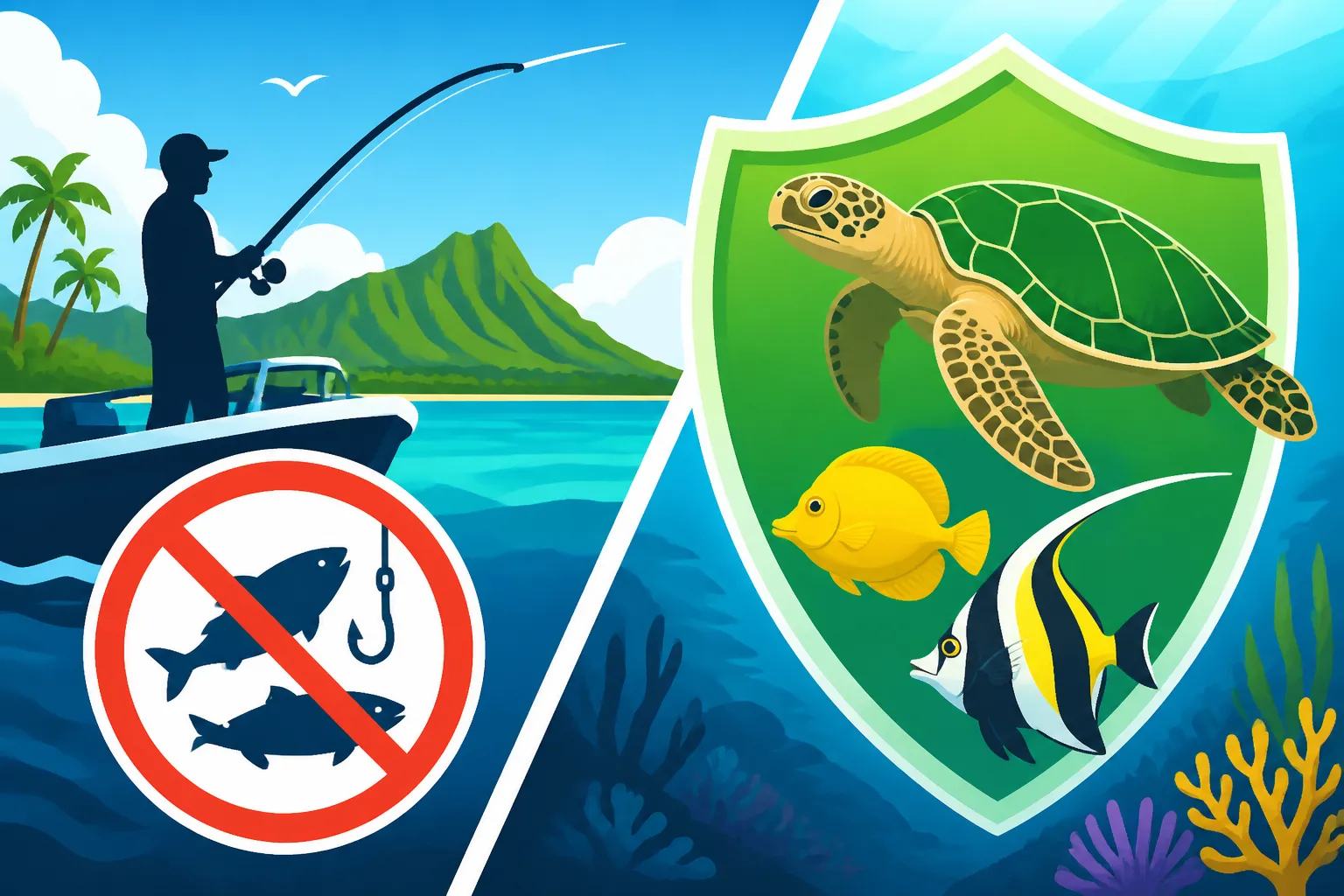
Beyond species-specific rules, Hawaii guards its marine resources by establishing designated geographical zones where all fishing—or specific types of gear—is entirely prohibited. Casting into these protected waters, even for non-protected fish species, can result in immediate gear confiscation and court summonses.
Marine Life Conservation Districts (MLCDs)
Marine Life Conservation Districts are established to allow fish stocks and coral reef ecosystems to recover without human extraction pressure. Famous destinations like Oahu’s Hanauma Bay, Maui’s Molokini Shoal, and the Big Island’s Kealakekua Bay fall under strict MLCD guidelines.
Before packing your rods for a beach day, study Hawaii Marine Life Conservation Districts, Explained to understand where fishing zones start and stop. In almost all MLCDs, taking any marine life—whether fish, invertebrate, limu (seaweed), or shell—is completely illegal. Knowing What a Marine Life Conservation District means for anglers saves you from unknowingly casting into sanctuary boundaries marked only by offshore buoys or shoreline plaques.
Many tourists and visiting anglers wonder Is Fishing Allowed at Hanauma Bay?; the short answer is an absolute no. Hanauma Bay is one of the oldest and most strictly enforced no-take MLCDs in the state, where even carrying fishing tackle down to the beach park is prohibited.
Fisheries Management Areas and West Hawaii Reserves
In addition to statewide MLCDs, the DLNR manages regional zones called Fisheries Management Areas (FMAs) and Fish Replenishment Areas (FRAs). Along the West Coast of the Big Island, for example, networks of coastal waters restrict specific gear types to protect declining reef species and prevent user conflicts between aquarium fish collectors, recreational anglers, and dive charter operators.
Checking boundary maps for Hawaii Fish Replenishment Areas in West Hawaii is essential if you plan to launch a kayak or shore-fish along the Kona and Kohala coastlines. These regulated zones may prohibit lay net fishing, spear-gun use, or night harvesting while allowing traditional hook-and-line angling for unmanaged edible species.
Best Practices for Ethical Hawaii Anglers and Gear Setup
Protecting Hawaii’s unique marine heritage does not mean you have to give up coastal fishing. By making small adjustments to your tackle selection and adopting ethical catch-and-release techniques, you can enjoy landing trophy game fish while ensuring vulnerable or protected species survive accidental hookups.
Barbless Circle Hooks and Terminal Rigging
One of the most effective modifications an island angler can make is switching to barbless circle hooks. Standard J-hooks often snag deep in an animal’s esophagus or stomach, causing fatal internal hemorrhaging. Circle hooks are designed to slide out of the gut and set cleanly in the corner of the jaw, drastically reducing mortality rates for both regulated game fish and incidental catches like sea turtles.
Crushing the barb on your circle hooks offers several distinct benefits:
- Faster release times: Barbless hooks back out of tough jaw tissue with minimal pressure, reducing stress on the animal.
- Increased angler safety: If a thrashing ray or sharp lava ledge causes a hook to slip into your hand, a barbless hook pulls out smoothly without requiring emergency medical attention.
- Easier line cutting: If an animal breaks your line, a barbless circle hook will rust out or shake free much faster than a thick barbed hook.
You can easily modify your existing tackle box by using hook-crimping pliers to squeeze down barbs, or you can order specialized barbless circle hooks on Amazon before your trip. The DLNR actively promotes the Barbless Circle Hook Project, encouraging shoreline anglers targeting giant trevally to embrace barbless terminal gear without sacrificing catch efficiency.
Deepwater Release Care and Sustainable Angling
When targeting deepwater species along oceanic drop-offs, anglers often catch fish suffering from barotrauma—a condition where expanding gases in the swim bladder expand as the fish is brought up from deep water. If an angler accidentally catches an undersized or non-target deepwater fish, simply tossing it back onto the ocean surface renders it helpless against surface predators like birds or sharks.
Using weighted descender devices—which carry fish back down to their depth of capture before releasing them—ensures deepwater reef fish survive release. Adding a simple clip-on descent tool purchased on Amazon to your bottomfishing kit allows you to vent or drop non-target catches safely back to the seabed floor.
Coupling smart tackle choices with proven Shore Fishing Techniques for Hawaii allows you to target local favorites like papio, bonefish, and goatfish safely. Reviewing identification guides for Bottomfish Species of Hawaii ensures you can immediately distinguish between prized food fish and non-target, slow-growing species that require extra care during release.
By respecting local marine life laws, staying aware of conservation district boundaries, and keeping proper release gear in your tackle kit, you help preserve Hawaii’s world-class fishing grounds for generations to come.
Disclaimer
This article is for general informational purposes only and does not constitute professional advice. Laws, prices and regulations vary by location and change over time. Consult a qualified professional for guidance on your specific situation.