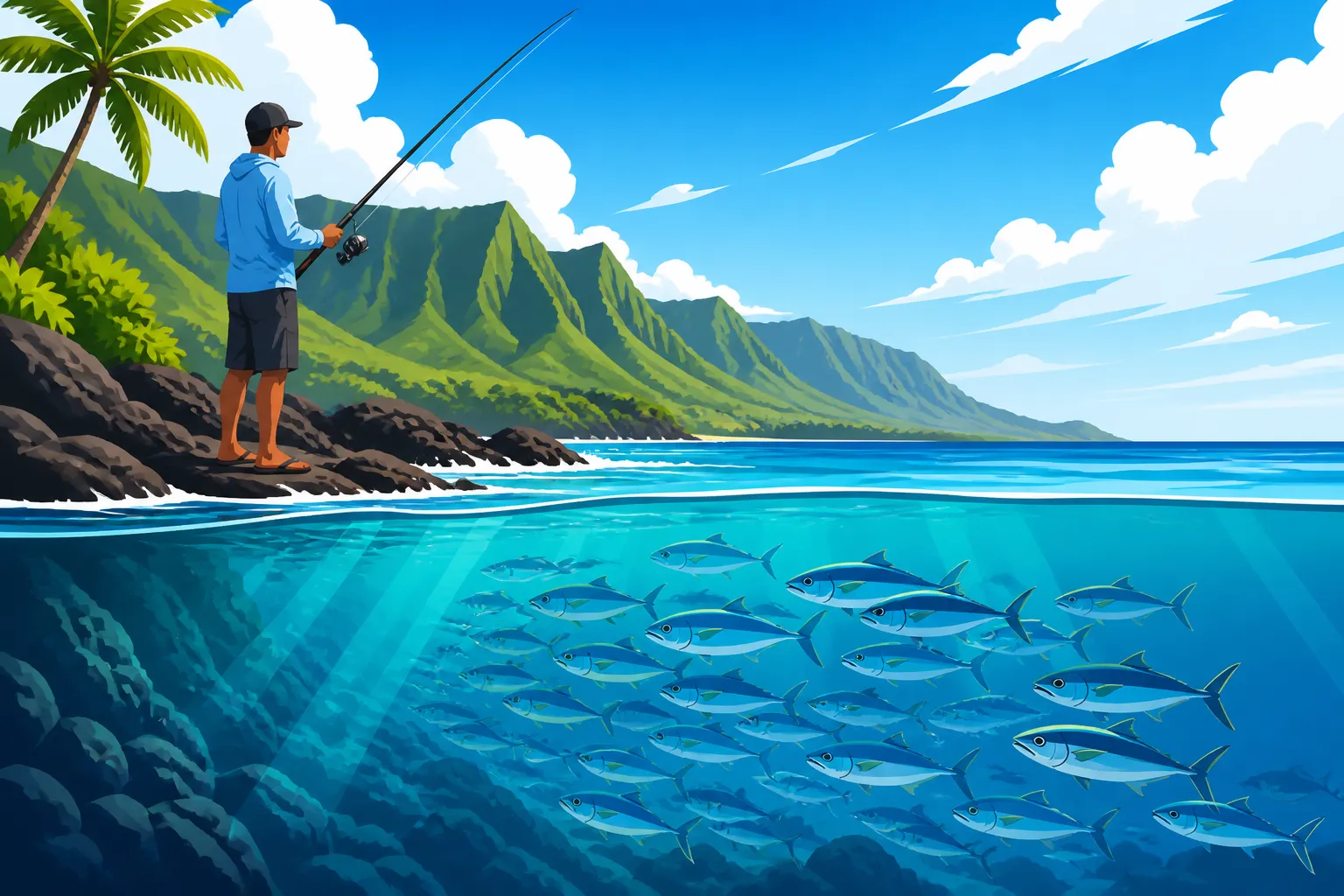
What akule schools look like from shore
One of the biggest frustrations for any angler hitting the Hawaiian shoreline is knowing where the fish are, especially when it comes to baitfish. You scan the horizon, hoping for a sign, but sometimes it feels like you're looking for a needle in a haystack. This guide is all about giving you the inside scoop on how to spot those elusive akule (bigeye scad) schools directly from the beach, helping you turn observation into successful fishing.
Understanding Akule: Hawaii's Versatile Baitfish
Before we dive into spotting them, let's get a little familiar with akule themselves. These aren't just any fish; they're an incredibly important species in Hawaii, cherished by local anglers for both their culinary value and their effectiveness as bait for larger, prized game fish. Understanding their behavior is the first step to knowing what to look for when you're scanning the water.
Why Akule are a Local Favorite
Akule are schooling fish, often found in large numbers near shorelines, harbors, and bays, but they can also venture into deeper waters. They’re a relatively small, silvery fish, known for their large eyes – hence the "bigeye scad" moniker. For us local anglers, akule are a double win. First, they're absolutely delicious, whether fried, grilled, or eaten sashimi-style. There’s nothing quite like fresh akule right out of the ocean. Second, and perhaps even more significant for many, they are phenomenal bait.
Think about it: what do the big boys like ulua (giant trevally), papio (juvenile trevally), or even offshore pelagics like ahi (yellowfin tuna) feed on? Smaller fish, and akule are right at the top of their menu. Having a bucket full of live akule can make all the difference between a slow day and hooking into a monster. That's why being able to spot and then catch these baitfish from shore is a skill every serious Hawaii angler wants to master. You can read more about their collective habits in Hawaii Akule (Bigeye Scad) Schooling Behavior.
The Thrill of the Shoreline Akule Hunt
There's a unique satisfaction that comes from spotting a school of akule from the sand or lava rock, knowing that you've got a chance to intercept them. It's a blend of detective work and anticipation. You're not just casting blindly; you're actively reading the ocean, interpreting its subtle clues, and then making a move. When a school appears, the calm, serene ocean suddenly transforms into a bustling highway of activity.
For many, shoreline fishing in Hawaii is about accessibility and connection to the 'aina. You don't always need a boat or fancy gear to get into some great fishing, especially when targeting akule. The experience of seeing the ocean come alive, feeling the excitement build, and then potentially landing a school of fish that you spotted with your own eyes, is incredibly rewarding. It's a truly authentic Hawaiian fishing experience that's both challenging and deeply gratifying.
Key Visual Cues: How to Spot Akule Schools from the Beach
Spotting akule from shore is less about seeing the individual fish and more about recognizing the subtle (and sometimes not-so-subtle) disturbances they create on the water's surface. It's like looking for ripples in a pond – you're seeing the effect of their presence, not necessarily the source directly.
Surface Disturbances: The Obvious Signs
These are the most tell-tale indicators that a school of akule is in the area. Learning to differentiate these from wind chop or currents is crucial.
Ripples and "Nervous Water"
The first thing you'll often notice, especially on a relatively calm day, is an area of water that just looks "different." It's not a uniform wave pattern or wind chop. Instead, you'll see a patch of water with fine, consistent ripples, almost like rain falling softly, or a vibrating sheen. This is often called "nervous water" because it implies something is actively moving just below the surface, disturbing the calm. Akule schools, moving as a synchronized unit, create this distinct disturbance. Imagine a giant, invisible hand gently stroking the water's surface – that's the kind of subtle movement you're looking for. It's often a much tighter, more agitated ripple pattern than what you'd see from a steady breeze across the water.
Boils and "Flashes"
If the akule are particularly active, or if they're being pursued by predators, the surface disturbance can become much more pronounced. You might see "boils" where the water seems to bubble up or churn as the school pushes against the surface. This indicates a very dense school or one that is moving rapidly. Along with boils, you'll often catch flashes of silver or white as individual fish turn on their sides near the surface, reflecting the sunlight. These flashes can be sporadic or constant, depending on the school's activity level and depth. When you see these bright, intermittent glints, it's a strong sign that a school of akule is right there, either feeding voraciously or frantically trying to escape a larger fish.
Diving Birds
This is probably the easiest and most exciting sign to spot from afar. If you see seabirds – especially terns or frigatebirds – actively diving and swooping into a specific area of the ocean, you can bet your last shrimp that there's a baitfish school there. Birds are masters at spotting these schools from above, and they'll gather quickly when food is available. Don't confuse casual bird flight with active feeding; look for the committed dives and splashes. A frenzy of birds working a particular spot is like a flashing neon sign telling you, "Fish here!" This isn't always specifically akule, it could be opelu or aku, but it's always a good indication of baitfish presence.
Subsurface Clues: Looking Deeper
Sometimes the akule schools aren't actively on the surface, but you can still spot them if you know what to look for beneath the waves.
Dark Masses or Clouds
In clear Hawaiian waters, especially from an elevated vantage point like a cliff or a pier, you might be able to see the school as a dark, amorphous mass moving just below the surface. This dark shape is the collective shadow of hundreds, if not thousands, of fish. The size and density of this shadow will give you an idea of the school's size. It might appear to pulse or change shape as the fish move and turn. On a really bright, sunny day, with calm water, this dark cloud can be surprisingly distinct. It's often easier to spot these against a lighter sandy bottom or in shallower areas where the sunlight penetrates well.
Shimmering or Glinting Effects
Even if the school isn't a solid dark mass, the collective reflection of their silvery scales can create a unique shimmering or glinting effect under the water. It's like looking at a sequined fabric underwater, constantly moving and catching the light. This is particularly noticeable when the sun hits the school at certain angles, creating a flash of light that seems to come from beneath the surface. This "underwater sparkle" is a strong indicator of an active baitfish school just waiting to be targeted.
Predatory Activity: Bigger Fish Tell the Story
Akule aren't alone out there. They're a vital part of the food chain, and where you find akule, you often find their predators.
Ulua and Papio Busting the Surface
This is arguably the most electrifying sign. If you see large splashes, violent disturbances, or even the backs and tails of bigger fish breaking the surface in a specific area, it means ulua or papio are actively hunting the akule. These larger trevally will herd and smash through bait balls, creating a chaotic scene. This is a prime opportunity not only to catch akule but also to cast a lure or a bigger bait into the fray for a chance at a trophy trevally. The sound of a large ulua busting a bait school is unmistakable and gets the heart pumping! Find out how to target these predators in How to Catch Ulua from Shore and How to Catch Papio on Hawaii's Shoreline.
Other Game Fish
Beyond trevally, other pelagic species like ono (wahoo) or mahimahi might also be observed crashing through akule schools, especially if the schools are pushed further offshore or around FADs (Fish Aggregating Devices). While less common to spot from shore, an occasional high-speed splash or even a glimpse of a larger fish leaping can indicate a feast is happening. This is why akule are such prized bait; they attract all the major players. For targeting these offshore species, akule is often the best bait, as discussed in Best Bait for Ahi Fishing.
Here's a quick reference table for spotting akule from shore:
| Visual Cue | Description | Ideal Conditions | Implication for Anglers |
|---|---|---|---|
| Nervous Water/Ripples | Fine, agitated ripples on a calm surface, distinct from wind chop. | Calm, clear water | Akule moving just below surface. Good time to cast for bait. |
| Boils/Flashes | Water churning or bubbling; intermittent silver/white reflections. | Active feeding, sunlight | Dense, active school. Excellent for casting. |
| Diving Birds | Terns, frigatebirds actively swooping and diving into the water. | Any time birds feed | Large baitfish school, likely being harassed by predators. |
| Dark Masses | Amorphous, dark shapes moving below surface, often against lighter bottom. | Clear, calm, elevated view | Large school at slightly deeper depth. Good for chumming. |
| Underwater Shimmer | Collective glinting of scales beneath the surface. | Sunny, clear water | Active school, possibly spread out or moving quickly. |
| Predator Busts | Large splashes, game fish breaking surface (ulua, papio, etc.). | Any time predators feed | Akule being actively hunted. Best opportunity for game fish. |
Environmental Factors That Influence Akule Sightings
It’s not just about knowing what to look for; it’s also about knowing when and where to look. The ocean is a dynamic environment, and akule behavior is heavily influenced by conditions.
Optimal Water Conditions for Akule
Just like us, fish prefer certain conditions, and akule are no different. They tend to be more visible and active when the water is clear and relatively calm.
Clarity and Calmness
Crystal-clear Hawaiian waters allow for better visibility, making it easier to spot those subsurface dark masses or shimmering effects. Calm days, with minimal wind chop, are also ideal because they make surface disturbances like "nervous water" much more pronounced and easier to distinguish from natural wave action. After a big storm or heavy rain, the water can become murky with runoff, reducing visibility and often pushing akule schools further offshore until conditions improve. So, pick your days wisely for prime akule spotting.
Light Conditions
The angle and intensity of the sun play a huge role in how visible akule schools are. Early morning and late afternoon are often prime times. The lower angle of the sun can create reflections that highlight surface disturbances or reveal subsurface glints that would be washed out by the harsh midday sun. Sometimes, having the sun at your back can significantly reduce glare and help you see deeper into the water. This is also when many predatory fish are most active, chasing baitfish schools.
Tidal and Current Influences
Tides and currents act like highways for baitfish, dictating their movement and where they congregate. Understanding these patterns is key to predicting where akule might show up.
High Tide vs. Low Tide
Akule can be found during any tide, but many anglers find that incoming or outgoing tides, especially around the high tide mark, can be particularly productive. As the tide pushes in, it often brings in cooler, nutrient-rich water, which can attract baitfish closer to shore. Conversely, an outgoing tide can sometimes concentrate baitfish as water recedes from shallow areas. Observing local patterns at your favorite Best Shore Fishing Spots in Hawaii will give you the best insight, as every location can be a little different.
Current Breaks and Edges
Akule, like many baitfish, will often orient themselves along current breaks or edges where different water movements meet. These areas often concentrate plankton and smaller food sources, making them attractive feeding grounds. Look for areas where the current seems to create a seam or a ripple line, or where water is flowing around a point or reef structure. These are natural ambush points for both the akule and the predators that feed on them.
Time of Day and Seasonality
While akule can be present year-round, there are certainly optimal times and seasons when you're more likely to encounter larger schools.
Dawn and Dusk Activity
As mentioned, early morning (dawn) and late afternoon (dusk) are often the most productive times. The changing light conditions and typically calmer winds make it easier to spot schools, and these are peak feeding times for many fish species. The low light provides a bit of cover for the akule, but also allows predators to hunt effectively, pushing the schools into tighter formations or closer to the surface.
Seasonal Patterns
While akule are generally present throughout the year in Hawaii, their schooling behavior and proximity to shore can fluctuate seasonally. Some times of year might see larger, denser schools appearing, while others they might be more scattered or hold further offshore. For example, some islands might see more consistent akule presence during certain months, possibly linked to spawning cycles or prevalent baitfish movements. For specific insights into when these schools might arrive, check out When akule schools show up on Oahu.
Essential Gear and Scouting Techniques for Akule Spotting
It's not enough to just stand on the beach and squint. To maximize your chances of spotting akule, a few pieces of gear and a strategic approach can make a world of difference.
Optical Aids: See More Clearly
Your naked eye is good, but enhancing your vision can significantly improve your spotting capabilities, especially when dealing with subtle clues from a distance.
Polarized Sunglasses
This is non-negotiable for any serious shoreline angler in Hawaii. Polarized sunglasses cut glare off the water's surface, allowing you to see into the water rather than just reflections on the water. This dramatically enhances your ability to spot subsurface dark masses, shimmering effects, and even individual fish moving just below the surface. They're also vital for protecting your eyes from the intense Hawaiian sun. You can find excellent polarized sunglasses from various reputable brands. Many anglers have a trusty pair they picked up from Amazon, for example. They truly are a game-changer for reading the water.
Binoculars or a Spotting Scope
When you're scanning large expanses of ocean from an elevated position, a good pair of binoculars is invaluable. They allow you to zoom in on distant bird activity, confirm suspicious ripples, or get a closer look at a dark mass far offshore. You don't need a super high-powered, expensive pair; a standard 7x or 8x magnification is usually sufficient. A spotting scope, while less portable, can be even better if you're set up at a fixed vantage point, offering incredible detail over long distances. Again, a quick search on Amazon will show you plenty of options that won't break the bank.
Strategic Scouting and Patience
Spotting akule from shore is an art that combines observation, patience, and knowing where to position yourself.
Elevated Vantage Points
The best place to spot akule schools is often from an elevated position. Think cliffs, bluffs, seawalls, or even the top of a sand dune. Being higher up gives you a wider field of view and allows you to see deeper into the water column without the distortion of a low angle. From these spots, you can often track a school's movement along the coastline for a significant distance. If you're on a flat beach, walking slowly and continuously scanning is your best bet, but always prioritize gaining elevation if possible.
Constant Scanning and Observation
Don't just stare blankly at one spot. Develop a systematic scanning routine, slowly moving your gaze from left to right, covering the entire visible water column, and then repeating. Pay close attention to areas where currents merge, near points of land, or in the mouth of bays. These are common pathways and congregation areas for baitfish. It might take time, sometimes an hour or more, before a school reveals itself. Patience is key; the ocean rarely gives up its secrets quickly. Remember, every little ripple, every distant bird, is a potential clue. Once you spot them, you'll want to use effective Shore Fishing Techniques for Hawaii to try and catch them, or perhaps even prepare for How to fish for akule right after a school arrives.
By understanding the nature of akule, knowing the visual and environmental cues, and equipping yourself with the right tools, you'll dramatically increase your chances of spotting these vital baitfish from the Hawaiian shoreline. It's a skill that takes practice, but the rewards—both in terms of fresh fish for dinner and live bait for bigger game—are well worth the effort.
Disclaimer
This article is for general informational purposes only and does not constitute professional advice. Laws, prices and regulations vary by location and change over time. Consult a qualified professional for guidance on your specific situation.